

574
software solutions supplied by leading manufacturers, to which all branches of the company have common access. Due to the activities conducted by KGHM, there are also IT
systems tailored to specific business needs. Some of them are applied at one branch only,
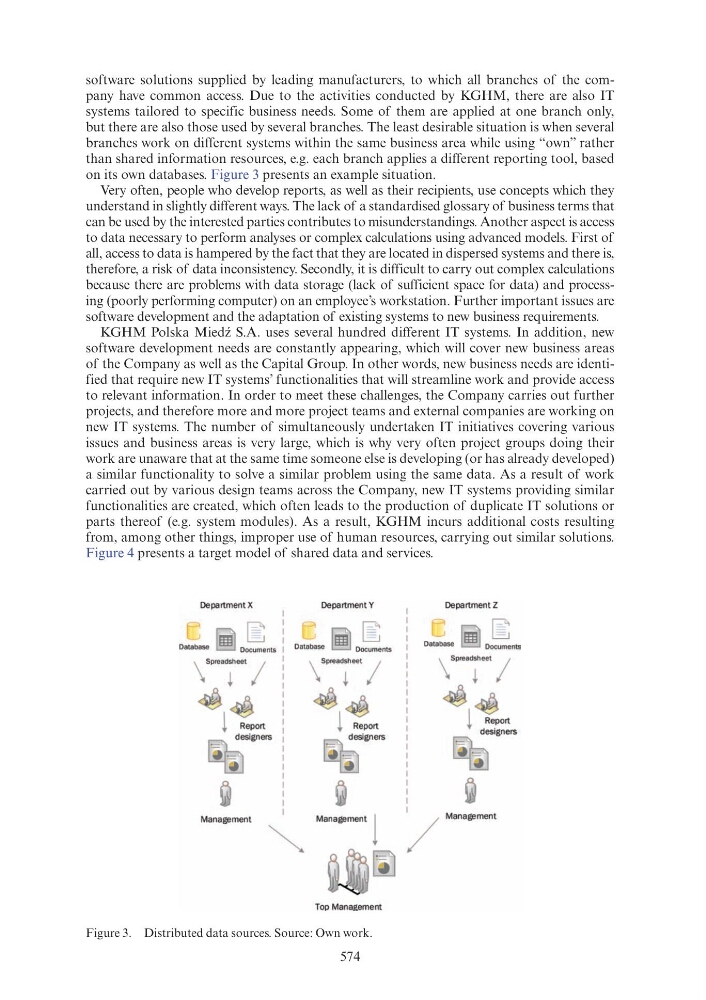
but there are also those used by several branches. The least desirable situation is when several
branches work on different systems within the same business area while using “own” rather
than shared information resources, e.g. each branch applies a different reporting tool, based
on its own databases. Figure 3 presents an example situation.
Very often, people who develop reports, as well as their recipients, use concepts which they
understand in slightly different ways. The lack of a standardised glossary of business terms that
can be used by the interested parties contributes to misunderstandings. Another aspect is access
to data necessary to perform analyses or complex calculations using advanced models. First of
all, access to data is hampered by the fact that they are located in dispersed systems and there is,
therefore, a risk of data inconsistency. Secondly, it is difficult to carry out complex calculations
because there are problems with data storage (lack of sufficient space for data) and processing (poorly performing computer) on an employee’s workstation. Further important issues are
software development and the adaptation of existing systems to new business requirements.
KGHM Polska Miedź S.A. uses several hundred different IT systems. In addition, new
software development needs are constantly appearing, which will cover new business areas
of the Company as well as the Capital Group. In other words, new business needs are identified that require new IT systems’ functionalities that will streamline work and provide access
to relevant information. In order to meet these challenges, the Company carries out further
projects, and therefore more and more project teams and external companies are working on
new IT systems. The number of simultaneously undertaken IT initiatives covering various
issues and business areas is very large, which is why very often project groups doing their
work are unaware that at the same time someone else is developing (or has already developed)
a similar functionality to solve a similar problem using the same data. As a result of work
carried out by various design teams across the Company, new IT systems providing similar
functionalities are created, which often leads to the production of duplicate IT solutions or
parts thereof (e.g. system modules). As a result, KGHM incurs additional costs resulting
from, among other things, improper use of human resources, carrying out similar solutions.
Figure 4 presents a target model of shared data and services.
Figure 3. Distributed data sources. Source: Own work.
Department X
~ ~
Database ~ Doc: ents
\ Spreadt et I
~~
~ Report
~sign ers
Management
Department Y
Database
g Documents
\ Spreadt et I
~~
~ Report
~signers
Top Management
Department Z
~ ~
Database ~ Documents
/
Management