

484
In the scope of the study, production and transportation system of a longwall top coal caving operation was modelled by using of discrete event simulation technique.
3 CASE STUDY OVERVIEW
In this case study, data were collected from an operation located in Soma, Turkey. The available data infrastructure in the mine control room was accessed and a manual entry dump of
the shearer and shield movement was created. The geology of the research area is introduced
as it is one of the crucial parameters that affect the performance of the longwall equipment.
3.1 Geology of the study area
The LTCC mining operation is located in Soma Basin, Turkey. The stratigraphic sequences
of the rock formation from bottom layer to top layer are Pre-Neogene rock formations, Neogene sediments, and Post Neogene sediments (Nebert 1978). Pre-Neogene rock formation
is the oldest formation in the region and is composed of grey greywacke, meta-sandstone,
arkose, schist and conglomerate (Nebert 1978). The Neogene rock formation is composed
of two different units, Miocene aged series and Pliocene aged series. Miocene aged series
are composed of intermediate level lignite formation, limestone-clay-gravel bands Gastropoda fossils formation, marl (leaf traces) formation, bottom level lignite formation and claysand-gravel formation. On the other hand, Pliocene aged series are composed of fine-grained
silicified limestone-tuff formation, conglomerate-sandstone-clay formation, marl-tuff-claylimestone-leaf fossils formation, top-level lignite formation, and clay-sandstone-banded
sericite (mottled) formation (Nebert 1978). Pleistocene aged and Holocene aged rocks form
the Post-Neogene unit that mostly involves reddish coloured, blocky-coarse conglomerates
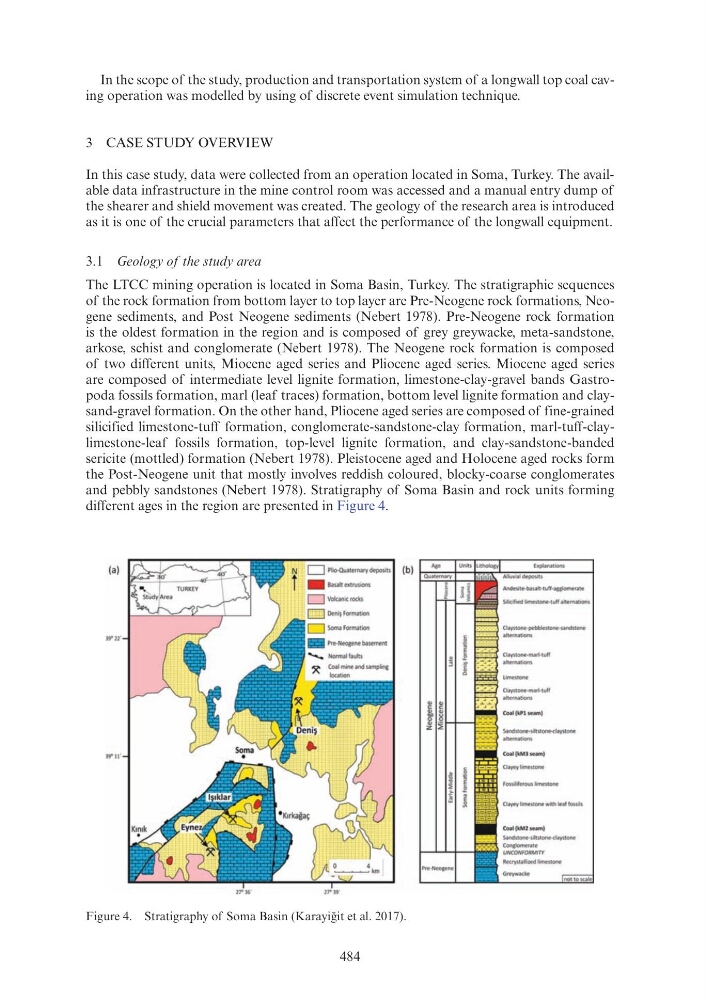
and pebbly sandstones (Nebert 1978). Stratigraphy of Soma Basin and rock units forming
different ages in the region are presented in Figure 4.
Figure 4. Stratigraphy of Soma Basin (Karayiğit et al. 2017).
c=J Plio-Quaternary deposits {b)
. . Basaltextrusions
~ Volcanicrocks
In the scope of the study, production and transportation system of a longwall top coal caving operation was modelled by using of discrete event simulation technique.
3 CASE STUDY OVERVIEW
In this case study, data were collected from an operation located in Soma, Turkey. The available data infrastructure in the mine control room was accessed and a manual entry dump of
the shearer and shield movement was created. The geology of the research area is introduced
as it is one of the crucial parameters that affect the performance of the longwall equipment.
3.1 Geology of the study area
The LTCC mining operation is located in Soma Basin, Turkey. The stratigraphic sequences
of the rock formation from bottom layer to top layer are Pre-Neogene rock formations, Neogene sediments, and Post Neogene sediments (Nebert 1978). Pre-Neogene rock formation
is the oldest formation in the region and is composed of grey greywacke, meta-sandstone,
arkose, schist and conglomerate (Nebert 1978). The Neogene rock formation is composed
of two different units, Miocene aged series and Pliocene aged series. Miocene aged series
are composed of intermediate level lignite formation, limestone-clay-gravel bands Gastropoda fossils formation, marl (leaf traces) formation, bottom level lignite formation and claysand-gravel formation. On the other hand, Pliocene aged series are composed of fine-grained
silicified limestone-tuff formation, conglomerate-sandstone-clay formation, marl-tuff-claylimestone-leaf fossils formation, top-level lignite formation, and clay-sandstone-banded
sericite (mottled) formation (Nebert 1978). Pleistocene aged and Holocene aged rocks form
the Post-Neogene unit that mostly involves reddish coloured, blocky-coarse conglomerates
and pebbly sandstones (Nebert 1978). Stratigraphy of Soma Basin and rock units forming
different ages in the region are presented in Figure 4.
Figure 4. Stratigraphy of Soma Basin (Karayiğit et al. 2017).
c=J Plio-Quaternary deposits {b)
. . Basaltextrusions
~ Volcanicrocks