

483
mining system since the major part of the coal seam is excavated with the aid of gravity (Le et al.
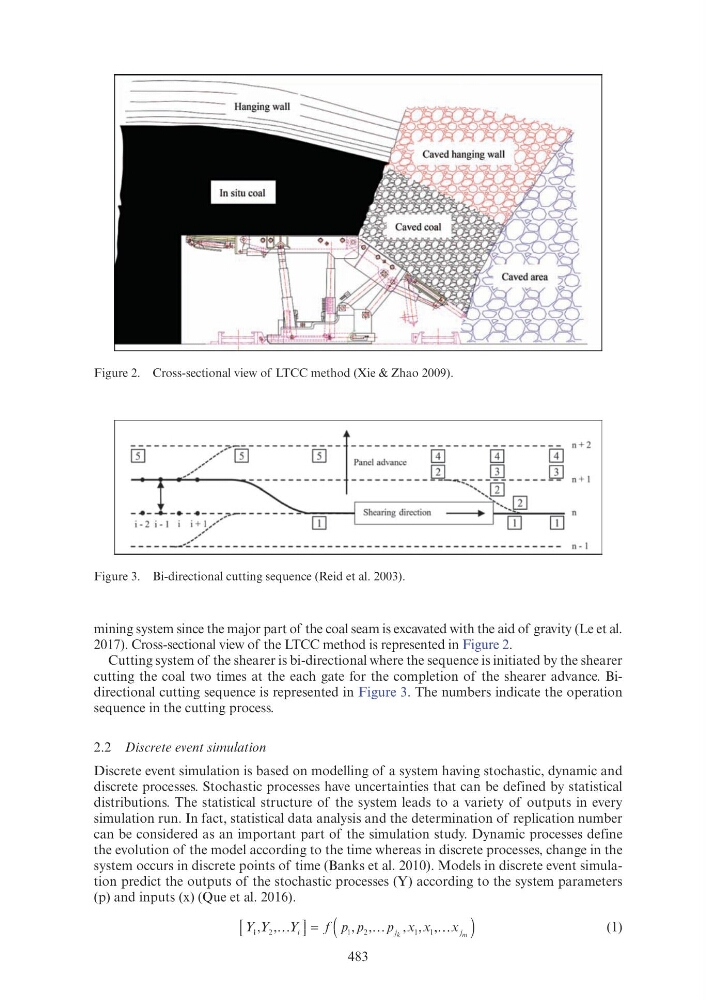
2017). Cross-sectional view of the LTCC method is represented in Figure 2.
Cutting system of the shearer is bi-directional where the sequence is initiated by the shearer
cutting the coal two times at the each gate for the completion of the shearer advance. Bidirectional cutting sequence is represented in Figure 3. The numbers indicate the operation
sequence in the cutting process.
2.2 Discrete event simulation
Discrete event simulation is based on modelling of a system having stochastic, dynamic and
discrete processes. Stochastic processes have uncertainties that can be defined by statistical
distributions. The statistical structure of the system leads to a variety of outputs in every
simulation run. In fact, statistical data analysis and the determination of replication number
can be considered as an important part of the simulation study. Dynamic processes define
the evolution of the model according to the time whereas in discrete processes, change in the
system occurs in discrete points of time (Banks et al. 2010). Models in discrete event simulation predict the outputs of the stochastic processes (Y) according to the system parameters
(p) and inputs (x) (Que et al. 2016).
f p p
p x x
x
i
j
f p
p
j
k
m
j j
j j
p 2
p p
1 x
p p
,
x 1 1
x
f p p
…
[
]
Y Y Y i
Y Y
1 2
Y Y
Y Y ,
2
Y Y …Y Y Y
(
)
(1)
Figure 2. Cross-sectional view of LTCC method (Xie & Zhao 2009).
Figure 3. Bi-directional cutting sequence (Reid et al. 2003).
------------?--------------r--------------------------- [1]
_,/' W
W Panel advance GJ
GJ
GJ
_/
m
m m
I
I . I ~----- - - - - - - - - - - - ---~-~-~-:~_~ci;---- •- - • - •- - :-~-- - - - - - - -I Sheanng d~rectton -----+ 1 f-~=-~;....-=,
i- 2 i - 1 i i + l /
OJ .
. OJ OJ
,,,'"
-------~------------------------------------ - ---------n+2
n+l
n- I
mining system since the major part of the coal seam is excavated with the aid of gravity (Le et al.
2017). Cross-sectional view of the LTCC method is represented in Figure 2.
Cutting system of the shearer is bi-directional where the sequence is initiated by the shearer
cutting the coal two times at the each gate for the completion of the shearer advance. Bidirectional cutting sequence is represented in Figure 3. The numbers indicate the operation
sequence in the cutting process.
2.2 Discrete event simulation
Discrete event simulation is based on modelling of a system having stochastic, dynamic and
discrete processes. Stochastic processes have uncertainties that can be defined by statistical
distributions. The statistical structure of the system leads to a variety of outputs in every
simulation run. In fact, statistical data analysis and the determination of replication number
can be considered as an important part of the simulation study. Dynamic processes define
the evolution of the model according to the time whereas in discrete processes, change in the
system occurs in discrete points of time (Banks et al. 2010). Models in discrete event simulation predict the outputs of the stochastic processes (Y) according to the system parameters
(p) and inputs (x) (Que et al. 2016).
f p p
p x x
x
i
j
f p
p
j
k
m
j j
j j
p 2
p p
1 x
p p
,
x 1 1
x
f p p
…
[
]
Y Y Y i
Y Y
1 2
Y Y
Y Y ,
2
Y Y …Y Y Y
(
)
(1)
Figure 2. Cross-sectional view of LTCC method (Xie & Zhao 2009).
Figure 3. Bi-directional cutting sequence (Reid et al. 2003).
------------?--------------r--------------------------- [1]
_,/' W
W Panel advance GJ
GJ
GJ
_/
m
m m
I
I . I ~----- - - - - - - - - - - - ---~-~-~-:~_~ci;---- •- - • - •- - :-~-- - - - - - - -I Sheanng d~rectton -----+ 1 f-~=-~;....-=,
i- 2 i - 1 i i + l /
OJ .
. OJ OJ
,,,'"
-------~------------------------------------ - ---------n+2
n+l
n- I