

482
packages such as Arena® Simulation Software and GPSS/H with Proof Animation. These
software packages provide visual and easy-to-use interfaces to the end user. In the mining
simulation literature, several researchers implemented discrete event simulation technique to
different stages of production by using these software packages. Ozdemir & Kumral (2018)
investigated the feasibility of the production target of an open pit mine by considering the
stochastic structure of the mine by using of Arena® Software. Que et al. (2016) studied
the efficiency consideration of a ground articulate pipeline system and shovel interaction by
using of Arena® Software. Tarshizi (2014) conducted a research on simulating evacuation
scenarios, places of rescue chambers and equipment used in rescue operations of an underground mine by using of GPSS/H. Tarshizi et al. (2015) analyzed the environmental impact
of a coal mine having two pit operations considering haulage performance and production
target of the mine by using of GPSS/H.
Main objective of this study is to implement discrete event simulation to an underground
Longwall Top Coal Caving Mine (LTCC) in Turkey to investigate the shearer performance of
the longwall operation by considering the amount of coal produced in a shift (8 hrs). In the
study, duration of the shearer delays, time between arrivals of the shearer durations, cutting
speed of the shearer, flit speed of the shearer, and reversal time of the shearer drum have been
considered for the evaluation of the shearer performance.
2 METHODOLOGY
Methodology of this study covers modelling of the mine and analysis of the simulation model.
2.1 Longwall top coal caving
Coal seams are sedimentary deposits that commonly have large longitudinal extents and uniform thicknesses. The longwall mining method has been developed to take advantage of this
sedimentary deposit property. In longwall mining method, rock properties of the hanging
wall and footwall might be considered as non-critical concepts since the hanging wall is artificially supported. In fact, longwall mining method can be applied in cases where the hanging
wall and footwall are weak or competent. Mechanization can be easily adapted in longwall
mining method (Hustrulid & Bullock 2001) and depends on the uniformity of the deposits
related to geological condition of the region. Thus, uniformity of the deposits is one of the
main challenges in mechanized longwall mines. In mechanized longwall mines, shearers are
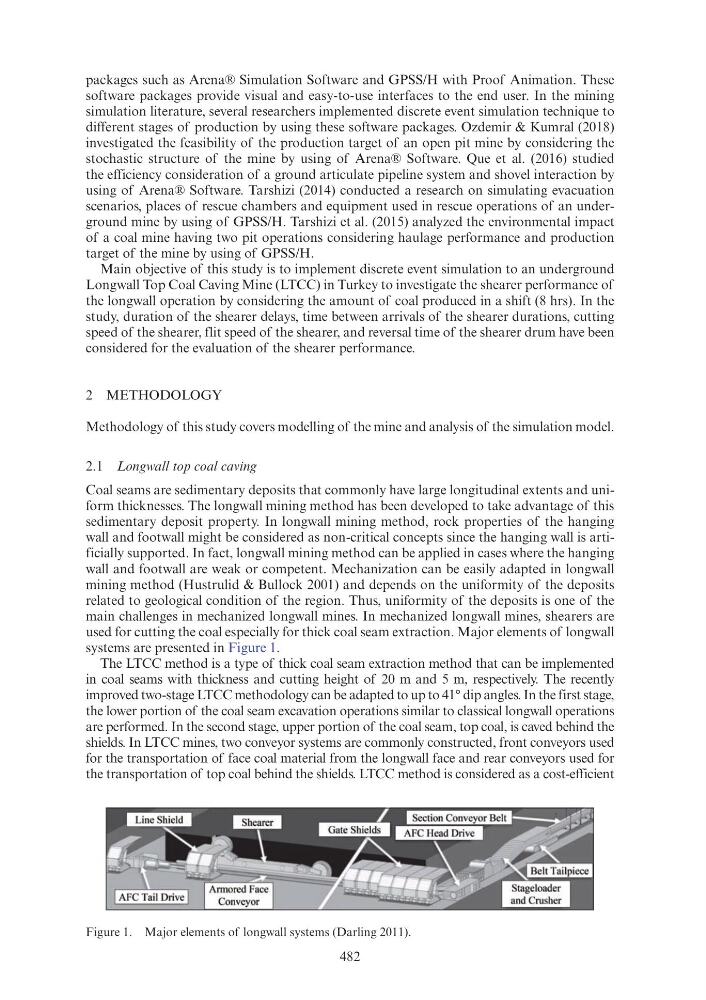
used for cutting the coal especially for thick coal seam extraction. Major elements of longwall
systems are presented in Figure 1.
The LTCC method is a type of thick coal seam extraction method that can be implemented
in coal seams with thickness and cutting height of 20 m and 5 m, respectively. The recently
improved two-stage LTCC methodology can be adapted to up to 41° dip angles. In the first stage,
the lower portion of the coal seam excavation operations similar to classical longwall operations
are performed. In the second stage, upper portion of the coal seam, top coal, is caved behind the
shields. In LTCC mines, two conveyor systems are commonly constructed, front conveyors used
for the transportation of face coal material from the longwall face and rear conveyors used for
the transportation of top coal behind the shields. LTCC method is considered as a cost-efficient
Figure 1. Major elements of longwall systems (Darling 2011).
packages such as Arena® Simulation Software and GPSS/H with Proof Animation. These
software packages provide visual and easy-to-use interfaces to the end user. In the mining
simulation literature, several researchers implemented discrete event simulation technique to
different stages of production by using these software packages. Ozdemir & Kumral (2018)
investigated the feasibility of the production target of an open pit mine by considering the
stochastic structure of the mine by using of Arena® Software. Que et al. (2016) studied
the efficiency consideration of a ground articulate pipeline system and shovel interaction by
using of Arena® Software. Tarshizi (2014) conducted a research on simulating evacuation
scenarios, places of rescue chambers and equipment used in rescue operations of an underground mine by using of GPSS/H. Tarshizi et al. (2015) analyzed the environmental impact
of a coal mine having two pit operations considering haulage performance and production
target of the mine by using of GPSS/H.
Main objective of this study is to implement discrete event simulation to an underground
Longwall Top Coal Caving Mine (LTCC) in Turkey to investigate the shearer performance of
the longwall operation by considering the amount of coal produced in a shift (8 hrs). In the
study, duration of the shearer delays, time between arrivals of the shearer durations, cutting
speed of the shearer, flit speed of the shearer, and reversal time of the shearer drum have been
considered for the evaluation of the shearer performance.
2 METHODOLOGY
Methodology of this study covers modelling of the mine and analysis of the simulation model.
2.1 Longwall top coal caving
Coal seams are sedimentary deposits that commonly have large longitudinal extents and uniform thicknesses. The longwall mining method has been developed to take advantage of this
sedimentary deposit property. In longwall mining method, rock properties of the hanging
wall and footwall might be considered as non-critical concepts since the hanging wall is artificially supported. In fact, longwall mining method can be applied in cases where the hanging
wall and footwall are weak or competent. Mechanization can be easily adapted in longwall
mining method (Hustrulid & Bullock 2001) and depends on the uniformity of the deposits
related to geological condition of the region. Thus, uniformity of the deposits is one of the
main challenges in mechanized longwall mines. In mechanized longwall mines, shearers are
used for cutting the coal especially for thick coal seam extraction. Major elements of longwall
systems are presented in Figure 1.
The LTCC method is a type of thick coal seam extraction method that can be implemented
in coal seams with thickness and cutting height of 20 m and 5 m, respectively. The recently
improved two-stage LTCC methodology can be adapted to up to 41° dip angles. In the first stage,
the lower portion of the coal seam excavation operations similar to classical longwall operations
are performed. In the second stage, upper portion of the coal seam, top coal, is caved behind the
shields. In LTCC mines, two conveyor systems are commonly constructed, front conveyors used
for the transportation of face coal material from the longwall face and rear conveyors used for
the transportation of top coal behind the shields. LTCC method is considered as a cost-efficient
Figure 1. Major elements of longwall systems (Darling 2011).