

459
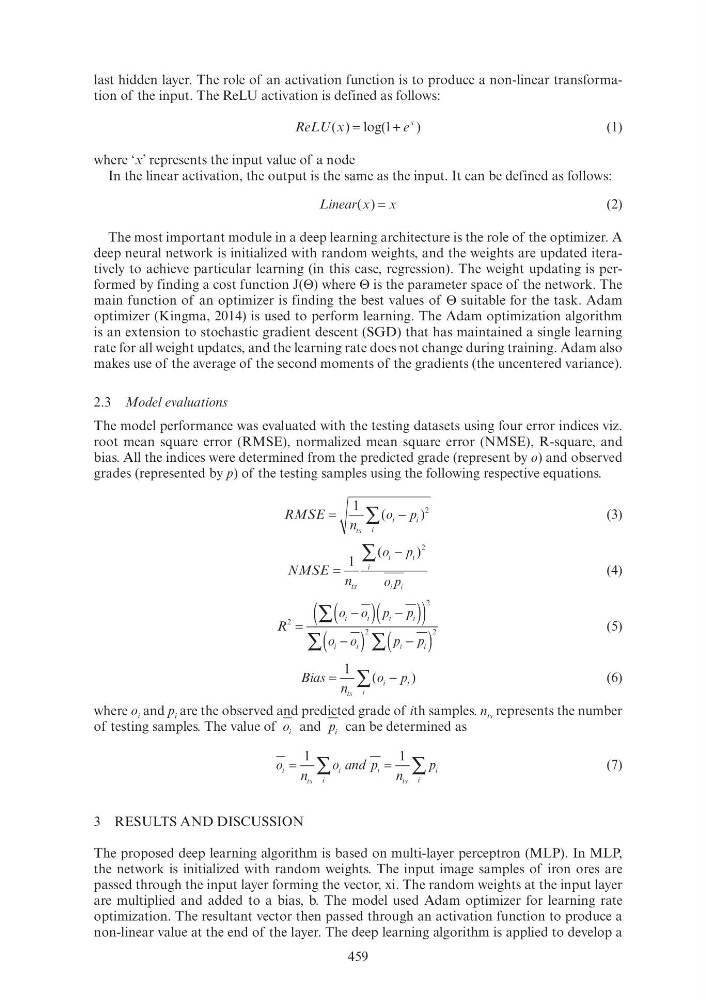
last hidden layer. The role of an activation function is to produce a non-linear transformation of the input. The ReLU activation is defined as follows:
ReLU
e
x
( )
x
og(
l (
)
+
log(1
(1)
where ‘x’ represents the input value of a node
In the linear activation, the output is the same as the input. It can be defined as follows:
Linear i i
x
( )
x
(2)
The most important module in a deep learning architecture is the role of the optimizer. A
deep neural network is initialized with random weights, and the weights are updated iteratively to achieve particular learning (in this case, regression). The weight updating is performed by finding a cost function J(Θ) where Θ is the parameter space of the network. The
main function of an optimizer is finding the best values of Θ suitable for the task. Adam
optimizer (Kingma, 2014) is used to perform learning. The Adam optimization algorithm
is an extension to stochastic gradient descent (SGD) that has maintained a single learning
rate for all weight updates, and the learning rate does not change during training. Adam also
makes use of the average of the second moments of the gradients (the uncentered variance).
2.3 Model evaluations
The model performance was evaluated with the testing datasets using four error indices viz.
root mean square error (RMSE), normalized mean square error (NMSE), R-square, and
bias. All the indices were determined from the predicted grade (represent by o) and observed
grades (represented by p) of the testing samples using the following respective equations.
RMSE
n ts
i
i
i
=
∑
1
2
(
)
o p
i
i
p
o
(3)
NMSE M M
n
o p
ts
i
i
i
i i
p
=
∑
1
2
(
)
o p
i
i
p
(4)
R
2
2
2
2
=
(
)
( )
o o
i
i
o ( )
p p
i
i
p
( )
o o
i
i
o
( )
p p
i
i
p
∑
∑
(5)
Bias i i
n ts
i
i
i
= ∑
1
(
)
o p
i
i
p
o
(6)
where o i and p i are the observed and predicted grade of ith samples. n ts represents the number
of testing samples. The value of o i and p i can be determined as
o
n
o and p
n
p
i
ts
i
i
and p
ts
i
i
i
=
o and p
=
∑
∑
1
1
d
∑
(7)
3 RESULTS AND DISCUSSION
The proposed deep learning algorithm is based on multi-layer perceptron (MLP). In MLP,
the network is initialized with random weights. The input image samples of iron ores are
passed through the input layer forming the vector, xi. The random weights at the input layer
are multiplied and added to a bias, b. The model used Adam optimizer for learning rate
optimization. The resultant vector then passed through an activation function to produce a
non-linear value at the end of the layer. The deep learning algorithm is applied to develop a
last hidden layer. The role of an activation function is to produce a non-linear transformation of the input. The ReLU activation is defined as follows:
ReLU
e
x
( )
x
og(
l (
)
+
log(1
(1)
where ‘x’ represents the input value of a node
In the linear activation, the output is the same as the input. It can be defined as follows:
Linear i i
x
( )
x
(2)
The most important module in a deep learning architecture is the role of the optimizer. A
deep neural network is initialized with random weights, and the weights are updated iteratively to achieve particular learning (in this case, regression). The weight updating is performed by finding a cost function J(Θ) where Θ is the parameter space of the network. The
main function of an optimizer is finding the best values of Θ suitable for the task. Adam
optimizer (Kingma, 2014) is used to perform learning. The Adam optimization algorithm
is an extension to stochastic gradient descent (SGD) that has maintained a single learning
rate for all weight updates, and the learning rate does not change during training. Adam also
makes use of the average of the second moments of the gradients (the uncentered variance).
2.3 Model evaluations
The model performance was evaluated with the testing datasets using four error indices viz.
root mean square error (RMSE), normalized mean square error (NMSE), R-square, and
bias. All the indices were determined from the predicted grade (represent by o) and observed
grades (represented by p) of the testing samples using the following respective equations.
RMSE
n ts
i
i
i
=
∑
1
2
(
)
o p
i
i
p
o
(3)
NMSE M M
n
o p
ts
i
i
i
i i
p
=
∑
1
2
(
)
o p
i
i
p
(4)
R
2
2
2
2
=
(
)
( )
o o
i
i
o ( )
p p
i
i
p
( )
o o
i
i
o
( )
p p
i
i
p
∑
∑
(5)
Bias i i
n ts
i
i
i
= ∑
1
(
)
o p
i
i
p
o
(6)
where o i and p i are the observed and predicted grade of ith samples. n ts represents the number
of testing samples. The value of o i and p i can be determined as
o
n
o and p
n
p
i
ts
i
i
and p
ts
i
i
i
=
o and p
=
∑
∑
1
1
d
∑
(7)
3 RESULTS AND DISCUSSION
The proposed deep learning algorithm is based on multi-layer perceptron (MLP). In MLP,
the network is initialized with random weights. The input image samples of iron ores are
passed through the input layer forming the vector, xi. The random weights at the input layer
are multiplied and added to a bias, b. The model used Adam optimizer for learning rate
optimization. The resultant vector then passed through an activation function to produce a
non-linear value at the end of the layer. The deep learning algorithm is applied to develop a