

458
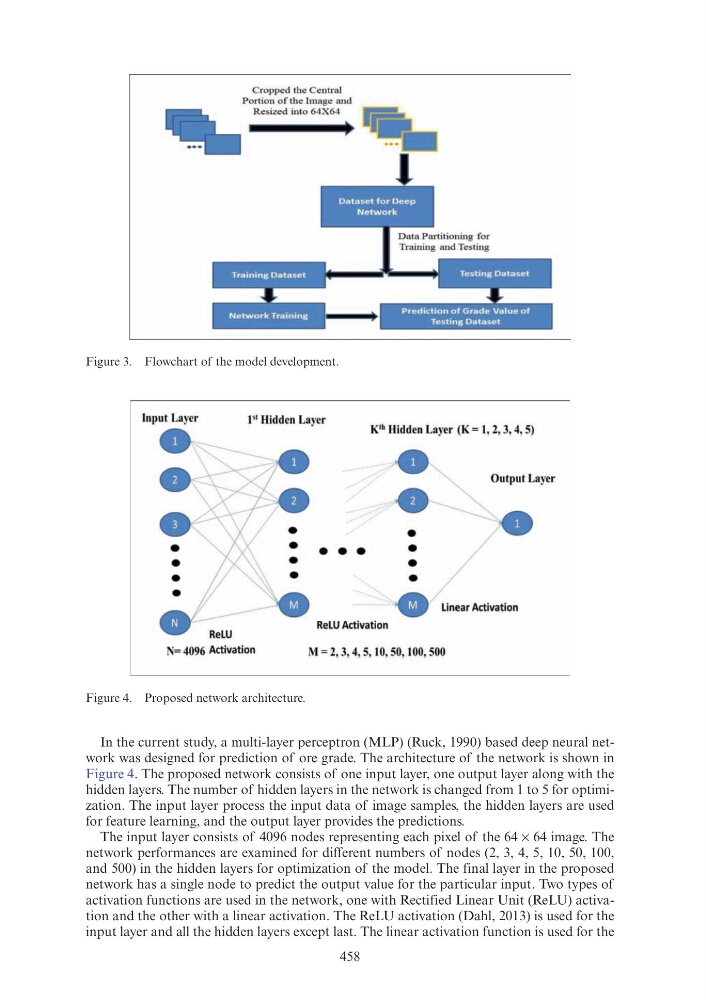
In the current study, a multi-layer perceptron (MLP) (Ruck, 1990) based deep neural network was designed for prediction of ore grade. The architecture of the network is shown in
Figure 4. The proposed network consists of one input layer, one output layer along with the
hidden layers. The number of hidden layers in the network is changed from 1 to 5 for optimization. The input layer process the input data of image samples, the hidden layers are used
for feature learning, and the output layer provides the predictions.
The input layer consists of 4096 nodes representing each pixel of the 64 × 64 image. The
network performances are examined for different numbers of nodes (2, 3, 4, 5, 10, 50, 100,
and 500) in the hidden layers for optimization of the model. The final layer in the proposed
network has a single node to predict the output value for the particular input. Two types of
activation functions are used in the network, one with Rectified Linear Unit (ReLU) activation and the other with a linear activation. The ReLU activation (Dahl, 2013) is used for the
input layer and all the hidden layers except last. The linear activation function is used for the
Figure 3. Flowchart of the model development.
Figure 4. Proposed network architecture.
Input Layer
Cropped the Central
Portion of the Image and
Resized into 64X64
Training Dataset
Network Training
1" Hidden Layer
K 1 h Hidden Layer (K = 1, 2, 3, 4, 5)
•
• • • • •
•
ReLU Activation
Output Layer
Linear Activation
N= 4096 Activation
M = 2, 3, 4, 5, 10, 50, 100, 500
In the current study, a multi-layer perceptron (MLP) (Ruck, 1990) based deep neural network was designed for prediction of ore grade. The architecture of the network is shown in
Figure 4. The proposed network consists of one input layer, one output layer along with the
hidden layers. The number of hidden layers in the network is changed from 1 to 5 for optimization. The input layer process the input data of image samples, the hidden layers are used
for feature learning, and the output layer provides the predictions.
The input layer consists of 4096 nodes representing each pixel of the 64 × 64 image. The
network performances are examined for different numbers of nodes (2, 3, 4, 5, 10, 50, 100,
and 500) in the hidden layers for optimization of the model. The final layer in the proposed
network has a single node to predict the output value for the particular input. Two types of
activation functions are used in the network, one with Rectified Linear Unit (ReLU) activation and the other with a linear activation. The ReLU activation (Dahl, 2013) is used for the
input layer and all the hidden layers except last. The linear activation function is used for the
Figure 3. Flowchart of the model development.
Figure 4. Proposed network architecture.
Input Layer
Cropped the Central
Portion of the Image and
Resized into 64X64
Training Dataset
Network Training
1" Hidden Layer
K 1 h Hidden Layer (K = 1, 2, 3, 4, 5)
•
• • • • •
•
ReLU Activation
Output Layer
Linear Activation
N= 4096 Activation
M = 2, 3, 4, 5, 10, 50, 100, 500