

450
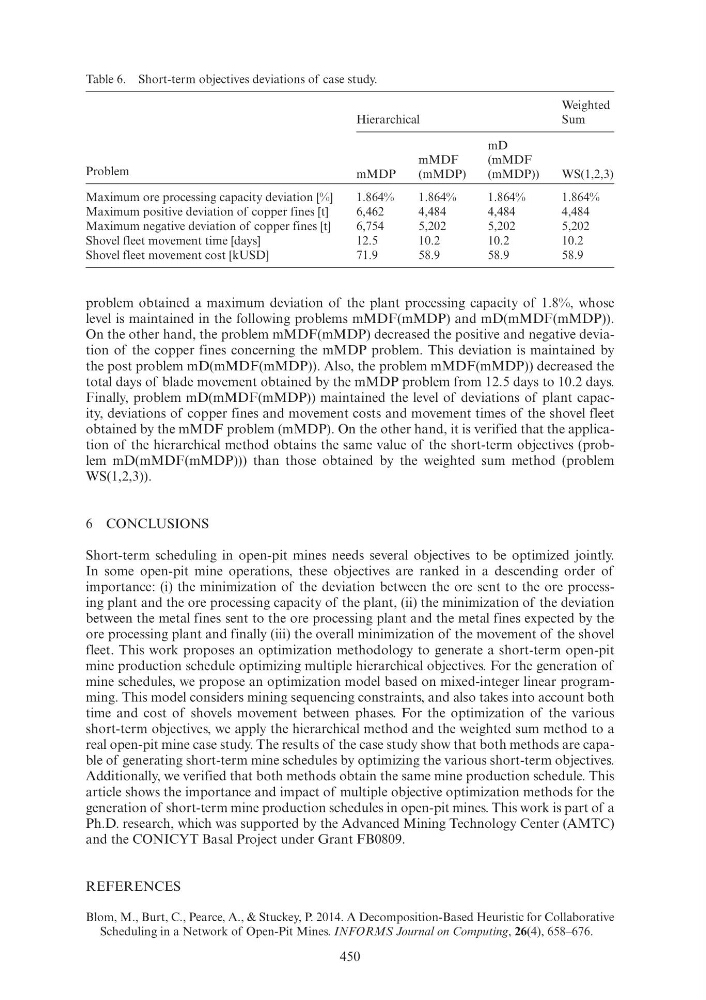
problem obtained a maximum deviation of the plant processing capacity of 1.8%, whose
level is maintained in the following problems mMDF(mMDP) and mD(mMDF(mMDP)).
On the other hand, the problem mMDF(mMDP) decreased the positive and negative deviation of the copper fines concerning the mMDP problem. This deviation is maintained by
the post problem mD(mMDF(mMDP)). Also, the problem mMDF(mMDP)) decreased the
total days of blade movement obtained by the mMDP problem from 12.5 days to 10.2 days.
Finally, problem mD(mMDF(mMDP)) maintained the level of deviations of plant capacity, deviations of copper fines and movement costs and movement times of the shovel fleet
obtained by the mMDF problem (mMDP). On the other hand, it is verified that the application of the hierarchical method obtains the same value of the short-term objectives (problem mD(mMDF(mMDP))) than those obtained by the weighted sum method (problem
WS(1,2,3)).
6 CONCLUSIONS
Short-term scheduling in open-pit mines needs several objectives to be optimized jointly.
In some open-pit mine operations, these objectives are ranked in a descending order of
importance: (i) the minimization of the deviation between the ore sent to the ore processing plant and the ore processing capacity of the plant, (ii) the minimization of the deviation
between the metal fines sent to the ore processing plant and the metal fines expected by the
ore processing plant and finally (iii) the overall minimization of the movement of the shovel
fleet. This work proposes an optimization methodology to generate a short-term open-pit
mine production schedule optimizing multiple hierarchical objectives. For the generation of
mine schedules, we propose an optimization model based on mixed-integer linear programming. This model considers mining sequencing constraints, and also takes into account both
time and cost of shovels movement between phases. For the optimization of the various
short-term objectives, we apply the hierarchical method and the weighted sum method to a
real open-pit mine case study. The results of the case study show that both methods are capable of generating short-term mine schedules by optimizing the various short-term objectives.
Additionally, we verified that both methods obtain the same mine production schedule. This
article shows the importance and impact of multiple objective optimization methods for the
generation of short-term mine production schedules in open-pit mines. This work is part of a
Ph.D. research, which was supported by the Advanced Mining Technology Center (AMTC)
and the CONICYT Basal Project under Grant FB0809.
REFERENCES
Blom, M., Burt, C., Pearce, A., & Stuckey, P. 2014. A Decomposition-Based Heuristic for Collaborative
Scheduling in a Network of Open-Pit Mines. INFORMS Journal on Computing, 26(4), 658–676.
Table 6. Short-term objectives deviations of case study.
Problem
Hierarchical
Weighted
Sum
mMDP
mMDF
(mMDP)
mD
(mMDF
(mMDP))
WS(1,2,3)
Maximum ore processing capacity deviation [%]
1.864%
1.864%
1.864%
1.864%
Maximum positive deviation of copper fines [t]
6,462
4,484
4,484
4,484
Maximum negative deviation of copper fines [t]
6,754
5,202
5,202
5,202
Shovel fleet movement time [days]
12.5
10.2
10.2
10.2
Shovel fleet movement cost [kUSD]
71.9
58.9
58.9
58.9
problem obtained a maximum deviation of the plant processing capacity of 1.8%, whose
level is maintained in the following problems mMDF(mMDP) and mD(mMDF(mMDP)).
On the other hand, the problem mMDF(mMDP) decreased the positive and negative deviation of the copper fines concerning the mMDP problem. This deviation is maintained by
the post problem mD(mMDF(mMDP)). Also, the problem mMDF(mMDP)) decreased the
total days of blade movement obtained by the mMDP problem from 12.5 days to 10.2 days.
Finally, problem mD(mMDF(mMDP)) maintained the level of deviations of plant capacity, deviations of copper fines and movement costs and movement times of the shovel fleet
obtained by the mMDF problem (mMDP). On the other hand, it is verified that the application of the hierarchical method obtains the same value of the short-term objectives (problem mD(mMDF(mMDP))) than those obtained by the weighted sum method (problem
WS(1,2,3)).
6 CONCLUSIONS
Short-term scheduling in open-pit mines needs several objectives to be optimized jointly.
In some open-pit mine operations, these objectives are ranked in a descending order of
importance: (i) the minimization of the deviation between the ore sent to the ore processing plant and the ore processing capacity of the plant, (ii) the minimization of the deviation
between the metal fines sent to the ore processing plant and the metal fines expected by the
ore processing plant and finally (iii) the overall minimization of the movement of the shovel
fleet. This work proposes an optimization methodology to generate a short-term open-pit
mine production schedule optimizing multiple hierarchical objectives. For the generation of
mine schedules, we propose an optimization model based on mixed-integer linear programming. This model considers mining sequencing constraints, and also takes into account both
time and cost of shovels movement between phases. For the optimization of the various
short-term objectives, we apply the hierarchical method and the weighted sum method to a
real open-pit mine case study. The results of the case study show that both methods are capable of generating short-term mine schedules by optimizing the various short-term objectives.
Additionally, we verified that both methods obtain the same mine production schedule. This
article shows the importance and impact of multiple objective optimization methods for the
generation of short-term mine production schedules in open-pit mines. This work is part of a
Ph.D. research, which was supported by the Advanced Mining Technology Center (AMTC)
and the CONICYT Basal Project under Grant FB0809.
REFERENCES
Blom, M., Burt, C., Pearce, A., & Stuckey, P. 2014. A Decomposition-Based Heuristic for Collaborative
Scheduling in a Network of Open-Pit Mines. INFORMS Journal on Computing, 26(4), 658–676.
Table 6. Short-term objectives deviations of case study.
Problem
Hierarchical
Weighted
Sum
mMDP
mMDF
(mMDP)
mD
(mMDF
(mMDP))
WS(1,2,3)
Maximum ore processing capacity deviation [%]
1.864%
1.864%
1.864%
1.864%
Maximum positive deviation of copper fines [t]
6,462
4,484
4,484
4,484
Maximum negative deviation of copper fines [t]
6,754
5,202
5,202
5,202
Shovel fleet movement time [days]
12.5
10.2
10.2
10.2
Shovel fleet movement cost [kUSD]
71.9
58.9
58.9
58.9