

448
ranked functions to exceed a prescribed fraction of their optimal values obtained on the corresponding steps (Grodzevich & Romanko, 2006). In this work, these sets of additional constraints do not allow the values of each of the higher ranked functions to take no other than
the same optimum value obtained on the corresponding steps. In the proposed optimization
model, the sets of constraints that impose that the maximum deviation of ore processing
capacity per period does not take another value than the obtained in the previously solved
problem are 19 and 20. Analogously, the set of constraints that enforce that the maximum
deviation of fines per period does not take another value than the obtained in the previously
solved problem are 21 to 23. The following problems need to be solved in the context of the
hierarchical method:
• mMDP: Minimize the maximum deviation between ore sent to the ore processing plant
and the ore processing capacity per period.
• mMDF(mMDP): Minimize the maximum deviation between metal fines sent to the ore
processing plant and the expected metal fines by ore processing plant per period, subject
to the minimum maximum deviation between ore sent to the processing plant and the ore
processing capacity per period.
• mD(mMDF(mMDP)): Minimize overall shovel movement between phases subject to:
(i) minimum maximum deviation between ore sent to the processing plant and the ore
processing capacity per period, and (ii) the minimum maximum deviation between metal
fines sent to the processing plant and the expected metal fines by the ore processing capacity per period.
4 CASE STUDY
A case study of an open-pit copper mine is considered to verify the model. Year 4 is selected
as the short-term schedule for the case study. The schedule requires 63.49 [Mt] of ore and
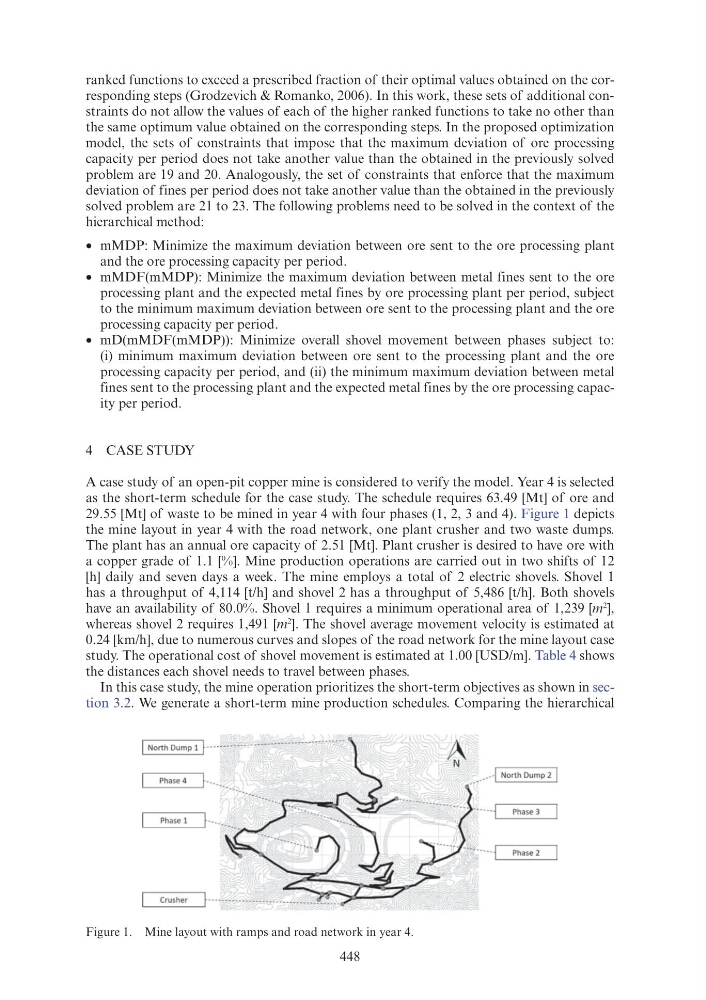
29.55 [Mt] of waste to be mined in year 4 with four phases (1, 2, 3 and 4). Figure 1 depicts
the mine layout in year 4 with the road network, one plant crusher and two waste dumps.
The plant has an annual ore capacity of 2.51 [Mt]. Plant crusher is desired to have ore with
a copper grade of 1.1 [%]. Mine production operations are carried out in two shifts of 12
[h] daily and seven days a week. The mine employs a total of 2 electric shovels. Shovel 1
has a throughput of 4,114 [t/h] and shovel 2 has a throughput of 5,486 [t/h]. Both shovels
have an availability of 80.0%. Shovel 1 requires a minimum operational area of 1,239 [m
2 ],
whereas shovel 2 requires 1,491 [m
2
]. The shovel average movement velocity is estimated at
0.24 [km/h], due to numerous curves and slopes of the road network for the mine layout case
study. The operational cost of shovel movement is estimated at 1.00 [USD/m]. Table 4 shows
the distances each shovel needs to travel between phases.
In this case study, the mine operation prioritizes the short-term objectives as shown in section 3.2. We generate a short-term mine production schedules. Comparing the hierarchical
Figure 1. Mine layout with ramps and road network in year 4.
.--1 North Dump 2 I
---j Phase 3
· ··~
Phase 2
crusher
ranked functions to exceed a prescribed fraction of their optimal values obtained on the corresponding steps (Grodzevich & Romanko, 2006). In this work, these sets of additional constraints do not allow the values of each of the higher ranked functions to take no other than
the same optimum value obtained on the corresponding steps. In the proposed optimization
model, the sets of constraints that impose that the maximum deviation of ore processing
capacity per period does not take another value than the obtained in the previously solved
problem are 19 and 20. Analogously, the set of constraints that enforce that the maximum
deviation of fines per period does not take another value than the obtained in the previously
solved problem are 21 to 23. The following problems need to be solved in the context of the
hierarchical method:
• mMDP: Minimize the maximum deviation between ore sent to the ore processing plant
and the ore processing capacity per period.
• mMDF(mMDP): Minimize the maximum deviation between metal fines sent to the ore
processing plant and the expected metal fines by ore processing plant per period, subject
to the minimum maximum deviation between ore sent to the processing plant and the ore
processing capacity per period.
• mD(mMDF(mMDP)): Minimize overall shovel movement between phases subject to:
(i) minimum maximum deviation between ore sent to the processing plant and the ore
processing capacity per period, and (ii) the minimum maximum deviation between metal
fines sent to the processing plant and the expected metal fines by the ore processing capacity per period.
4 CASE STUDY
A case study of an open-pit copper mine is considered to verify the model. Year 4 is selected
as the short-term schedule for the case study. The schedule requires 63.49 [Mt] of ore and
29.55 [Mt] of waste to be mined in year 4 with four phases (1, 2, 3 and 4). Figure 1 depicts
the mine layout in year 4 with the road network, one plant crusher and two waste dumps.
The plant has an annual ore capacity of 2.51 [Mt]. Plant crusher is desired to have ore with
a copper grade of 1.1 [%]. Mine production operations are carried out in two shifts of 12
[h] daily and seven days a week. The mine employs a total of 2 electric shovels. Shovel 1
has a throughput of 4,114 [t/h] and shovel 2 has a throughput of 5,486 [t/h]. Both shovels
have an availability of 80.0%. Shovel 1 requires a minimum operational area of 1,239 [m
2 ],
whereas shovel 2 requires 1,491 [m
2
]. The shovel average movement velocity is estimated at
0.24 [km/h], due to numerous curves and slopes of the road network for the mine layout case
study. The operational cost of shovel movement is estimated at 1.00 [USD/m]. Table 4 shows
the distances each shovel needs to travel between phases.
In this case study, the mine operation prioritizes the short-term objectives as shown in section 3.2. We generate a short-term mine production schedules. Comparing the hierarchical
Figure 1. Mine layout with ramps and road network in year 4.
.--1 North Dump 2 I
---j Phase 3
· ··~
Phase 2
crusher