

447
s FR
F F
p s t
pr t
v p s t
t T
p P r R
( )
r
−
∑
≥
∀
p r t
v
{ }
∈
P r
,
s
, ,
r
,
,
p P P
1
(18)
d
D
t T
t
d d
∀
D
(19)
p P f F b B
p f b
pf b t
t
RM p
x
T
p f b t
T d t PC
t T
P f
∑
⋅ x
=
t
d t
−
∀ ∈
t
,
,
f F
f
,
f
, f ,
(20)
g
G
t T
t ≤
∀
G
(21)
g
G
t T
t ≤
∀
G
(22)
p P f F b B
p f b
pf b t
t
t
p P f F b B
p f
RM p
x
T
p f b t
T
g g
t
RM p
P f
−
+
g
P f
∑
∑
⋅ x
+
=
g
+
g
,
,
f F
f
,
f
, f ,
,
,
f F
f
,
f b
p
b b
f b t
fb
x
O
p f b t
F f b G
t T
⋅ x
⋅
∀
EG
∈
, f ,
,
t
f
(23)
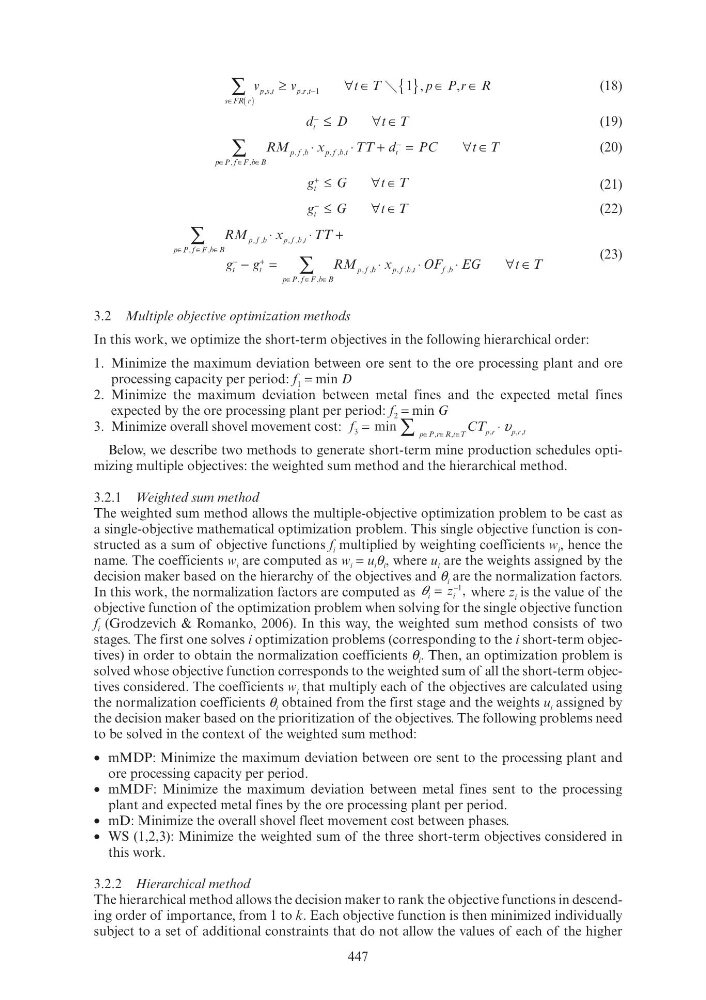
3.2 Multiple objective optimization methods
In this work, we optimize the short-term objectives in the following hierarchical order:
1. Minimize the maximum deviation between ore sent to the ore processing plant and ore
processing capacity per period: f 1 = min D
2. Minimize the maximum deviation between metal fines and the expected metal fines
expected by the ore processing plant per period: f 2 = min G
3. Minimize overall shovel movement cost: f
C T p r
T T
p r t
p P R t T
3
f f
⋅
CT
P r
∑ ∑
i
r
p ,
,
,
R
∈
r
υ
Below, we describe two methods to generate short-term mine production schedules optimizing multiple objectives: the weighted sum method and the hierarchical method.
3.2.1 Weighted sum method
The weighted sum method allows the multiple-objective optimization problem to be cast as
a single-objective mathematical optimization problem. This single objective function is constructed as a sum of objective functions f i multiplied by weighting coefficients w i , hence the
name. The coefficients w i are computed as w i = u i θ i , where u i are the weights assigned by the
decision maker based on the hierarchy of the objectives and θ i are the normalization factors.
In this work, the normalization factors are computed as i
i
θ z
=
−1 , where z i is the value of the
objective function of the optimization problem when solving for the single objective function
f i (Grodzevich & Romanko, 2006). In this way, the weighted sum method consists of two
stages. The first one solves i optimization problems (corresponding to the i short-term objectives) in order to obtain the normalization coefficients θ i . Then, an optimization problem is
solved whose objective function corresponds to the weighted sum of all the short-term objectives considered. The coefficients w i that multiply each of the objectives are calculated using
the normalization coefficients θ i obtained from the first stage and the weights u i assigned by
the decision maker based on the prioritization of the objectives. The following problems need
to be solved in the context of the weighted sum method:
• mMDP: Minimize the maximum deviation between ore sent to the processing plant and
ore processing capacity per period.
• mMDF: Minimize the maximum deviation between metal fines sent to the processing
plant and expected metal fines by the ore processing plant per period.
• mD: Minimize the overall shovel fleet movement cost between phases.
• WS (1,2,3): Minimize the weighted sum of the three short-term objectives considered in
this work.
3.2.2 Hierarchical method
The hierarchical method allows the decision maker to rank the objective functions in descending order of importance, from 1 to k. Each objective function is then minimized individually
subject to a set of additional constraints that do not allow the values of each of the higher
s FR
F F
p s t
pr t
v p s t
t T
p P r R
( )
r
−
∑
≥
∀
p r t
v
{ }
∈
P r
,
s
, ,
r
,
,
p P P
1
(18)
d
D
t T
t
d d
∀
D
(19)
p P f F b B
p f b
pf b t
t
RM p
x
T
p f b t
T d t PC
t T
P f
∑
⋅ x
=
t
d t
−
∀ ∈
t
,
,
f F
f
,
f
, f ,
(20)
g
G
t T
t ≤
∀
G
(21)
g
G
t T
t ≤
∀
G
(22)
p P f F b B
p f b
pf b t
t
t
p P f F b B
p f
RM p
x
T
p f b t
T
g g
t
RM p
P f
−
+
g
P f
∑
∑
⋅ x
+
=
g
+
g
,
,
f F
f
,
f
, f ,
,
,
f F
f
,
f b
p
b b
f b t
fb
x
O
p f b t
F f b G
t T
⋅ x
⋅
∀
EG
∈
, f ,
,
t
f
(23)
3.2 Multiple objective optimization methods
In this work, we optimize the short-term objectives in the following hierarchical order:
1. Minimize the maximum deviation between ore sent to the ore processing plant and ore
processing capacity per period: f 1 = min D
2. Minimize the maximum deviation between metal fines and the expected metal fines
expected by the ore processing plant per period: f 2 = min G
3. Minimize overall shovel movement cost: f
C T p r
T T
p r t
p P R t T
3
f f
⋅
CT
P r
∑ ∑
i
r
p ,
,
,
R
∈
r
υ
Below, we describe two methods to generate short-term mine production schedules optimizing multiple objectives: the weighted sum method and the hierarchical method.
3.2.1 Weighted sum method
The weighted sum method allows the multiple-objective optimization problem to be cast as
a single-objective mathematical optimization problem. This single objective function is constructed as a sum of objective functions f i multiplied by weighting coefficients w i , hence the
name. The coefficients w i are computed as w i = u i θ i , where u i are the weights assigned by the
decision maker based on the hierarchy of the objectives and θ i are the normalization factors.
In this work, the normalization factors are computed as i
i
θ z
=
−1 , where z i is the value of the
objective function of the optimization problem when solving for the single objective function
f i (Grodzevich & Romanko, 2006). In this way, the weighted sum method consists of two
stages. The first one solves i optimization problems (corresponding to the i short-term objectives) in order to obtain the normalization coefficients θ i . Then, an optimization problem is
solved whose objective function corresponds to the weighted sum of all the short-term objectives considered. The coefficients w i that multiply each of the objectives are calculated using
the normalization coefficients θ i obtained from the first stage and the weights u i assigned by
the decision maker based on the prioritization of the objectives. The following problems need
to be solved in the context of the weighted sum method:
• mMDP: Minimize the maximum deviation between ore sent to the processing plant and
ore processing capacity per period.
• mMDF: Minimize the maximum deviation between metal fines sent to the processing
plant and expected metal fines by the ore processing plant per period.
• mD: Minimize the overall shovel fleet movement cost between phases.
• WS (1,2,3): Minimize the weighted sum of the three short-term objectives considered in
this work.
3.2.2 Hierarchical method
The hierarchical method allows the decision maker to rank the objective functions in descending order of importance, from 1 to k. Each objective function is then minimized individually
subject to a set of additional constraints that do not allow the values of each of the higher