

397
there is extra fleet capacity available. The adjustment factor is constrained by mf to uniformly
distribute the additional truck fleet capacity among all the needy paths to balance ore and
waste production.
mf
pf
p f
t
tc t
t
T
sd
f f
sd
f f
d
D
s
S
=
⎧
⎨
⎪
⎧ ⎧
⎪
⎨ ⎨
⎪ ⎪
⎩
⎪
⎨ ⎨
⎪ ⎩ ⎩
⎪ ⎪
⎫
⎬
⎪
⎫ ⎫
⎪
⎬ ⎬
⎪ ⎪
⎭
⎪
⎬ ⎬
⎪ ⎭ ⎭
⎪ ⎪
∀ ∈
t
=
=
=
∑
∑
∑
max ,
⎨
(
)
pf
pmsf
sd
f f
sd
f f
−
1
1
1
1
,
,
d
and s
{
}
,
1 ..., . . T ∀ ∈
d {
}
,...,
∀
{
}
,...,S
, and s
}
,...,D
∀ ∈
s {
(8)
where:
tc t
truck capacity for truck t in the fleet
pf sd the path flow rate for a path linking shovel s to dump d
pmsf sd The path flow rate for path linking shovel s to dump d that has been met so far
4 APPLICATION TO A CASE STUDY
To test the developed framework in a case study, we need two types of data, the strategic
schedule, and the technical and the operational data. However, because of the unavailability
of required data from the operating mine, the strategic production schedule was borrowed
form Upadhyay (2016), and the operating equipment are assumed. The required distributions for processes of truck and shovel operation were fitted on the historical data using
operational data of an existing mine.
4.1 Mine location and its operational data
Gol-E-Gohar iron ore mine is located in Kerman Province of Iran. The project lies in the
southwest of the province, approximately 50 km southeast of the city of Sirjan. Mining operation in Gol-E-Gohar is being handled by a truck and shovel material handling system.
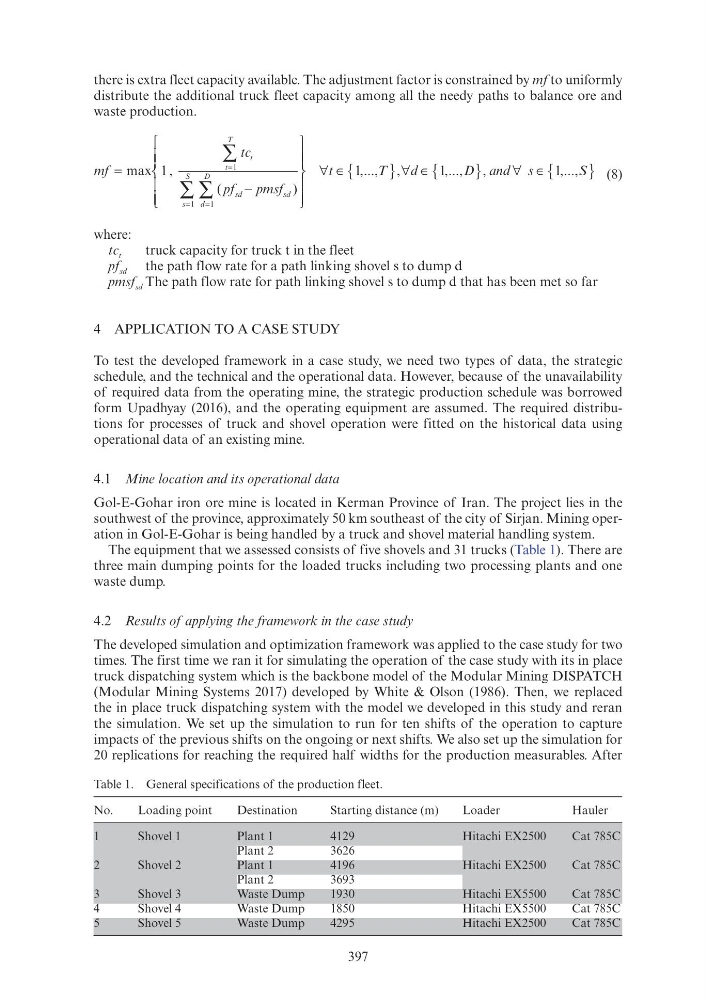
The equipment that we assessed consists of five shovels and 31 trucks (Table 1). There are
three main dumping points for the loaded trucks including two processing plants and one
waste dump.
4.2 Results of applying the framework in the case study
The developed simulation and optimization framework was applied to the case study for two
times. The first time we ran it for simulating the operation of the case study with its in place
truck dispatching system which is the backbone model of the Modular Mining DISPATCH
(Modular Mining Systems 2017) developed by White & Olson (1986). Then, we replaced
the in place truck dispatching system with the model we developed in this study and reran
the simulation. We set up the simulation to run for ten shifts of the operation to capture
impacts of the previous shifts on the ongoing or next shifts. We also set up the simulation for
20 replications for reaching the required half widths for the production measurables. After
Table 1. General specifications of the production fleet.
No.
Loading point
Destination
Starting distance (m)
Loader
Hauler
1
Shovel 1
Plant 1
4129
Hitachi EX2500
Cat 785C
Plant 2
3626
2
Shovel 2
Plant 1
4196
Hitachi EX2500
Cat 785C
Plant 2
3693
3
Shovel 3
Waste Dump
1930
Hitachi EX5500
Cat 785C
4
Shovel 4
Waste Dump
1850
Hitachi EX5500
Cat 785C
5
Shovel 5
Waste Dump
4295
Hitachi EX2500
Cat 785C
there is extra fleet capacity available. The adjustment factor is constrained by mf to uniformly
distribute the additional truck fleet capacity among all the needy paths to balance ore and
waste production.
mf
pf
p f
t
tc t
t
T
sd
f f
sd
f f
d
D
s
S
=
⎧
⎨
⎪
⎧ ⎧
⎪
⎨ ⎨
⎪ ⎪
⎩
⎪
⎨ ⎨
⎪ ⎩ ⎩
⎪ ⎪
⎫
⎬
⎪
⎫ ⎫
⎪
⎬ ⎬
⎪ ⎪
⎭
⎪
⎬ ⎬
⎪ ⎭ ⎭
⎪ ⎪
∀ ∈
t
=
=
=
∑
∑
∑
max ,
⎨
(
)
pf
pmsf
sd
f f
sd
f f
−
1
1
1
1
,
,
d
and s
{
}
,
1 ..., . . T ∀ ∈
d {
}
,...,
∀
{
}
,...,S
, and s
}
,...,D
∀ ∈
s {
(8)
where:
tc t
truck capacity for truck t in the fleet
pf sd the path flow rate for a path linking shovel s to dump d
pmsf sd The path flow rate for path linking shovel s to dump d that has been met so far
4 APPLICATION TO A CASE STUDY
To test the developed framework in a case study, we need two types of data, the strategic
schedule, and the technical and the operational data. However, because of the unavailability
of required data from the operating mine, the strategic production schedule was borrowed
form Upadhyay (2016), and the operating equipment are assumed. The required distributions for processes of truck and shovel operation were fitted on the historical data using
operational data of an existing mine.
4.1 Mine location and its operational data
Gol-E-Gohar iron ore mine is located in Kerman Province of Iran. The project lies in the
southwest of the province, approximately 50 km southeast of the city of Sirjan. Mining operation in Gol-E-Gohar is being handled by a truck and shovel material handling system.
The equipment that we assessed consists of five shovels and 31 trucks (Table 1). There are
three main dumping points for the loaded trucks including two processing plants and one
waste dump.
4.2 Results of applying the framework in the case study
The developed simulation and optimization framework was applied to the case study for two
times. The first time we ran it for simulating the operation of the case study with its in place
truck dispatching system which is the backbone model of the Modular Mining DISPATCH
(Modular Mining Systems 2017) developed by White & Olson (1986). Then, we replaced
the in place truck dispatching system with the model we developed in this study and reran
the simulation. We set up the simulation to run for ten shifts of the operation to capture
impacts of the previous shifts on the ongoing or next shifts. We also set up the simulation for
20 replications for reaching the required half widths for the production measurables. After
Table 1. General specifications of the production fleet.
No.
Loading point
Destination
Starting distance (m)
Loader
Hauler
1
Shovel 1
Plant 1
4129
Hitachi EX2500
Cat 785C
Plant 2
3626
2
Shovel 2
Plant 1
4196
Hitachi EX2500
Cat 785C
Plant 2
3693
3
Shovel 3
Waste Dump
1930
Hitachi EX5500
Cat 785C
4
Shovel 4
Waste Dump
1850
Hitachi EX5500
Cat 785C
5
Shovel 5
Waste Dump
4295
Hitachi EX2500
Cat 785C