

396
C
t
na
T
s
ltt
qt dt ett
td
C C s
d d
ts
s
td
td
td
tds d d
=
=
= ltt
dt
−
( ,
t
)
(
S
)
( , )
s
3
4
s
+ s)
(
S
t
TT
t
s
(
)
tinq t′ t t s
t
s s
s
tenr t
+
× (
)
t s
ts
st
lt
+
∀ ∈
t {
} ∀ {
}
S
)
t t s × ( t t
st
t t
′
t t =
∑
1
s
}
T
∀ ∈
s {
&
& &∀ ∈{
}
,...,
d
(2)
where:
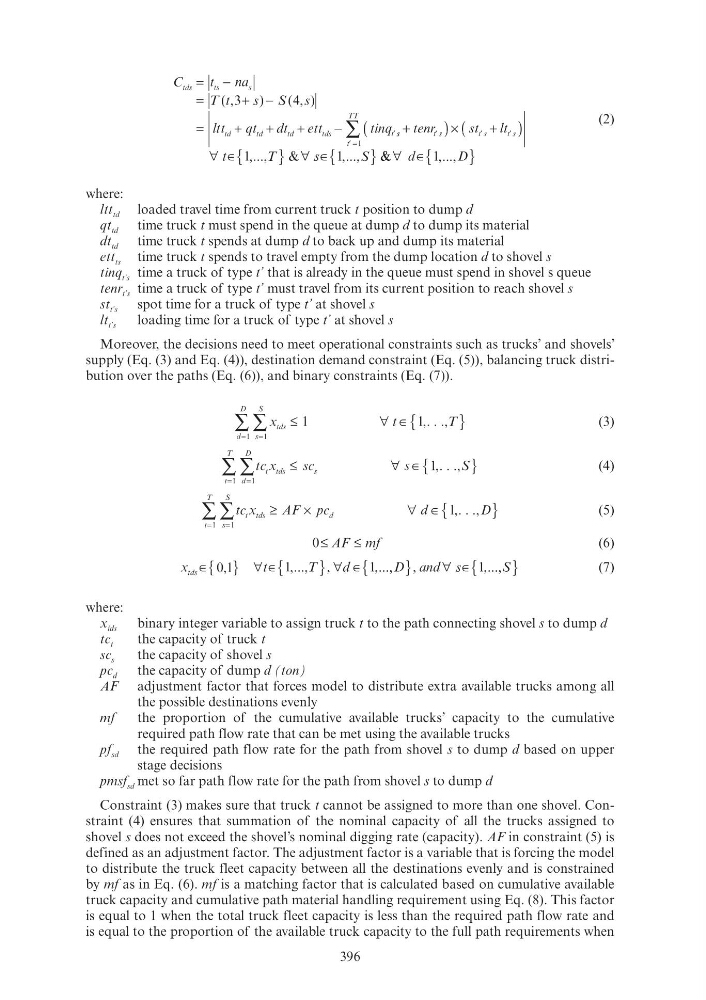
ltt td loaded travel time from current truck t position to dump d
qt td time truck t must spend in the queue at dump d to dump its material
dt td time truck t spends at dump d to back up and dump its material
ett ts time truck t spends to travel empty from the dump location d to shovel s
tinq t’s time a truck of type t’ that is already in the queue must spend in shovel s queue
tenr t’s time a truck of type t’ must travel from its current position to reach shovel s
st t’s spot time for a truck of type t’ at shovel s
lt t’s
loading time for a truck of type t’ at shovel s
Moreover, the decisions need to meet operational constraints such as trucks’ and shovels’
supply (Eq. (3) and Eq. (4)), destination demand constraint (Eq. (5)), balancing truck distribution over the paths (Eq. (6)), and binary constraints (Eq. (7)).
D
S
tds d d
x
t
tds d
∑ ∑ ≤
∀
{
}
T
1
s= s
t
∀ ∈{
(3)
t
d
D
t
T
tds
s
d d
tc x tds d
s
s
∑ ∑
≤
∀
sc s
∈{
}
S
1
d =
d
(4)
t
s
t
T
S
tds
d
d d
tc x
A
tds d
F pc
d
d
∑ ∑
AF
∈
d {
}
D
1
1
s= s
(5)
0≤
≤
AF mf
(6)
x
t
d
and s
tds d d
{ } ∀ ∈
t {
} ∀d {
}
D
∀ ∈
s {
}
S
d
}
T ∀ ∈
d {
,
,
(7)
where:
x ids
binary integer variable to assign truck t to the path connecting shovel s to dump d
tc t
the capacity of truck t
sc s
the capacity of shovel s
pc d
the capacity of dump d (ton)
AF adjustment factor that forces model to distribute extra available trucks among all
the possible destinations evenly
mf
the proportion of the cumulative available trucks’ capacity to the cumulative
required path flow rate that can be met using the available trucks
pf sd the required path flow rate for the path from shovel s to dump d based on upper
stage decisions
pmsf sd met so far path flow rate for the path from shovel s to dump d
Constraint (3) makes sure that truck t cannot be assigned to more than one shovel. Constraint (4) ensures that summation of the nominal capacity of all the trucks assigned to
shovel s does not exceed the shovel’s nominal digging rate (capacity). AF in constraint (5) is
defined as an adjustment factor. The adjustment factor is a variable that is forcing the model
to distribute the truck fleet capacity between all the destinations evenly and is constrained
by mf as in Eq. (6). mf is a matching factor that is calculated based on cumulative available
truck capacity and cumulative path material handling requirement using Eq. (8). This factor
is equal to 1 when the total truck fleet capacity is less than the required path flow rate and
is equal to the proportion of the available truck capacity to the full path requirements when
C
t
na
T
s
ltt
qt dt ett
td
C C s
d d
ts
s
td
td
td
tds d d
=
=
= ltt
dt
−
( ,
t
)
(
S
)
( , )
s
3
4
s
+ s)
(
S
t
TT
t
s
(
)
tinq t′ t t s
t
s s
s
tenr t
+
× (
)
t s
ts
st
lt
+
∀ ∈
t {
} ∀ {
}
S
)
t t s × ( t t
st
t t
′
t t =
∑
1
s
}
T
∀ ∈
s {
&
& &∀ ∈{
}
,...,
d
(2)
where:
ltt td loaded travel time from current truck t position to dump d
qt td time truck t must spend in the queue at dump d to dump its material
dt td time truck t spends at dump d to back up and dump its material
ett ts time truck t spends to travel empty from the dump location d to shovel s
tinq t’s time a truck of type t’ that is already in the queue must spend in shovel s queue
tenr t’s time a truck of type t’ must travel from its current position to reach shovel s
st t’s spot time for a truck of type t’ at shovel s
lt t’s
loading time for a truck of type t’ at shovel s
Moreover, the decisions need to meet operational constraints such as trucks’ and shovels’
supply (Eq. (3) and Eq. (4)), destination demand constraint (Eq. (5)), balancing truck distribution over the paths (Eq. (6)), and binary constraints (Eq. (7)).
D
S
tds d d
x
t
tds d
∑ ∑ ≤
∀
{
}
T
1
s= s
t
∀ ∈{
(3)
t
d
D
t
T
tds
s
d d
tc x tds d
s
s
∑ ∑
≤
∀
sc s
∈{
}
S
1
d =
d
(4)
t
s
t
T
S
tds
d
d d
tc x
A
tds d
F pc
d
d
∑ ∑
AF
∈
d {
}
D
1
1
s= s
(5)
0≤
≤
AF mf
(6)
x
t
d
and s
tds d d
{ } ∀ ∈
t {
} ∀d {
}
D
∀ ∈
s {
}
S
d
}
T ∀ ∈
d {
,
,
(7)
where:
x ids
binary integer variable to assign truck t to the path connecting shovel s to dump d
tc t
the capacity of truck t
sc s
the capacity of shovel s
pc d
the capacity of dump d (ton)
AF adjustment factor that forces model to distribute extra available trucks among all
the possible destinations evenly
mf
the proportion of the cumulative available trucks’ capacity to the cumulative
required path flow rate that can be met using the available trucks
pf sd the required path flow rate for the path from shovel s to dump d based on upper
stage decisions
pmsf sd met so far path flow rate for the path from shovel s to dump d
Constraint (3) makes sure that truck t cannot be assigned to more than one shovel. Constraint (4) ensures that summation of the nominal capacity of all the trucks assigned to
shovel s does not exceed the shovel’s nominal digging rate (capacity). AF in constraint (5) is
defined as an adjustment factor. The adjustment factor is a variable that is forcing the model
to distribute the truck fleet capacity between all the destinations evenly and is constrained
by mf as in Eq. (6). mf is a matching factor that is calculated based on cumulative available
truck capacity and cumulative path material handling requirement using Eq. (8). This factor
is equal to 1 when the total truck fleet capacity is less than the required path flow rate and
is equal to the proportion of the available truck capacity to the full path requirements when