

395
reviewed the application of simulation in production optimization in mines. Hodkiewicz
et al. (2010) reviewed the simulation studies in both fields of underground and surface mining and highlighted lack of an integrated mining simulation model which incorporate truck
workshop as part of the mining system.
3 MODEL DEVELOPMENT
3.1 Integrated simulation and optimization framework
The integrated stochastic simulation and optimization framework developed here consists of
four main components: two optimization and two simulation sub models. The two optimization components are decision-making tools in fleet management systems that solve the paths’
flow rate and truck dispatching problems (White & Olson 1986, Alarie & Gamache 2002). The
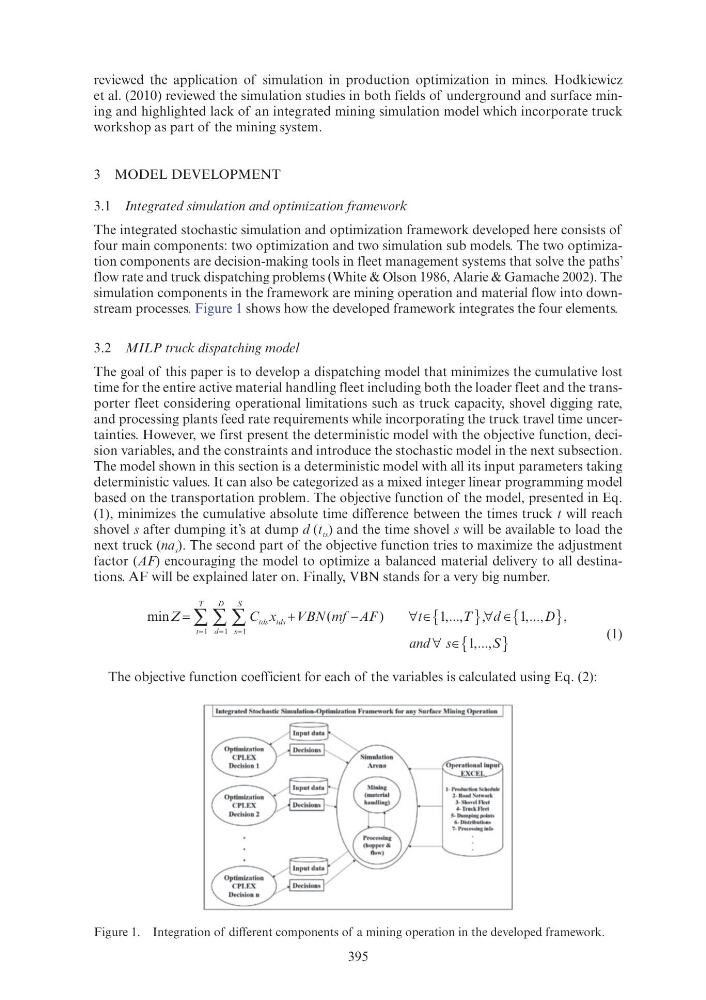
simulation components in the framework are mining operation and material flow into downstream processes. Figure 1 shows how the developed framework integrates the four elements.
3.2 MILP truck dispatching model
The goal of this paper is to develop a dispatching model that minimizes the cumulative lost
time for the entire active material handling fleet including both the loader fleet and the transporter fleet considering operational limitations such as truck capacity, shovel digging rate,
and processing plants feed rate requirements while incorporating the truck travel time uncertainties. However, we first present the deterministic model with the objective function, decision variables, and the constraints and introduce the stochastic model in the next subsection.
The model shown in this section is a deterministic model with all its input parameters taking
deterministic values. It can also be categorized as a mixed integer linear programming model
based on the transportation problem. The objective function of the model, presented in Eq.
(1), minimizes the cumulative absolute time difference between the times truck t will reach
shovel s after dumping it’s at dump d (t ts ) and the time shovel s will be available to load the
next truck (na s ). The second part of the objective function tries to maximize the adjustment
factor (AF) encouraging the model to optimize a balanced material delivery to all destinations. AF will be explained later on. Finally, VBN stands for a very big number.
min
(
)
,
mf
t
d
tds t
d d
ds
s
S
d
D
t
T
−
∀
)
AF
∈{
}
,...,
∀d
=
=
=
∑
∑
∑
1
1
1
, d
}
,...,T ∀ ∈
, d
,
and s
{
}
,.
1 .., . . D
∀ ∈
s {
}
,...,S
(1)
The objective function coefficient for each of the variables is calculated using Eq. (2):
Figure 1. Integration of different components of a mining operation in the developed framework.
reviewed the application of simulation in production optimization in mines. Hodkiewicz
et al. (2010) reviewed the simulation studies in both fields of underground and surface mining and highlighted lack of an integrated mining simulation model which incorporate truck
workshop as part of the mining system.
3 MODEL DEVELOPMENT
3.1 Integrated simulation and optimization framework
The integrated stochastic simulation and optimization framework developed here consists of
four main components: two optimization and two simulation sub models. The two optimization components are decision-making tools in fleet management systems that solve the paths’
flow rate and truck dispatching problems (White & Olson 1986, Alarie & Gamache 2002). The
simulation components in the framework are mining operation and material flow into downstream processes. Figure 1 shows how the developed framework integrates the four elements.
3.2 MILP truck dispatching model
The goal of this paper is to develop a dispatching model that minimizes the cumulative lost
time for the entire active material handling fleet including both the loader fleet and the transporter fleet considering operational limitations such as truck capacity, shovel digging rate,
and processing plants feed rate requirements while incorporating the truck travel time uncertainties. However, we first present the deterministic model with the objective function, decision variables, and the constraints and introduce the stochastic model in the next subsection.
The model shown in this section is a deterministic model with all its input parameters taking
deterministic values. It can also be categorized as a mixed integer linear programming model
based on the transportation problem. The objective function of the model, presented in Eq.
(1), minimizes the cumulative absolute time difference between the times truck t will reach
shovel s after dumping it’s at dump d (t ts ) and the time shovel s will be available to load the
next truck (na s ). The second part of the objective function tries to maximize the adjustment
factor (AF) encouraging the model to optimize a balanced material delivery to all destinations. AF will be explained later on. Finally, VBN stands for a very big number.
min
(
)
,
mf
t
d
tds t
d d
ds
s
S
d
D
t
T
−
∀
)
AF
∈{
}
,...,
∀d
=
=
=
∑
∑
∑
1
1
1
, d
}
,...,T ∀ ∈
, d
,
and s
{
}
,.
1 .., . . D
∀ ∈
s {
}
,...,S
(1)
The objective function coefficient for each of the variables is calculated using Eq. (2):
Figure 1. Integration of different components of a mining operation in the developed framework.