

296
3 CASE STUDY
An exercise was performed using data from an underground gold mine in Brazil. Anglogold
Ashanti’s Cuiabá mine is located in the city of Sabará, state of Minas Gerais, in the Southeast part of Brazil. Nowadays the mine has reached a depth of 1300 m and produces around
1.3 Mtpa.
The mining methods currently being applied in Cuiabá are the Sublevel Stoping and Cut &
Fill. The first method is generally used where the orebodies present a dip greater than 37º,
and the second method is applied where the orebodies are more flat bedded. For this evaluation, only Sublevel Stoping areas are being considered.
The mine is segmented in two parts based on the orebodies thickness. One part is the
Narrow Vein deposit, which is composed by three orebodies (BAL, GAL and CGA) with
a thickness of 1–2 m. The other part is called Main Orebodies, composed by two orebodies
(FGS and SER) with thickness greater than 5 m.
In order to guarantee the rock mass stability, a combination of sill and rib pillars is used
following the geotechnical assumptions and constraints. Normally the sill pillars are left
between panels, so that the mining panel length in the vertical direction does not exceed 60 m.
Although, during the short-term, a detailed geotechnical assessment for each stope occurs,
in long and medium-terms plans the rib pillars are placed along the oredrives following a
general set of geotechnical assumptions regarding pillar and stope span sizes. The rib pillars
usually are left with 6 m length. The spans size varies depending on the region of the mine.
For the Narrow Veins region, the standard size for the spans are 20 m while in the Main
Orebodies a value of 30 m is often applied. The most common approach is to pursue the
maximum size of the span and leave the minimum possible number of rib pillars.
A case study considering areas of a year plan was done using the software created and results
were compared to the regular pattern solution (which aims minimum number of rib pillars).
With the algorithm, we could compare two different objective functions: maximization of
metal content and maximization of profit value (which considers a benefit when less mass is
mined for same metal).
3.1.1 Metal content optimization
In the first analysis, a comparison between the amount of gold ounces in the regular grid and
the optimized grid was made.
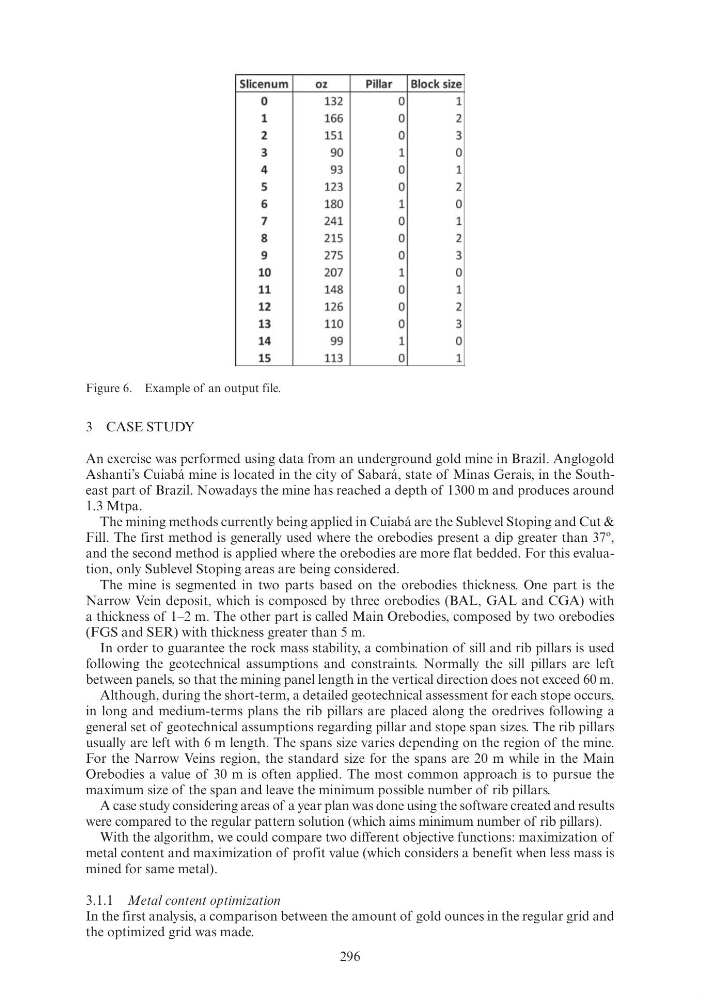
Figure 6. Example of an output file.
3 CASE STUDY
An exercise was performed using data from an underground gold mine in Brazil. Anglogold
Ashanti’s Cuiabá mine is located in the city of Sabará, state of Minas Gerais, in the Southeast part of Brazil. Nowadays the mine has reached a depth of 1300 m and produces around
1.3 Mtpa.
The mining methods currently being applied in Cuiabá are the Sublevel Stoping and Cut &
Fill. The first method is generally used where the orebodies present a dip greater than 37º,
and the second method is applied where the orebodies are more flat bedded. For this evaluation, only Sublevel Stoping areas are being considered.
The mine is segmented in two parts based on the orebodies thickness. One part is the
Narrow Vein deposit, which is composed by three orebodies (BAL, GAL and CGA) with
a thickness of 1–2 m. The other part is called Main Orebodies, composed by two orebodies
(FGS and SER) with thickness greater than 5 m.
In order to guarantee the rock mass stability, a combination of sill and rib pillars is used
following the geotechnical assumptions and constraints. Normally the sill pillars are left
between panels, so that the mining panel length in the vertical direction does not exceed 60 m.
Although, during the short-term, a detailed geotechnical assessment for each stope occurs,
in long and medium-terms plans the rib pillars are placed along the oredrives following a
general set of geotechnical assumptions regarding pillar and stope span sizes. The rib pillars
usually are left with 6 m length. The spans size varies depending on the region of the mine.
For the Narrow Veins region, the standard size for the spans are 20 m while in the Main
Orebodies a value of 30 m is often applied. The most common approach is to pursue the
maximum size of the span and leave the minimum possible number of rib pillars.
A case study considering areas of a year plan was done using the software created and results
were compared to the regular pattern solution (which aims minimum number of rib pillars).
With the algorithm, we could compare two different objective functions: maximization of
metal content and maximization of profit value (which considers a benefit when less mass is
mined for same metal).
3.1.1 Metal content optimization
In the first analysis, a comparison between the amount of gold ounces in the regular grid and
the optimized grid was made.
Figure 6. Example of an output file.