

269
In Figure 5, one can see that, for zero overburden, as open-pit mining goes deeper (bigger
PRM), the ore quality factor Q diminishes, although the Q factor lies between 15 and 13,
a relatively high index. On the other hand, for maximum (73 m) overburden, as the PRM
grows, Q grows as well. This is because the so-called fixed cost of the overburden is diluted,
as more and more ore is mined by open-pit mining. The same applies for lines corresponding
from 64-m to 9-m overburden depth.
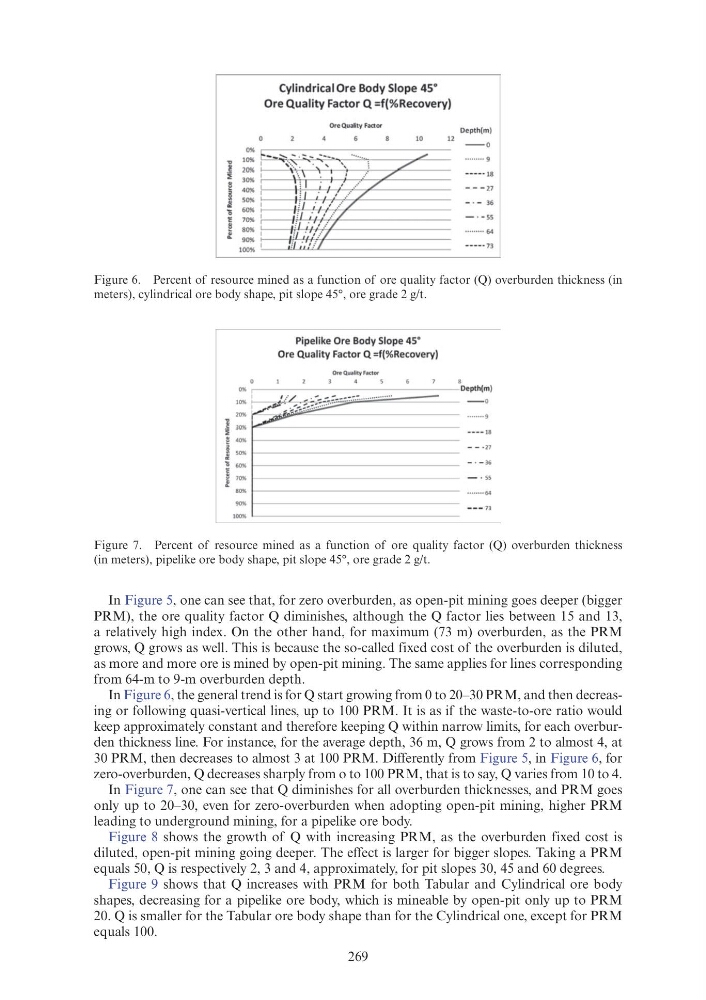
In Figure 6, the general trend is for Q start growing from 0 to 20–30 PRM, and then decreasing or following quasi-vertical lines, up to 100 PRM. It is as if the waste-to-ore ratio would
keep approximately constant and therefore keeping Q within narrow limits, for each overburden thickness line. For instance, for the average depth, 36 m, Q grows from 2 to almost 4, at
30 PRM, then decreases to almost 3 at 100 PRM. Differently from Figure 5, in Figure 6, for
zero-overburden, Q decreases sharply from o to 100 PRM, that is to say, Q varies from 10 to 4.
In Figure 7, one can see that Q diminishes for all overburden thicknesses, and PRM goes
only up to 20–30, even for zero-overburden when adopting open-pit mining, higher PRM
leading to underground mining, for a pipelike ore body.
Figure 8 shows the growth of Q with increasing PRM, as the overburden fixed cost is
diluted, open-pit mining going deeper. The effect is larger for bigger slopes. Taking a PRM
equals 50, Q is respectively 2, 3 and 4, approximately, for pit slopes 30, 45 and 60 degrees.
Figure 9 shows that Q increases with PRM for both Tabular and Cylindrical ore body
shapes, decreasing for a pipelike ore body, which is mineable by open-pit only up to PRM
20. Q is smaller for the Tabular ore body shape than for the Cylindrical one, except for PRM
equals 100.
Figure 6. Percent of resource mined as a function of ore quality factor (Q) overburden thickness (in
meters), cylindrical ore body shape, pit slope 45°, ore grade 2 g/t.
Figure 7. Percent of resource mined as a function of ore quality factor (Q) overburden thickness
(in meters), pipelike ore body shape, pit slope 45°, ore grade 2 g/t.
Cylindrical Ore Body Slope 45"
Ore Quality Factor Q =f(%Recovery)
Ore Quality Factor
10
1 2
30% r-----~T-~-r-+--~--~----------40% r-----t+~~+-~-~~£_ ____________ _
50% ~----~~~~~~~--------------60% ~~~L_Lf~~~----------------70% I
.
80%
90%
100%
Pipelike Ore Body Slope 45"
Ore Quality Factor Q =f(%Recovery)
Oepth{m)
--o
......... 9
----· 18
- - - 27
- . - 36
. - 55
......... 64
----· 73
Ore Quality f actor
'
4
5
8
O% ,-------------------------------------Depth(m)
---o
lO% 7~~~ :<~-.cc.c .... · ··
20% ~
·~ ~=----------------------------------····9
- --- 18
40% 1 ------------------------------------60%
70%
·55
80%
········ 64
90%
- - - 73
100%
In Figure 5, one can see that, for zero overburden, as open-pit mining goes deeper (bigger
PRM), the ore quality factor Q diminishes, although the Q factor lies between 15 and 13,
a relatively high index. On the other hand, for maximum (73 m) overburden, as the PRM
grows, Q grows as well. This is because the so-called fixed cost of the overburden is diluted,
as more and more ore is mined by open-pit mining. The same applies for lines corresponding
from 64-m to 9-m overburden depth.
In Figure 6, the general trend is for Q start growing from 0 to 20–30 PRM, and then decreasing or following quasi-vertical lines, up to 100 PRM. It is as if the waste-to-ore ratio would
keep approximately constant and therefore keeping Q within narrow limits, for each overburden thickness line. For instance, for the average depth, 36 m, Q grows from 2 to almost 4, at
30 PRM, then decreases to almost 3 at 100 PRM. Differently from Figure 5, in Figure 6, for
zero-overburden, Q decreases sharply from o to 100 PRM, that is to say, Q varies from 10 to 4.
In Figure 7, one can see that Q diminishes for all overburden thicknesses, and PRM goes
only up to 20–30, even for zero-overburden when adopting open-pit mining, higher PRM
leading to underground mining, for a pipelike ore body.
Figure 8 shows the growth of Q with increasing PRM, as the overburden fixed cost is
diluted, open-pit mining going deeper. The effect is larger for bigger slopes. Taking a PRM
equals 50, Q is respectively 2, 3 and 4, approximately, for pit slopes 30, 45 and 60 degrees.
Figure 9 shows that Q increases with PRM for both Tabular and Cylindrical ore body
shapes, decreasing for a pipelike ore body, which is mineable by open-pit only up to PRM
20. Q is smaller for the Tabular ore body shape than for the Cylindrical one, except for PRM
equals 100.
Figure 6. Percent of resource mined as a function of ore quality factor (Q) overburden thickness (in
meters), cylindrical ore body shape, pit slope 45°, ore grade 2 g/t.
Figure 7. Percent of resource mined as a function of ore quality factor (Q) overburden thickness
(in meters), pipelike ore body shape, pit slope 45°, ore grade 2 g/t.
Cylindrical Ore Body Slope 45"
Ore Quality Factor Q =f(%Recovery)
Ore Quality Factor
10
1 2
30% r-----~T-~-r-+--~--~----------40% r-----t+~~+-~-~~£_ ____________ _
50% ~----~~~~~~~--------------60% ~~~L_Lf~~~----------------70% I
.
80%
90%
100%
Pipelike Ore Body Slope 45"
Ore Quality Factor Q =f(%Recovery)
Oepth{m)
--o
......... 9
----· 18
- - - 27
- . - 36
. - 55
......... 64
----· 73
Ore Quality f actor
'
4
5
8
O% ,-------------------------------------Depth(m)
---o
lO% 7~~~ :<~-.cc.c .... · ··
20% ~
·~ ~=----------------------------------····9
- --- 18
40% 1 ------------------------------------60%
70%
·55
80%
········ 64
90%
- - - 73
100%