

270
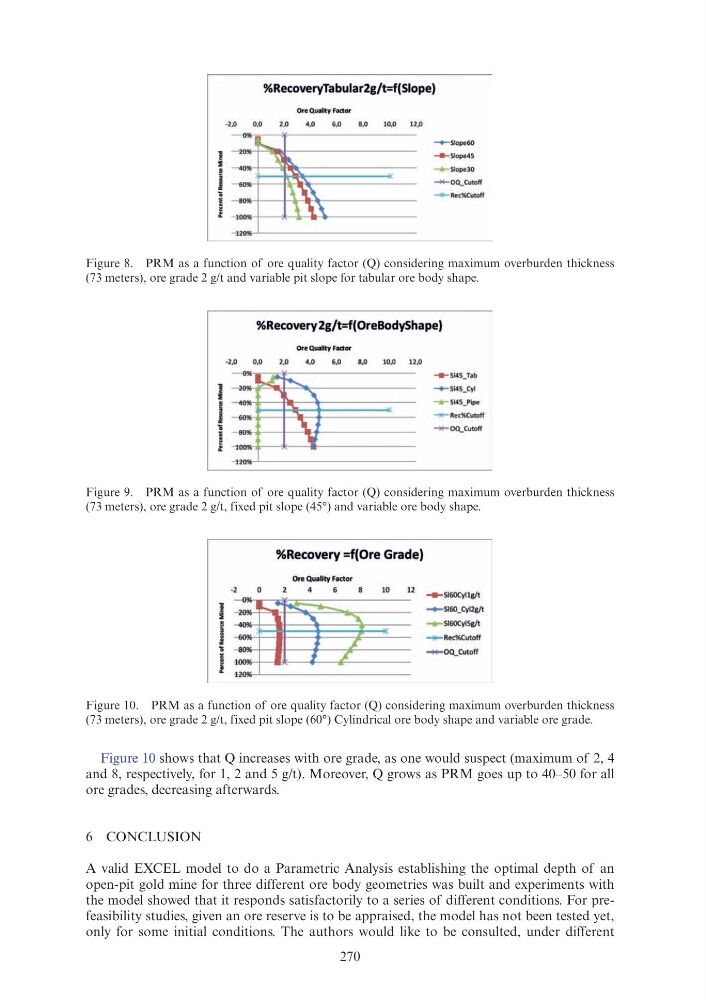
Figure 10 shows that Q increases with ore grade, as one would suspect (maximum of 2, 4
and 8, respectively, for 1, 2 and 5 g/t). Moreover, Q grows as PRM goes up to 40–50 for all
ore grades, decreasing afterwards.
6 CONCLUSION
A valid EXCEL model to do a Parametric Analysis establishing the optimal depth of an
open-pit gold mine for three different ore body geometries was built and experiments with
the model showed that it responds satisfactorily to a series of different conditions. For prefeasibility studies, given an ore reserve is to be appraised, the model has not been tested yet,
only for some initial conditions. The authors would like to be consulted, under different
Figure 8. PRM as a function of ore quality factor (Q) considering maximum overburden thickness
(73 meters), ore grade 2 g/t and variable pit slope for tabular ore body shape.
Figure 9. PRM as a function of ore quality factor (Q) considering maximum overburden thickness
(73 meters), ore grade 2 g/t, fixed pit slope (45°) and variable ore body shape.
Figure 10. PRM as a function of ore quality factor (Q) considering maximum overburden thickness
(73 meters), ore grade 2 g/t, fixed pit slope (60°) Cylindrical ore body shape and variable ore grade.
%RecoveryTabular2g/t=f(Siope)
Ore Qualit y Facto r
-2,0
0,0
2,0
4,0
6,0
- 26% .......
- 40
"\;) ~
--.;
1 '\ "''t '\
---il
~ lt\
--100
-H
8,0
10,0
12,0
~ Slope GO
---Siope45
-+-Slope 3D
~ OQ_Cutoff
~ Re c%Cutoff
%Recovery2g/t=f(OreBodyShape)
Ore Quality Factor
-2,0
0,0
2,0
4,0
6,0
8,0
10,0
12,0
---za ~ .......... '
--.;
-....
-s
~
-H
%Recovery =f(Ore Grade)
Ore Quality Factor
-2
4
6
10
12
~ SI45_Tab
.....-sl4s_cvl
......... $1 4S_Pipe
~ Re c%Cutoff
~ OQ_Cutoff
-
SI60Cyl1g/t
- -SI60_Cyl2g/t
...,._SI60Cy1Sg/ t
~ Rec%Cutoff
~ OQ_Cutoff
Figure 10 shows that Q increases with ore grade, as one would suspect (maximum of 2, 4
and 8, respectively, for 1, 2 and 5 g/t). Moreover, Q grows as PRM goes up to 40–50 for all
ore grades, decreasing afterwards.
6 CONCLUSION
A valid EXCEL model to do a Parametric Analysis establishing the optimal depth of an
open-pit gold mine for three different ore body geometries was built and experiments with
the model showed that it responds satisfactorily to a series of different conditions. For prefeasibility studies, given an ore reserve is to be appraised, the model has not been tested yet,
only for some initial conditions. The authors would like to be consulted, under different
Figure 8. PRM as a function of ore quality factor (Q) considering maximum overburden thickness
(73 meters), ore grade 2 g/t and variable pit slope for tabular ore body shape.
Figure 9. PRM as a function of ore quality factor (Q) considering maximum overburden thickness
(73 meters), ore grade 2 g/t, fixed pit slope (45°) and variable ore body shape.
Figure 10. PRM as a function of ore quality factor (Q) considering maximum overburden thickness
(73 meters), ore grade 2 g/t, fixed pit slope (60°) Cylindrical ore body shape and variable ore grade.
%RecoveryTabular2g/t=f(Siope)
Ore Qualit y Facto r
-2,0
0,0
2,0
4,0
6,0
- 26% .......
- 40
"\;) ~
--.;
1 '\ "''t '\
---il
~ lt\
--100
-H
8,0
10,0
12,0
~ Slope GO
---Siope45
-+-Slope 3D
~ OQ_Cutoff
~ Re c%Cutoff
%Recovery2g/t=f(OreBodyShape)
Ore Quality Factor
-2,0
0,0
2,0
4,0
6,0
8,0
10,0
12,0
---za ~ .......... '
--.;
-....
-s
~
-H
%Recovery =f(Ore Grade)
Ore Quality Factor
-2
4
6
10
12
~ SI45_Tab
.....-sl4s_cvl
......... $1 4S_Pipe
~ Re c%Cutoff
~ OQ_Cutoff
-
SI60Cyl1g/t
- -SI60_Cyl2g/t
...,._SI60Cy1Sg/ t
~ Rec%Cutoff
~ OQ_Cutoff