

267
SR
Cug Cop C C
Cw
=
(4)
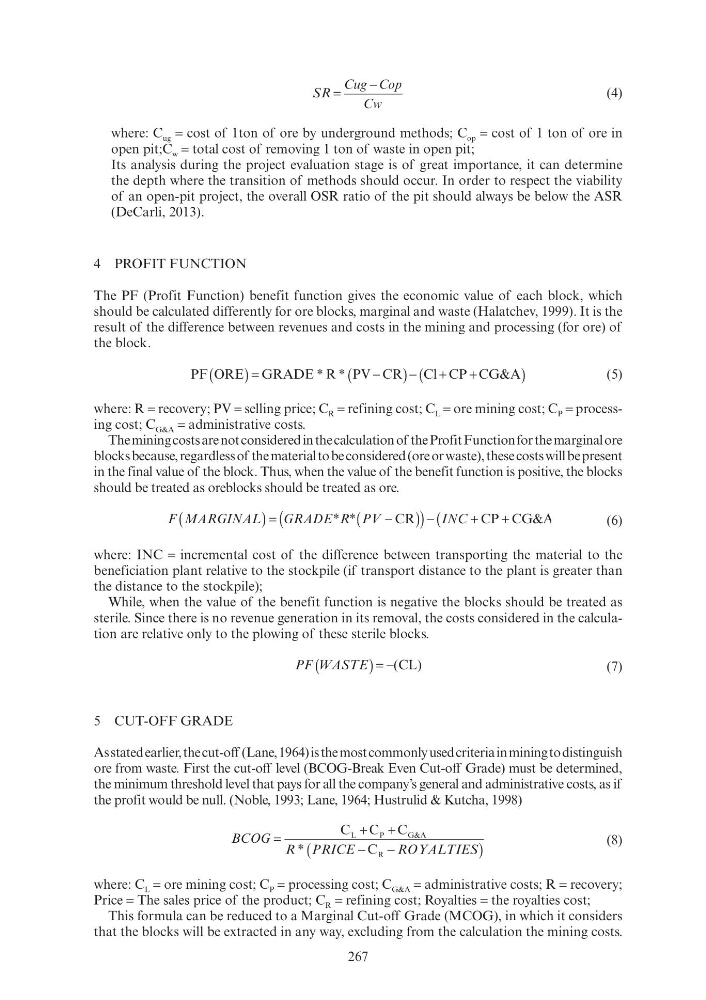
where: C ug = cost of 1ton of ore by underground methods; C op = cost of 1 ton of ore in
open pit;C w = total cost of removing 1 ton of waste in open pit;
Its analysis during the project evaluation stage is of great importance, it can determine
the depth where the transition of methods should occur. In order to respect the viability
of an open-pit project, the overall OSR ratio of the pit should always be below the ASR
(DeCarli, 2013).
4 PROFIT FUNCTION
The PF (Profit Function) benefit function gives the economic value of each block, which
should be calculated differently for ore blocks, marginal and waste (Halatchev, 1999). It is the
result of the difference between revenues and costs in the mining and processing (for ore) of
the block.
PF
GRADE * R *
(
)
ORE = GRADE * R * (
)
PV CR
−
PV
− (
)
Cl CP CG&A
+
Cl
+
(5)
where: R = recovery; PV = selling price; C R = refining cost; C L = ore mining cost; C P = processing cost; C G&A = administrative costs.
The mining costs are not considered in the calculation of the Profit Function for the marginal ore
blocks because, regardless of the material to be considered (ore or waste), these costs will be present
in the final value of the block. Thus, when the value of the benefit function is positive, the blocks
should be treated as oreblocks should be treated as ore.
F
GRADE R
(
)
MARGINAL M M
GRADE R
=
(
)
PV −
PV
(
) − (INC +
INC
+
* *
R R
(6)
where: INC = incremental cost of the difference between transporting the material to the
beneficiation plant relative to the stockpile (if transport distance to the plant is greater than
the distance to the stockpile);
While, when the value of the benefit function is negative the blocks should be treated as
sterile. Since there is no revenue generation in its removal, the costs considered in the calculation are relative only to the plowing of these sterile blocks.
PF (
)
WASTE T T = −(CL)
(7)
5 CUT-OFF GRADE
As stated earlier, the cut-off (Lane, 1964) is the most commonly used criteria in mining to distinguish
ore from waste. First the cut-off level (BCOG-Break Even Cut-off Grade) must be determined,
the minimum threshold level that pays for all the company’s general and administrative costs, as if
the profit would be null. (Noble, 1993; Lane, 1964; Hustrulid & Kutcha, 1998)
BCOG
R
=
+
(
)
ROYALTIES
−
C C
+
C
* ( PRICE −
L
P
C
+
G&A
(8)
where: C L = ore mining cost; C P = processing cost; C G&A = administrative costs; R = recovery;
Price = The sales price of the product; C R = refining cost; Royalties = the royalties cost;
This formula can be reduced to a Marginal Cut-off Grade (MCOG), in which it considers
that the blocks will be extracted in any way, excluding from the calculation the mining costs.
SR
Cug Cop C C
Cw
=
(4)
where: C ug = cost of 1ton of ore by underground methods; C op = cost of 1 ton of ore in
open pit;C w = total cost of removing 1 ton of waste in open pit;
Its analysis during the project evaluation stage is of great importance, it can determine
the depth where the transition of methods should occur. In order to respect the viability
of an open-pit project, the overall OSR ratio of the pit should always be below the ASR
(DeCarli, 2013).
4 PROFIT FUNCTION
The PF (Profit Function) benefit function gives the economic value of each block, which
should be calculated differently for ore blocks, marginal and waste (Halatchev, 1999). It is the
result of the difference between revenues and costs in the mining and processing (for ore) of
the block.
PF
GRADE * R *
(
)
ORE = GRADE * R * (
)
PV CR
−
PV
− (
)
Cl CP CG&A
+
Cl
+
(5)
where: R = recovery; PV = selling price; C R = refining cost; C L = ore mining cost; C P = processing cost; C G&A = administrative costs.
The mining costs are not considered in the calculation of the Profit Function for the marginal ore
blocks because, regardless of the material to be considered (ore or waste), these costs will be present
in the final value of the block. Thus, when the value of the benefit function is positive, the blocks
should be treated as oreblocks should be treated as ore.
F
GRADE R
(
)
MARGINAL M M
GRADE R
=
(
)
PV −
PV
(
) − (INC +
INC
+
* *
R R
(6)
where: INC = incremental cost of the difference between transporting the material to the
beneficiation plant relative to the stockpile (if transport distance to the plant is greater than
the distance to the stockpile);
While, when the value of the benefit function is negative the blocks should be treated as
sterile. Since there is no revenue generation in its removal, the costs considered in the calculation are relative only to the plowing of these sterile blocks.
PF (
)
WASTE T T = −(CL)
(7)
5 CUT-OFF GRADE
As stated earlier, the cut-off (Lane, 1964) is the most commonly used criteria in mining to distinguish
ore from waste. First the cut-off level (BCOG-Break Even Cut-off Grade) must be determined,
the minimum threshold level that pays for all the company’s general and administrative costs, as if
the profit would be null. (Noble, 1993; Lane, 1964; Hustrulid & Kutcha, 1998)
BCOG
R
=
+
(
)
ROYALTIES
−
C C
+
C
* ( PRICE −
L
P
C
+
G&A
(8)
where: C L = ore mining cost; C P = processing cost; C G&A = administrative costs; R = recovery;
Price = The sales price of the product; C R = refining cost; Royalties = the royalties cost;
This formula can be reduced to a Marginal Cut-off Grade (MCOG), in which it considers
that the blocks will be extracted in any way, excluding from the calculation the mining costs.