

266
unfeasible. The cutoff grade is the limiting content at which mineral exploitation becomes
unpractical, its value involves a series of variables, which must be well studied in order to
obtain an ideal value. The choice of cut-off grade can directly affect the profits of a company, since it can modify the economy and even the viability of the deposit by increasing or
decreasing the exploitable reserves.
3 CHOOSING THE MODEL
For the present work an open pit mine was chosen. In general, the Open-Pit (OP) method
predominates over Underground (Ug) in the world, as it allows greater recovery, flexibility
and safety, while the second method is more expensive and dangerous, being mainly used
when the bulk mineral is found at greater depths. Some deposits can be mined entirely by
one of these methods or by the combination of both. Thus, in order to discover the transition depth (TD – Transition Depth) between one and another, it is necessary to compare the
economic efficiencies of its operation, except when the advantages of one of them are totally
obvious (Bakhtavar et al., 2002).
The most used way in this evaluation is the waste-ore ratio, also called Stripping Ratio
(SR), which represents the amount of non-economic material that must be removed (waste)
to remove an ore unit (Hartman, 1992) expressed in m
3
/m; t/t; or m
3 /t.
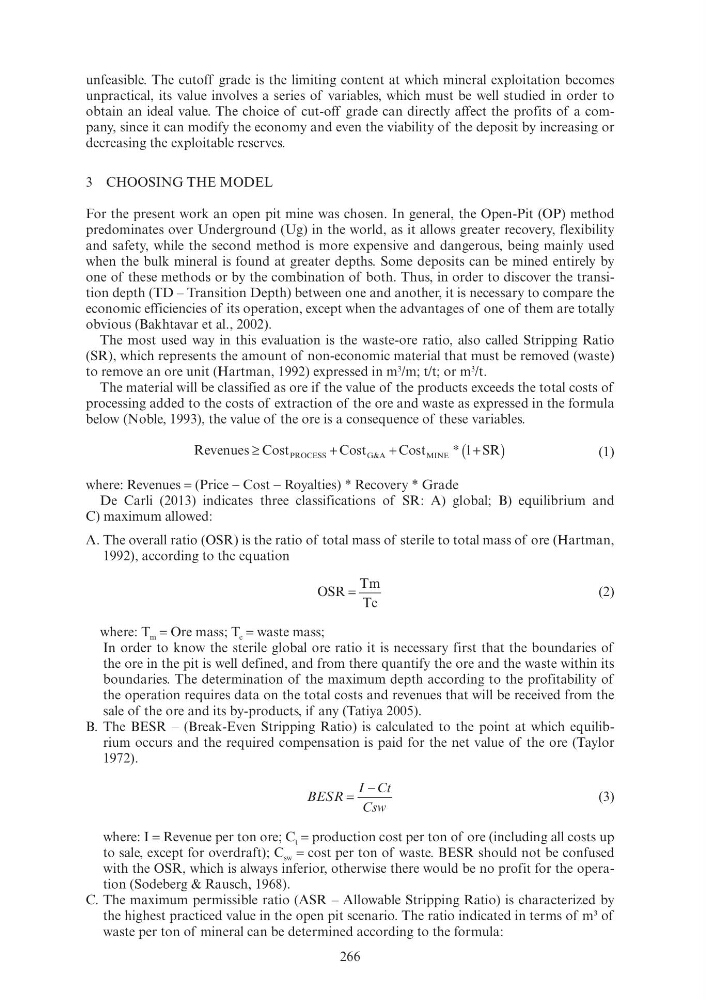
The material will be classified as ore if the value of the products exceeds the total costs of
processing added to the costs of extraction of the ore and waste as expressed in the formula
below (Noble, 1993), the value of the ore is a consequence of these variables.
Revenues Cost
C ost
Cost
*
PROCESS
G
Cost &A
MINE
Cost
Cost
* (
)
SR
+
(1)
where: Revenues = (Price − Cost − Royalties) * Recovery * Grade
De Carli (2013) indicates three classifications of SR: A) global; B) equilibrium and
C) maximum allowed:
A. The overall ratio (OSR) is the ratio of total mass of sterile to total mass of ore (Hartman,
1992), according to the equation
OSR
Tm
Te
=
(2)
where: T m = Ore mass; T e = waste mass;
In order to know the sterile global ore ratio it is necessary first that the boundaries of
the ore in the pit is well defined, and from there quantify the ore and the waste within its
boundaries. The determination of the maximum depth according to the profitability of
the operation requires data on the total costs and revenues that will be received from the
sale of the ore and its by-products, if any (Tatiya 2005).
B. The BESR – (Break-Even Stripping Ratio) is calculated to the point at which equilibrium occurs and the required compensation is paid for the net value of the ore (Taylor
1972).
BESR
I Ct
Csw
=
(3)
where: I = Revenue per ton ore; C t = production cost per ton of ore (including all costs up
to sale, except for overdraft); C sw = cost per ton of waste. BESR should not be confused
with the OSR, which is always inferior, otherwise there would be no profit for the operation (Sodeberg & Rausch, 1968).
C. The maximum permissible ratio (ASR – Allowable Stripping Ratio) is characterized by
the highest practiced value in the open pit scenario. The ratio indicated in terms of m3 of
waste per ton of mineral can be determined according to the formula:
unfeasible. The cutoff grade is the limiting content at which mineral exploitation becomes
unpractical, its value involves a series of variables, which must be well studied in order to
obtain an ideal value. The choice of cut-off grade can directly affect the profits of a company, since it can modify the economy and even the viability of the deposit by increasing or
decreasing the exploitable reserves.
3 CHOOSING THE MODEL
For the present work an open pit mine was chosen. In general, the Open-Pit (OP) method
predominates over Underground (Ug) in the world, as it allows greater recovery, flexibility
and safety, while the second method is more expensive and dangerous, being mainly used
when the bulk mineral is found at greater depths. Some deposits can be mined entirely by
one of these methods or by the combination of both. Thus, in order to discover the transition depth (TD – Transition Depth) between one and another, it is necessary to compare the
economic efficiencies of its operation, except when the advantages of one of them are totally
obvious (Bakhtavar et al., 2002).
The most used way in this evaluation is the waste-ore ratio, also called Stripping Ratio
(SR), which represents the amount of non-economic material that must be removed (waste)
to remove an ore unit (Hartman, 1992) expressed in m
3
/m; t/t; or m
3 /t.
The material will be classified as ore if the value of the products exceeds the total costs of
processing added to the costs of extraction of the ore and waste as expressed in the formula
below (Noble, 1993), the value of the ore is a consequence of these variables.
Revenues Cost
C ost
Cost
*
PROCESS
G
Cost &A
MINE
Cost
Cost
* (
)
SR
+
(1)
where: Revenues = (Price − Cost − Royalties) * Recovery * Grade
De Carli (2013) indicates three classifications of SR: A) global; B) equilibrium and
C) maximum allowed:
A. The overall ratio (OSR) is the ratio of total mass of sterile to total mass of ore (Hartman,
1992), according to the equation
OSR
Tm
Te
=
(2)
where: T m = Ore mass; T e = waste mass;
In order to know the sterile global ore ratio it is necessary first that the boundaries of
the ore in the pit is well defined, and from there quantify the ore and the waste within its
boundaries. The determination of the maximum depth according to the profitability of
the operation requires data on the total costs and revenues that will be received from the
sale of the ore and its by-products, if any (Tatiya 2005).
B. The BESR – (Break-Even Stripping Ratio) is calculated to the point at which equilibrium occurs and the required compensation is paid for the net value of the ore (Taylor
1972).
BESR
I Ct
Csw
=
(3)
where: I = Revenue per ton ore; C t = production cost per ton of ore (including all costs up
to sale, except for overdraft); C sw = cost per ton of waste. BESR should not be confused
with the OSR, which is always inferior, otherwise there would be no profit for the operation (Sodeberg & Rausch, 1968).
C. The maximum permissible ratio (ASR – Allowable Stripping Ratio) is characterized by
the highest practiced value in the open pit scenario. The ratio indicated in terms of m3 of
waste per ton of mineral can be determined according to the formula: