

222
when drilling through a broken rock mass as it has the tendency to stall the drill bit (Schunnesson, 1996). The Rock strength, fractures and voids can affect the penetration rate (Segui
& Higgins, 2002). The peaks on the logs of penetration rate to depth show the presence of
fractures, and widths of these peaks indicate the fractures’ aperture size (Khorzoughi, 2013).
As the drill bit encounters an open fracture, penetration rate increases and rotary torque
decreases, as there is no resistance based on the aperture size (Khorzoughi, 2013). The feed
pressure and pull down pressure show a slight drop as well, because there is no engagement
of the drill bit with the rock mass (Khorzoughi, 2013).
3.2 Structural data analysis
The ‘SMX Analyst’ tool of ShapeMetriX3D, which is very useful tool for present purposes,
(Gaich, et al., 2006; Haneberg, 2008; Vasuki, et al., 2014; Beyglou, 2016; Buyer & Schubert,
2017) was used to analyze the structural parameters of the 3D models,. Analysis included the
following steps:
− Marking structures on bench face;
− Adding scanlines at borehole locations;
− Determining depth of structures along scanlines.
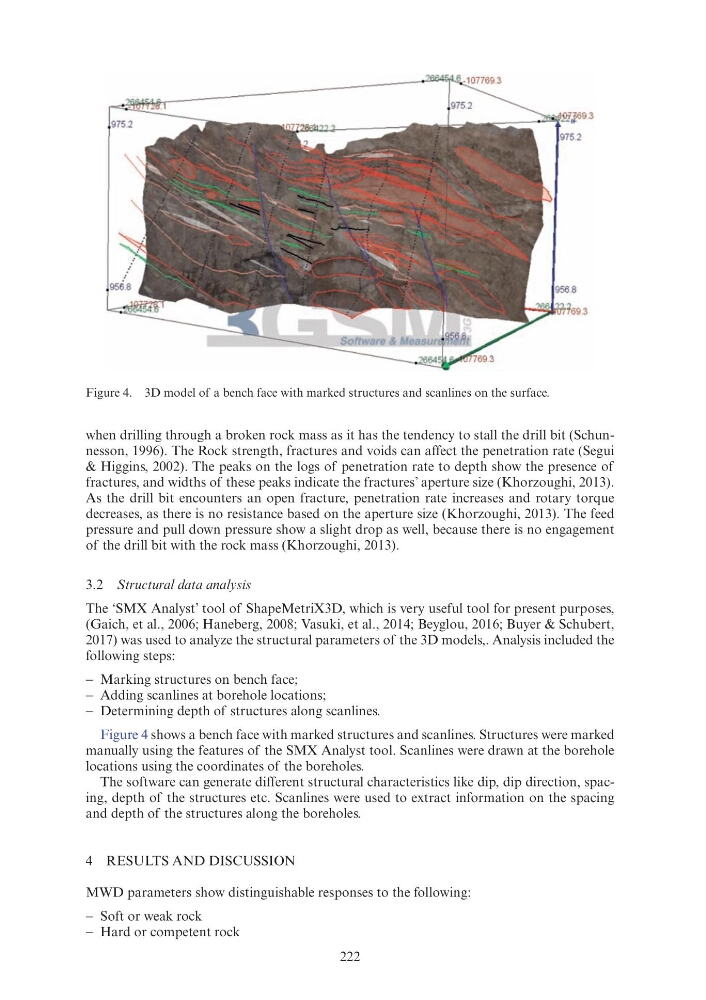
Figure 4 shows a bench face with marked structures and scanlines. Structures were marked
manually using the features of the SMX Analyst tool. Scanlines were drawn at the borehole
locations using the coordinates of the boreholes.
The software can generate different structural characteristics like dip, dip direction, spacing, depth of the structures etc. Scanlines were used to extract information on the spacing
and depth of the structures along the boreholes.
4 RESULTS AND DISCUSSION
MWD parameters show distinguishable responses to the following:
− Soft or weak rock
− Hard or competent rock
Figure 4. 3D model of a bench face with marked structures and scanlines on the surface.
when drilling through a broken rock mass as it has the tendency to stall the drill bit (Schunnesson, 1996). The Rock strength, fractures and voids can affect the penetration rate (Segui
& Higgins, 2002). The peaks on the logs of penetration rate to depth show the presence of
fractures, and widths of these peaks indicate the fractures’ aperture size (Khorzoughi, 2013).
As the drill bit encounters an open fracture, penetration rate increases and rotary torque
decreases, as there is no resistance based on the aperture size (Khorzoughi, 2013). The feed
pressure and pull down pressure show a slight drop as well, because there is no engagement
of the drill bit with the rock mass (Khorzoughi, 2013).
3.2 Structural data analysis
The ‘SMX Analyst’ tool of ShapeMetriX3D, which is very useful tool for present purposes,
(Gaich, et al., 2006; Haneberg, 2008; Vasuki, et al., 2014; Beyglou, 2016; Buyer & Schubert,
2017) was used to analyze the structural parameters of the 3D models,. Analysis included the
following steps:
− Marking structures on bench face;
− Adding scanlines at borehole locations;
− Determining depth of structures along scanlines.
Figure 4 shows a bench face with marked structures and scanlines. Structures were marked
manually using the features of the SMX Analyst tool. Scanlines were drawn at the borehole
locations using the coordinates of the boreholes.
The software can generate different structural characteristics like dip, dip direction, spacing, depth of the structures etc. Scanlines were used to extract information on the spacing
and depth of the structures along the boreholes.
4 RESULTS AND DISCUSSION
MWD parameters show distinguishable responses to the following:
− Soft or weak rock
− Hard or competent rock
Figure 4. 3D model of a bench face with marked structures and scanlines on the surface.