

179
3 CONSTRUCTION OF UNSTRUCTURED GRID
The construction of the unstructured grid requires the surfaces of the top and base of the ore
seam. These surfaces were obtained through the estimation of the Z coordinate of the top of
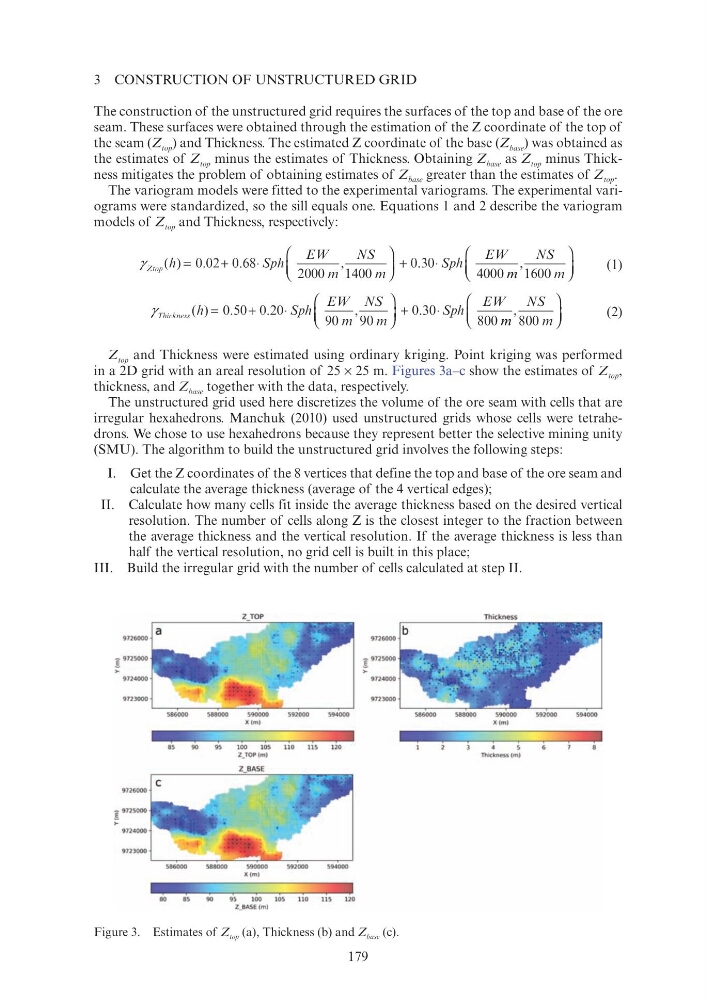
the seam (Z top ) and Thickness. The estimated Z coordinate of the base (Z base ) was obtained as
the estimates of Z top minus the estimates of Thickness. Obtaining Z base as Z top minus Thickness mitigates the problem of obtaining estimates of Z base greater than the estimates of Z top .
The variogram models were fitted to the experimental variograms. The experimental variograms were standardized, so the sill equals one. Equations 1 and 2 describe the variogram
models of Z top and Thickness, respectively:
γ Ztop
γ
h
S ph
S
EW
m
NS
m
Sph
EW
( )
h
,
.
⎛
⎝ ⎜
⎛ ⎛
⎝ ⎝
⎞
⎠ ⎟
⎞ ⎞
⎠ ⎠
+
⋅
2000 1400
0 3
. . 0
4000 m m
NS
m
,
1600
⎛
⎝ ⎜
⎛ ⎛
⎝ ⎝
⎞
⎠ ⎟
⎞ ⎞
⎠ ⎠
(1)
γ Thicknes
γ
s h
S ph
S
EW
m
NS
m
Sph
EW
( )
h
,
.
⎛
⎝ ⎜
⎛ ⎛
⎝ ⎝
⎞
⎠ ⎟
⎞ ⎞
⎠ ⎠
+
⋅
90
90
0 3
. . 0
800 m m
NS
m
,
800
⎛
⎝ ⎜
⎛ ⎛
⎝ ⎝
⎞
⎠ ⎟
⎞ ⎞
⎠ ⎠
(2)
Z top and Thickness were estimated using ordinary kriging. Point kriging was performed
in a 2D grid with an areal resolution of 25 × 25 m. Figures 3a–c show the estimates of Z top ,
thickness, and Z base together with the data, respectively.
The unstructured grid used here discretizes the volume of the ore seam with cells that are
irregular hexahedrons. Manchuk (2010) used unstructured grids whose cells were tetrahedrons. We chose to use hexahedrons because they represent better the selective mining unity
(SMU). The algorithm to build the unstructured grid involves the following steps:
I. Get the Z coordinates of the 8 vertices that define the top and base of the ore seam and
calculate the average thickness (average of the 4 vertical edges);
II. Calculate how many cells fit inside the average thickness based on the desired vertical
resolution. The number of cells along Z is the closest integer to the fraction between
the average thickness and the vertical resolution. If the average thickness is less than
half the vertical resolution, no grid cell is built in this place;
III. Build the irregular grid with the number of cells calculated at step II.
Figure 3. Estimates of Z top (a), Thickness (b) and Z base (c).
9726000
§: 9725000
~
9724000
9723000
592000
X(m)
8S
90
9S
100
lOS
llO
llS
120
Z_TOP(m)
ThicKness (m)
9726000
§: 9725000
~
9724000
9723000
X(m)
80
8S
90
9S
100
lOS
llO
llS
120
Z_BA5E (m)
3 CONSTRUCTION OF UNSTRUCTURED GRID
The construction of the unstructured grid requires the surfaces of the top and base of the ore
seam. These surfaces were obtained through the estimation of the Z coordinate of the top of
the seam (Z top ) and Thickness. The estimated Z coordinate of the base (Z base ) was obtained as
the estimates of Z top minus the estimates of Thickness. Obtaining Z base as Z top minus Thickness mitigates the problem of obtaining estimates of Z base greater than the estimates of Z top .
The variogram models were fitted to the experimental variograms. The experimental variograms were standardized, so the sill equals one. Equations 1 and 2 describe the variogram
models of Z top and Thickness, respectively:
γ Ztop
γ
h
S ph
S
EW
m
NS
m
Sph
EW
( )
h
,
.
⎛
⎝ ⎜
⎛ ⎛
⎝ ⎝
⎞
⎠ ⎟
⎞ ⎞
⎠ ⎠
+
⋅
2000 1400
0 3
. . 0
4000 m m
NS
m
,
1600
⎛
⎝ ⎜
⎛ ⎛
⎝ ⎝
⎞
⎠ ⎟
⎞ ⎞
⎠ ⎠
(1)
γ Thicknes
γ
s h
S ph
S
EW
m
NS
m
Sph
EW
( )
h
,
.
⎛
⎝ ⎜
⎛ ⎛
⎝ ⎝
⎞
⎠ ⎟
⎞ ⎞
⎠ ⎠
+
⋅
90
90
0 3
. . 0
800 m m
NS
m
,
800
⎛
⎝ ⎜
⎛ ⎛
⎝ ⎝
⎞
⎠ ⎟
⎞ ⎞
⎠ ⎠
(2)
Z top and Thickness were estimated using ordinary kriging. Point kriging was performed
in a 2D grid with an areal resolution of 25 × 25 m. Figures 3a–c show the estimates of Z top ,
thickness, and Z base together with the data, respectively.
The unstructured grid used here discretizes the volume of the ore seam with cells that are
irregular hexahedrons. Manchuk (2010) used unstructured grids whose cells were tetrahedrons. We chose to use hexahedrons because they represent better the selective mining unity
(SMU). The algorithm to build the unstructured grid involves the following steps:
I. Get the Z coordinates of the 8 vertices that define the top and base of the ore seam and
calculate the average thickness (average of the 4 vertical edges);
II. Calculate how many cells fit inside the average thickness based on the desired vertical
resolution. The number of cells along Z is the closest integer to the fraction between
the average thickness and the vertical resolution. If the average thickness is less than
half the vertical resolution, no grid cell is built in this place;
III. Build the irregular grid with the number of cells calculated at step II.
Figure 3. Estimates of Z top (a), Thickness (b) and Z base (c).
9726000
§: 9725000
~
9724000
9723000
592000
X(m)
8S
90
9S
100
lOS
llO
llS
120
Z_TOP(m)
ThicKness (m)
9726000
§: 9725000
~
9724000
9723000
X(m)
80
8S
90
9S
100
lOS
llO
llS
120
Z_BA5E (m)