

149
4.3.6 Operational development constraints
These constraints ensure that the required operational developments are considered when
underground mining is the preferred option for extracting the ore body. These set of constraints define the operational development requirements including the type and length of
each operational development (level, ore drive, crosscuts) and lateral precedence relations
with the block extraction sequence.
5 COMPUTATIONAL IMPLEMENTATION OF THE MILP MODEL
5.1 Preparation of the model
The formulated MILP model was implemented with an experimental case study. MATLAB
2018a (Mathworks, 2018) environment was used to define the modelled framework and IBM
ILOG CPLEX Optimization Studio (ILOG, 2015) was integrated into MATLAB to solve
the MILP at a gap tolerance of 5%. The model was tested on an Intel(R) Core™ i7-7700HQ
CPU Dell computer @ 2.80GHz, with 32 GB RAM.
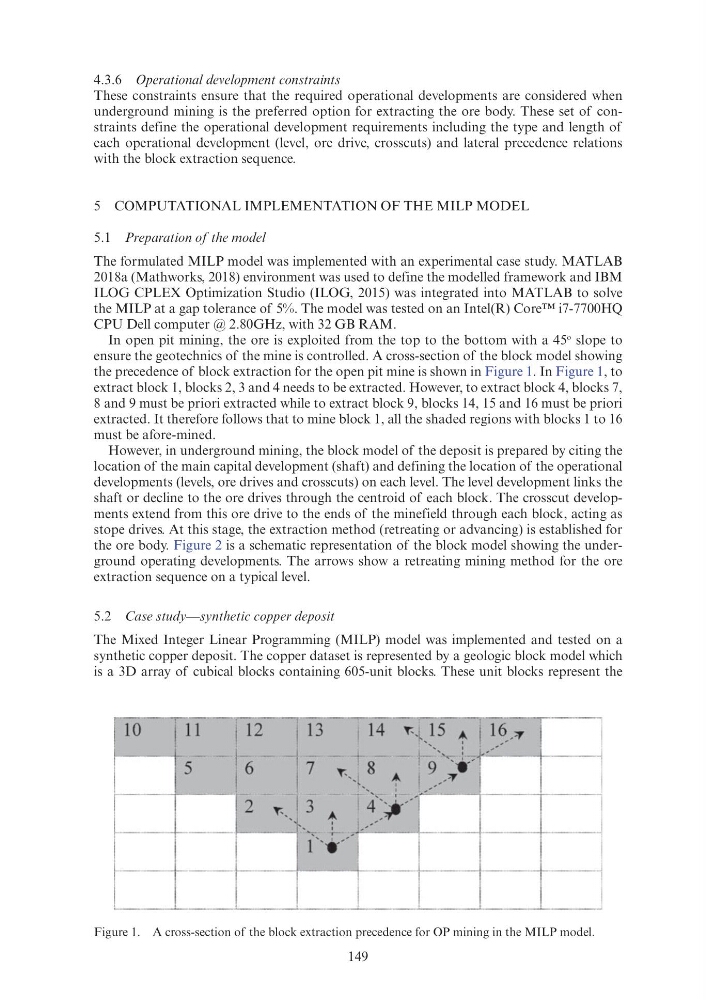
In open pit mining, the ore is exploited from the top to the bottom with a 45
o slope to
ensure the geotechnics of the mine is controlled. A cross-section of the block model showing
the precedence of block extraction for the open pit mine is shown in Figure 1. In Figure 1, to
extract block 1, blocks 2, 3 and 4 needs to be extracted. However, to extract block 4, blocks 7,
8 and 9 must be priori extracted while to extract block 9, blocks 14, 15 and 16 must be priori
extracted. It therefore follows that to mine block 1, all the shaded regions with blocks 1 to 16
must be afore-mined.
However, in underground mining, the block model of the deposit is prepared by citing the
location of the main capital development (shaft) and defining the location of the operational
developments (levels, ore drives and crosscuts) on each level. The level development links the
shaft or decline to the ore drives through the centroid of each block. The crosscut developments extend from this ore drive to the ends of the minefield through each block, acting as
stope drives. At this stage, the extraction method (retreating or advancing) is established for
the ore body. Figure 2 is a schematic representation of the block model showing the underground operating developments. The arrows show a retreating mining method for the ore
extraction sequence on a typical level.
5.2 Case study—synthetic copper deposit
The Mixed Integer Linear Programming (MILP) model was implemented and tested on a
synthetic copper deposit. The copper dataset is represented by a geologic block model which
is a 3D array of cubical blocks containing 605-unit blocks. These unit blocks represent the
Figure 1. A cross-section of the block extraction precedence for OP mining in the MILP model.
10
11
12
'"··············~···-··-···
5
6
2 ~- '
13
14 ~ -~5 t -~-~-~
'~"·+····································+················ + 7 ·········· · ······ · ················+ 8 . ............... . i 9:,,~~>
~··+···········-········· .. i
>-. t -----~
,,_3
__ :~~~- -- - · · · · · · · · · · · · · · · · · · · ·· · · · · ·· · · · · · · · · · ·
4.3.6 Operational development constraints
These constraints ensure that the required operational developments are considered when
underground mining is the preferred option for extracting the ore body. These set of constraints define the operational development requirements including the type and length of
each operational development (level, ore drive, crosscuts) and lateral precedence relations
with the block extraction sequence.
5 COMPUTATIONAL IMPLEMENTATION OF THE MILP MODEL
5.1 Preparation of the model
The formulated MILP model was implemented with an experimental case study. MATLAB
2018a (Mathworks, 2018) environment was used to define the modelled framework and IBM
ILOG CPLEX Optimization Studio (ILOG, 2015) was integrated into MATLAB to solve
the MILP at a gap tolerance of 5%. The model was tested on an Intel(R) Core™ i7-7700HQ
CPU Dell computer @ 2.80GHz, with 32 GB RAM.
In open pit mining, the ore is exploited from the top to the bottom with a 45
o slope to
ensure the geotechnics of the mine is controlled. A cross-section of the block model showing
the precedence of block extraction for the open pit mine is shown in Figure 1. In Figure 1, to
extract block 1, blocks 2, 3 and 4 needs to be extracted. However, to extract block 4, blocks 7,
8 and 9 must be priori extracted while to extract block 9, blocks 14, 15 and 16 must be priori
extracted. It therefore follows that to mine block 1, all the shaded regions with blocks 1 to 16
must be afore-mined.
However, in underground mining, the block model of the deposit is prepared by citing the
location of the main capital development (shaft) and defining the location of the operational
developments (levels, ore drives and crosscuts) on each level. The level development links the
shaft or decline to the ore drives through the centroid of each block. The crosscut developments extend from this ore drive to the ends of the minefield through each block, acting as
stope drives. At this stage, the extraction method (retreating or advancing) is established for
the ore body. Figure 2 is a schematic representation of the block model showing the underground operating developments. The arrows show a retreating mining method for the ore
extraction sequence on a typical level.
5.2 Case study—synthetic copper deposit
The Mixed Integer Linear Programming (MILP) model was implemented and tested on a
synthetic copper deposit. The copper dataset is represented by a geologic block model which
is a 3D array of cubical blocks containing 605-unit blocks. These unit blocks represent the
Figure 1. A cross-section of the block extraction precedence for OP mining in the MILP model.
10
11
12
'"··············~···-··-···
5
6
2 ~- '
13
14 ~ -~5 t -~-~-~
'~"·+····································+················ + 7 ·········· · ······ · ················+ 8 . ............... . i 9:,,~~>
~··+···········-········· .. i
>-. t -----~
,,_3
__ :~~~- -- - · · · · · · · · · · · · · · · · · · · ·· · · · · ·· · · · · · · · · · ·