

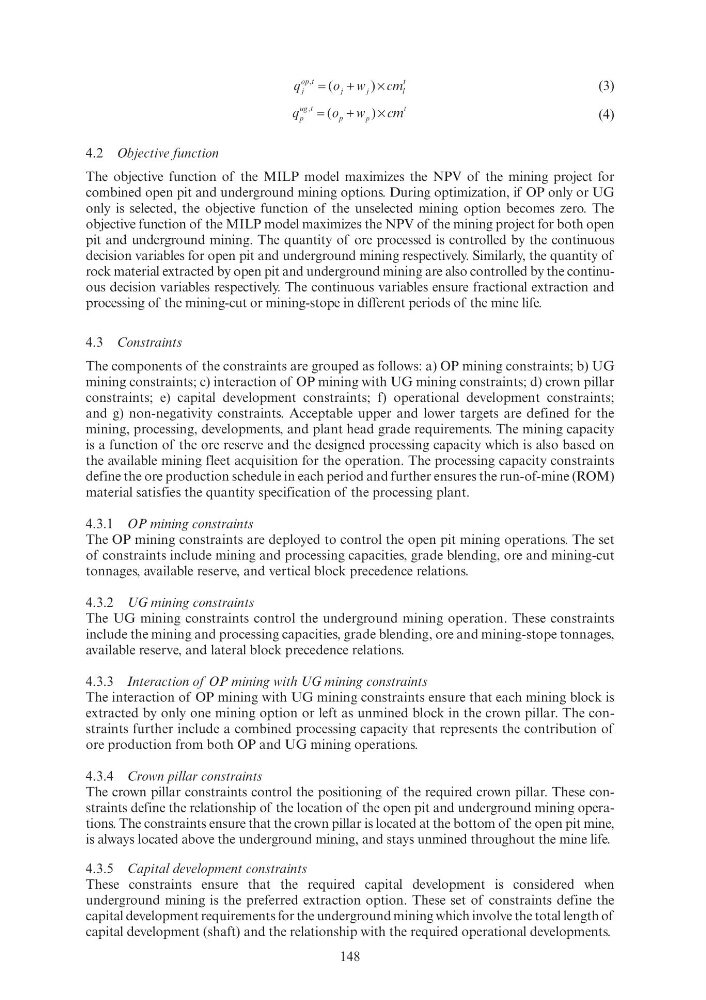
148
q
cm
j
op t
j
j
l
t
,
(
)
o w
j
j
w
(o j
×
(3)
q
cm
p
ug t
p
p
t
,
(
)
o w
p
p
o w
(o p
o
×
(4)
4.2 Objective function
The objective function of the MILP model maximizes the NPV of the mining project for
combined open pit and underground mining options. During optimization, if OP only or UG
only is selected, the objective function of the unselected mining option becomes zero. The
objective function of the MILP model maximizes the NPV of the mining project for both open
pit and underground mining. The quantity of ore processed is controlled by the continuous
decision variables for open pit and underground mining respectively. Similarly, the quantity of
rock material extracted by open pit and underground mining are also controlled by the continuous decision variables respectively. The continuous variables ensure fractional extraction and
processing of the mining-cut or mining-stope in different periods of the mine life.
4.3 Constraints
The components of the constraints are grouped as follows: a) OP mining constraints; b) UG
mining constraints; c) interaction of OP mining with UG mining constraints; d) crown pillar
constraints; e) capital development constraints; f) operational development constraints;
and g) non-negativity constraints. Acceptable upper and lower targets are defined for the
mining, processing, developments, and plant head grade requirements. The mining capacity
is a function of the ore reserve and the designed processing capacity which is also based on
the available mining fleet acquisition for the operation. The processing capacity constraints
define the ore production schedule in each period and further ensures the run-of-mine (ROM)
material satisfies the quantity specification of the processing plant.
4.3.1 OP mining constraints
The OP mining constraints are deployed to control the open pit mining operations. The set
of constraints include mining and processing capacities, grade blending, ore and mining-cut
tonnages, available reserve, and vertical block precedence relations.
4.3.2 UG mining constraints
The UG mining constraints control the underground mining operation. These constraints
include the mining and processing capacities, grade blending, ore and mining-stope tonnages,
available reserve, and lateral block precedence relations.
4.3.3 Interaction of OP mining with UG mining constraints
The interaction of OP mining with UG mining constraints ensure that each mining block is
extracted by only one mining option or left as unmined block in the crown pillar. The constraints further include a combined processing capacity that represents the contribution of
ore production from both OP and UG mining operations.
4.3.4 Crown pillar constraints
The crown pillar constraints control the positioning of the required crown pillar. These constraints define the relationship of the location of the open pit and underground mining operations. The constraints ensure that the crown pillar is located at the bottom of the open pit mine,
is always located above the underground mining, and stays unmined throughout the mine life.
4.3.5 Capital development constraints
These constraints ensure that the required capital development is considered when
underground mining is the preferred extraction option. These set of constraints define the
capital development requirements for the underground mining which involve the total length of
capital development (shaft) and the relationship with the required operational developments.
q
cm
j
op t
j
j
l
t
,
(
)
o w
j
j
w
(o j
×
(3)
q
cm
p
ug t
p
p
t
,
(
)
o w
p
p
o w
(o p
o
×
(4)
4.2 Objective function
The objective function of the MILP model maximizes the NPV of the mining project for
combined open pit and underground mining options. During optimization, if OP only or UG
only is selected, the objective function of the unselected mining option becomes zero. The
objective function of the MILP model maximizes the NPV of the mining project for both open
pit and underground mining. The quantity of ore processed is controlled by the continuous
decision variables for open pit and underground mining respectively. Similarly, the quantity of
rock material extracted by open pit and underground mining are also controlled by the continuous decision variables respectively. The continuous variables ensure fractional extraction and
processing of the mining-cut or mining-stope in different periods of the mine life.
4.3 Constraints
The components of the constraints are grouped as follows: a) OP mining constraints; b) UG
mining constraints; c) interaction of OP mining with UG mining constraints; d) crown pillar
constraints; e) capital development constraints; f) operational development constraints;
and g) non-negativity constraints. Acceptable upper and lower targets are defined for the
mining, processing, developments, and plant head grade requirements. The mining capacity
is a function of the ore reserve and the designed processing capacity which is also based on
the available mining fleet acquisition for the operation. The processing capacity constraints
define the ore production schedule in each period and further ensures the run-of-mine (ROM)
material satisfies the quantity specification of the processing plant.
4.3.1 OP mining constraints
The OP mining constraints are deployed to control the open pit mining operations. The set
of constraints include mining and processing capacities, grade blending, ore and mining-cut
tonnages, available reserve, and vertical block precedence relations.
4.3.2 UG mining constraints
The UG mining constraints control the underground mining operation. These constraints
include the mining and processing capacities, grade blending, ore and mining-stope tonnages,
available reserve, and lateral block precedence relations.
4.3.3 Interaction of OP mining with UG mining constraints
The interaction of OP mining with UG mining constraints ensure that each mining block is
extracted by only one mining option or left as unmined block in the crown pillar. The constraints further include a combined processing capacity that represents the contribution of
ore production from both OP and UG mining operations.
4.3.4 Crown pillar constraints
The crown pillar constraints control the positioning of the required crown pillar. These constraints define the relationship of the location of the open pit and underground mining operations. The constraints ensure that the crown pillar is located at the bottom of the open pit mine,
is always located above the underground mining, and stays unmined throughout the mine life.
4.3.5 Capital development constraints
These constraints ensure that the required capital development is considered when
underground mining is the preferred extraction option. These set of constraints define the
capital development requirements for the underground mining which involve the total length of
capital development (shaft) and the relationship with the required operational developments.