

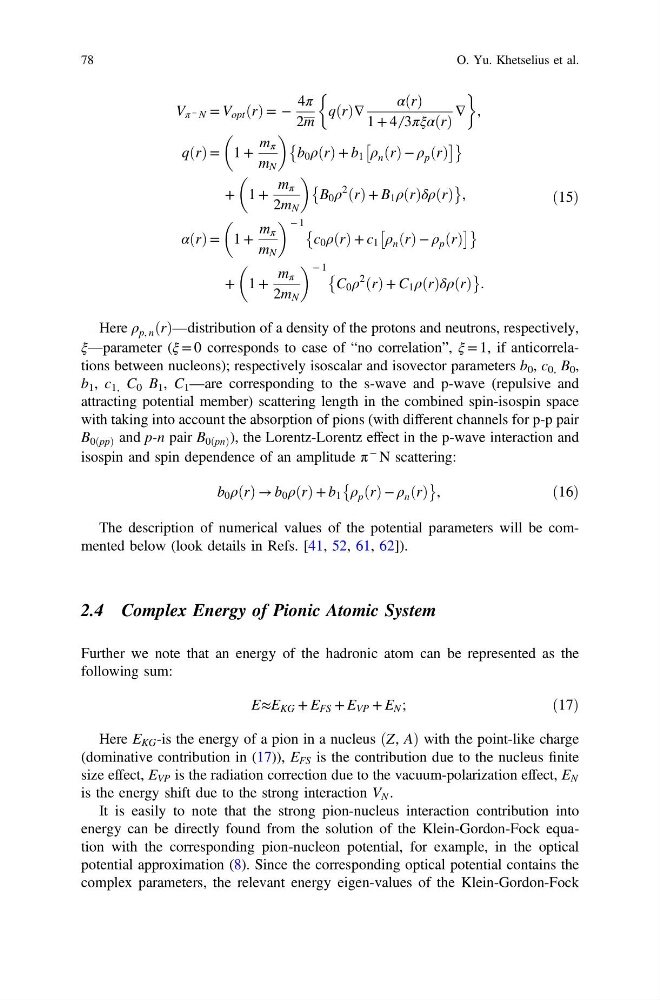
V π − N = V opt r
ð Þ = −
4π
2m
q r
ð Þ∇
α r
ð Þ
1 + 4 ̸ 3πξα r
ð Þ
∇
&
'
,
q r
ð Þ = 1+
m π
m N
b 0 ρ r
ð Þ + b 1 ρ n r
ð Þ − ρ p r
ð Þ
Â
Ã
È
É
+ 1+
m π
2m N
B 0 ρ
2 r
ð Þ + B 1 ρ r
ð Þδρ r
ð Þ
È
É
,
α r
ð Þ = 1+
m π
m N
− 1
c 0 ρ r
ð Þ + c 1 ρ n r
ð Þ − ρ p r
ð Þ
Â
Ã
È
É
+ 1+
m π
2m N
− 1
C 0 ρ
2 r
ð Þ + C 1 ρ r
ð Þδρ r
ð Þ
È
É
.
ð15Þ
Here ρ p, n r
ð Þ—distribution of a density of the protons and neutrons, respectively,
ξ—parameter (ξ = 0 corresponds to case of “no correlation”, ξ = 1, if anticorrelations between nucleons); respectively isoscalar and isovector parameters b 0 , c 0, B 0 ,
b 1 , c 1, C 0 B 1 , C 1 —are corresponding to the s-wave and p-wave (repulsive and
attracting potential member) scattering length in the combined spin-isospin space
with taking into account the absorption of pions (with different channels for p-p pair
B 0 pp
ð Þ and p-n pair B 0 pn
ð Þ ), the Lorentz-Lorentz effect in the p-wave interaction and
isospin and spin dependence of an amplitude π
− N scattering:
b 0 ρ r
ð Þ → b 0 ρ r
ð Þ + b 1 ρ p r
ð Þ − ρ n r
ð Þ
È
É
,
ð16Þ
The description of numerical values of the potential parameters will be commented below (look details in Refs. [41, 52, 61, 62]).
2.4 Complex Energy of Pionic Atomic System
Further we note that an energy of the hadronic atom can be represented as the
following sum:
E≈E KG + E FS + E VP + E N ;
ð17Þ
Here E KG -is the energy of a pion in a nucleus Z, A
ð
Þ with the point-like charge
(dominative contribution in (17)), E FS is the contribution due to the nucleus finite
size effect, E VP is the radiation correction due to the vacuum-polarization effect, E N
is the energy shift due to the strong interaction V N .
It is easily to note that the strong pion-nucleus interaction contribution into
energy can be directly found from the solution of the Klein-Gordon-Fock equation with the corresponding pion-nucleon potential, for example, in the optical
potential approximation (8). Since the corresponding optical potential contains the
complex parameters, the relevant energy eigen-values of the Klein-Gordon-Fock
78
O. Yu. Khetselius et al.
ð Þ = −
4π
2m
q r
ð Þ∇
α r
ð Þ
1 + 4 ̸ 3πξα r
ð Þ
∇
&
'
,
q r
ð Þ = 1+
m π
m N
b 0 ρ r
ð Þ + b 1 ρ n r
ð Þ − ρ p r
ð Þ
Â
Ã
È
É
+ 1+
m π
2m N
B 0 ρ
2 r
ð Þ + B 1 ρ r
ð Þδρ r
ð Þ
È
É
,
α r
ð Þ = 1+
m π
m N
− 1
c 0 ρ r
ð Þ + c 1 ρ n r
ð Þ − ρ p r
ð Þ
Â
Ã
È
É
+ 1+
m π
2m N
− 1
C 0 ρ
2 r
ð Þ + C 1 ρ r
ð Þδρ r
ð Þ
È
É
.
ð15Þ
Here ρ p, n r
ð Þ—distribution of a density of the protons and neutrons, respectively,
ξ—parameter (ξ = 0 corresponds to case of “no correlation”, ξ = 1, if anticorrelations between nucleons); respectively isoscalar and isovector parameters b 0 , c 0, B 0 ,
b 1 , c 1, C 0 B 1 , C 1 —are corresponding to the s-wave and p-wave (repulsive and
attracting potential member) scattering length in the combined spin-isospin space
with taking into account the absorption of pions (with different channels for p-p pair
B 0 pp
ð Þ and p-n pair B 0 pn
ð Þ ), the Lorentz-Lorentz effect in the p-wave interaction and
isospin and spin dependence of an amplitude π
− N scattering:
b 0 ρ r
ð Þ → b 0 ρ r
ð Þ + b 1 ρ p r
ð Þ − ρ n r
ð Þ
È
É
,
ð16Þ
The description of numerical values of the potential parameters will be commented below (look details in Refs. [41, 52, 61, 62]).
2.4 Complex Energy of Pionic Atomic System
Further we note that an energy of the hadronic atom can be represented as the
following sum:
E≈E KG + E FS + E VP + E N ;
ð17Þ
Here E KG -is the energy of a pion in a nucleus Z, A
ð
Þ with the point-like charge
(dominative contribution in (17)), E FS is the contribution due to the nucleus finite
size effect, E VP is the radiation correction due to the vacuum-polarization effect, E N
is the energy shift due to the strong interaction V N .
It is easily to note that the strong pion-nucleus interaction contribution into
energy can be directly found from the solution of the Klein-Gordon-Fock equation with the corresponding pion-nucleon potential, for example, in the optical
potential approximation (8). Since the corresponding optical potential contains the
complex parameters, the relevant energy eigen-values of the Klein-Gordon-Fock
78
O. Yu. Khetselius et al.