

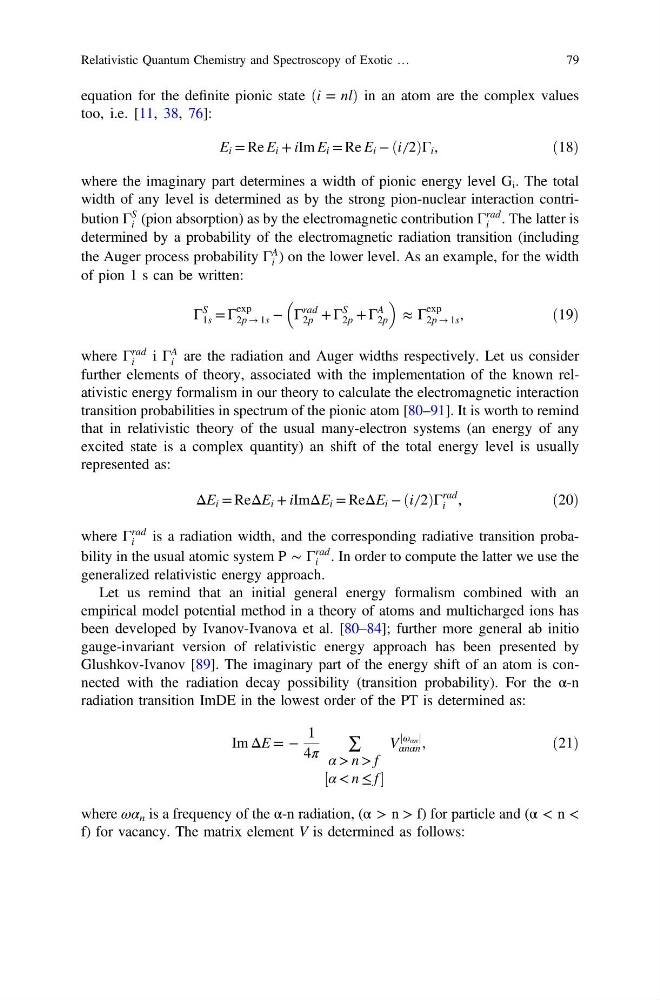
equation for the definite pionic state i = nl
ð
Þ in an atom are the complex values
too, i.e. [11, 38, 76]:
E i = Re E i + iIm E i = Re E i − i ̸ 2
ð ÞΓ i ,
ð18Þ
where the imaginary part determines a width of pionic energy level G i . The total
width of any level is determined as by the strong pion-nuclear interaction contribution Γ
S
i (pion absorption) as by the electromagnetic contribution Γ
rad
i . The latter is
determined by a probability of the electromagnetic radiation transition (including
the Auger process probability Γ
A
i ) on the lower level. As an example, for the width
of pion 1 s can be written:
Γ
S
1s = Γ
exp
2p → 1s − Γ
rad
2p + Γ
S
2p + Γ
A
2p
≈ Γ
exp
2p → 1s ,
ð19Þ
where Γ
rad
i
i Γ
A
i are the radiation and Auger widths respectively. Let us consider
further elements of theory, associated with the implementation of the known relativistic energy formalism in our theory to calculate the electromagnetic interaction
transition probabilities in spectrum of the pionic atom [80–91]. It is worth to remind
that in relativistic theory of the usual many-electron systems (an energy of any
excited state is a complex quantity) an shift of the total energy level is usually
represented as:
ΔE i = ReΔE i + iImΔE i = ReΔE i − i ̸ 2
ð ÞΓ
rad
i ,
ð20Þ
where Γ
rad
i
is a radiation width, and the corresponding radiative transition probability in the usual atomic system P ∼ Γ
rad
i . In order to compute the latter we use the
generalized relativistic energy approach.
Let us remind that an initial general energy formalism combined with an
empirical model potential method in a theory of atoms and multicharged ions has
been developed by Ivanov-Ivanova et al. [80–84]; further more general ab initio
gauge-invariant version of relativistic energy approach has been presented by
Glushkov-Ivanov [89]. The imaginary part of the energy shift of an atom is connected with the radiation decay possibility (transition probability). For the α-n
radiation transition ImDE in the lowest order of the PT is determined as:
Im ΔE = −
1
4π
∑
α > n > f
½α < n ≤ f
V
jω αn j
αnαn ,
ð21Þ
where ωα n is a frequency of the α-n radiation, (α > n > f) for particle and (α < n <
f) for vacancy. The matrix element V is determined as follows:
Relativistic Quantum Chemistry and Spectroscopy of Exotic …
79
ð
Þ in an atom are the complex values
too, i.e. [11, 38, 76]:
E i = Re E i + iIm E i = Re E i − i ̸ 2
ð ÞΓ i ,
ð18Þ
where the imaginary part determines a width of pionic energy level G i . The total
width of any level is determined as by the strong pion-nuclear interaction contribution Γ
S
i (pion absorption) as by the electromagnetic contribution Γ
rad
i . The latter is
determined by a probability of the electromagnetic radiation transition (including
the Auger process probability Γ
A
i ) on the lower level. As an example, for the width
of pion 1 s can be written:
Γ
S
1s = Γ
exp
2p → 1s − Γ
rad
2p + Γ
S
2p + Γ
A
2p
≈ Γ
exp
2p → 1s ,
ð19Þ
where Γ
rad
i
i Γ
A
i are the radiation and Auger widths respectively. Let us consider
further elements of theory, associated with the implementation of the known relativistic energy formalism in our theory to calculate the electromagnetic interaction
transition probabilities in spectrum of the pionic atom [80–91]. It is worth to remind
that in relativistic theory of the usual many-electron systems (an energy of any
excited state is a complex quantity) an shift of the total energy level is usually
represented as:
ΔE i = ReΔE i + iImΔE i = ReΔE i − i ̸ 2
ð ÞΓ
rad
i ,
ð20Þ
where Γ
rad
i
is a radiation width, and the corresponding radiative transition probability in the usual atomic system P ∼ Γ
rad
i . In order to compute the latter we use the
generalized relativistic energy approach.
Let us remind that an initial general energy formalism combined with an
empirical model potential method in a theory of atoms and multicharged ions has
been developed by Ivanov-Ivanova et al. [80–84]; further more general ab initio
gauge-invariant version of relativistic energy approach has been presented by
Glushkov-Ivanov [89]. The imaginary part of the energy shift of an atom is connected with the radiation decay possibility (transition probability). For the α-n
radiation transition ImDE in the lowest order of the PT is determined as:
Im ΔE = −
1
4π
∑
α > n > f
½α < n ≤ f
V
jω αn j
αnαn ,
ð21Þ
where ωα n is a frequency of the α-n radiation, (α > n > f) for particle and (α < n <
f) for vacancy. The matrix element V is determined as follows:
Relativistic Quantum Chemistry and Spectroscopy of Exotic …
79