

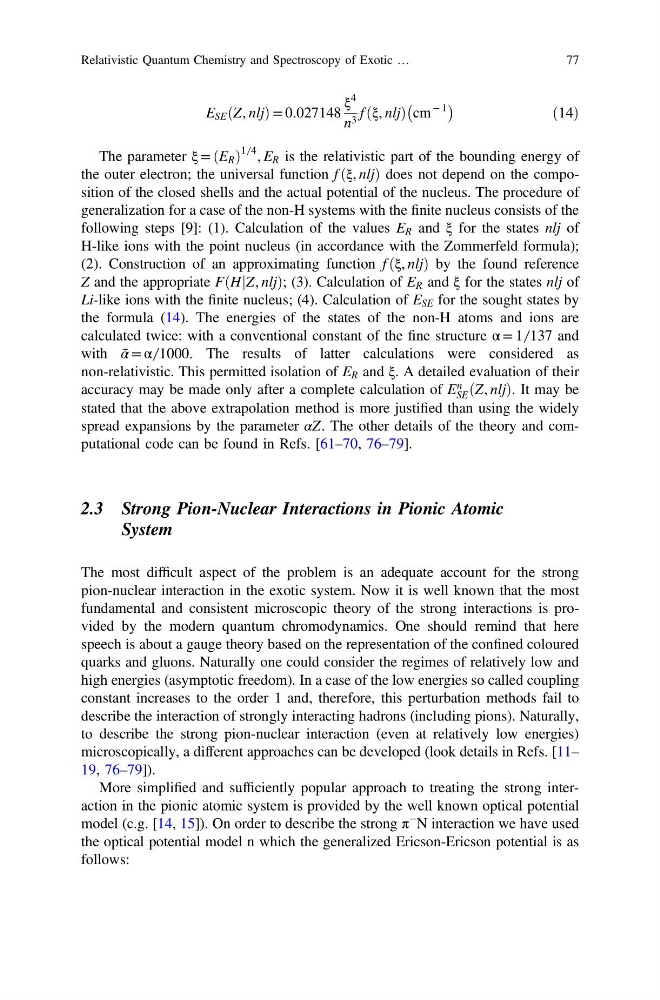
E SE Z, nlj
ð
Þ= 0.027148
ξ
4
n 3 f ξ, nlj
ð
Þ cm
− 1
À
Á
ð14Þ
The parameter ξ = E R
ð Þ
1 ̸ 4 , E R is the relativistic part of the bounding energy of
the outer electron; the universal function f ξ, nlj
ð
Þ does not depend on the composition of the closed shells and the actual potential of the nucleus. The procedure of
generalization for a case of the non-H systems with the finite nucleus consists of the
following steps [9]: (1). Calculation of the values E R and ξ for the states nlj of
H-like ions with the point nucleus (in accordance with the Zommerfeld formula);
(2). Construction of an approximating function f ξ, nlj
ð
Þ by the found reference
Z and the appropriate F HjZ, nlj
ð
Þ ; (3). Calculation of E R and ξ for the states nlj of
Li-like ions with the finite nucleus; (4). Calculation of E SE for the sought states by
the formula (14). The energies of the states of the non-H atoms and ions are
calculated twice: with a conventional constant of the fine structure α = 1 ̸ 137 and
with α̃ = α ̸ 1000. The results of latter calculations were considered as
non-relativistic. This permitted isolation of E R and ξ. A detailed evaluation of their
accuracy may be made only after a complete calculation of E
n
SE Z, nlj
ð
Þ. It may be
stated that the above extrapolation method is more justified than using the widely
spread expansions by the parameter αZ. The other details of the theory and computational code can be found in Refs. [61–70, 76–79].
2.3 Strong Pion-Nuclear Interactions in Pionic Atomic
System
The most difficult aspect of the problem is an adequate account for the strong
pion-nuclear interaction in the exotic system. Now it is well known that the most
fundamental and consistent microscopic theory of the strong interactions is provided by the modern quantum chromodynamics. One should remind that here
speech is about a gauge theory based on the representation of the confined coloured
quarks and gluons. Naturally one could consider the regimes of relatively low and
high energies (asymptotic freedom). In a case of the low energies so called coupling
constant increases to the order 1 and, therefore, this perturbation methods fail to
describe the interaction of strongly interacting hadrons (including pions). Naturally,
to describe the strong pion-nuclear interaction (even at relatively low energies)
microscopically, a different approaches can be developed (look details in Refs. [11–
19, 76–79]).
More simplified and sufficiently popular approach to treating the strong interaction in the pionic atomic system is provided by the well known optical potential
model (c.g. [14, 15]). On order to describe the strong π
− N interaction we have used
the optical potential model n which the generalized Ericson-Ericson potential is as
follows:
Relativistic Quantum Chemistry and Spectroscopy of Exotic …
77
ð
Þ= 0.027148
ξ
4
n 3 f ξ, nlj
ð
Þ cm
− 1
À
Á
ð14Þ
The parameter ξ = E R
ð Þ
1 ̸ 4 , E R is the relativistic part of the bounding energy of
the outer electron; the universal function f ξ, nlj
ð
Þ does not depend on the composition of the closed shells and the actual potential of the nucleus. The procedure of
generalization for a case of the non-H systems with the finite nucleus consists of the
following steps [9]: (1). Calculation of the values E R and ξ for the states nlj of
H-like ions with the point nucleus (in accordance with the Zommerfeld formula);
(2). Construction of an approximating function f ξ, nlj
ð
Þ by the found reference
Z and the appropriate F HjZ, nlj
ð
Þ ; (3). Calculation of E R and ξ for the states nlj of
Li-like ions with the finite nucleus; (4). Calculation of E SE for the sought states by
the formula (14). The energies of the states of the non-H atoms and ions are
calculated twice: with a conventional constant of the fine structure α = 1 ̸ 137 and
with α̃ = α ̸ 1000. The results of latter calculations were considered as
non-relativistic. This permitted isolation of E R and ξ. A detailed evaluation of their
accuracy may be made only after a complete calculation of E
n
SE Z, nlj
ð
Þ. It may be
stated that the above extrapolation method is more justified than using the widely
spread expansions by the parameter αZ. The other details of the theory and computational code can be found in Refs. [61–70, 76–79].
2.3 Strong Pion-Nuclear Interactions in Pionic Atomic
System
The most difficult aspect of the problem is an adequate account for the strong
pion-nuclear interaction in the exotic system. Now it is well known that the most
fundamental and consistent microscopic theory of the strong interactions is provided by the modern quantum chromodynamics. One should remind that here
speech is about a gauge theory based on the representation of the confined coloured
quarks and gluons. Naturally one could consider the regimes of relatively low and
high energies (asymptotic freedom). In a case of the low energies so called coupling
constant increases to the order 1 and, therefore, this perturbation methods fail to
describe the interaction of strongly interacting hadrons (including pions). Naturally,
to describe the strong pion-nuclear interaction (even at relatively low energies)
microscopically, a different approaches can be developed (look details in Refs. [11–
19, 76–79]).
More simplified and sufficiently popular approach to treating the strong interaction in the pionic atomic system is provided by the well known optical potential
model (c.g. [14, 15]). On order to describe the strong π
− N interaction we have used
the optical potential model n which the generalized Ericson-Ericson potential is as
follows:
Relativistic Quantum Chemistry and Spectroscopy of Exotic …
77