

QED effect of the vacuum polarization: A1—the Uehling-Serber term; A2, A3–
terms of order члeны пopядкa [α Zα
ð Þ
n (n = 2, …); A4- the Källen-Sabry correction of order α
2
αZ
ð Þ; A5–the Wichmann-Kroll correction of order кa α Zα
ð Þ
n
(n = 3). An effect of the vacuum polarization is usually taken into account in the
first PT theory order by means of the generalized Uehling-Serber potential with
modification to take into account the high-order radiative corrections. In particular,
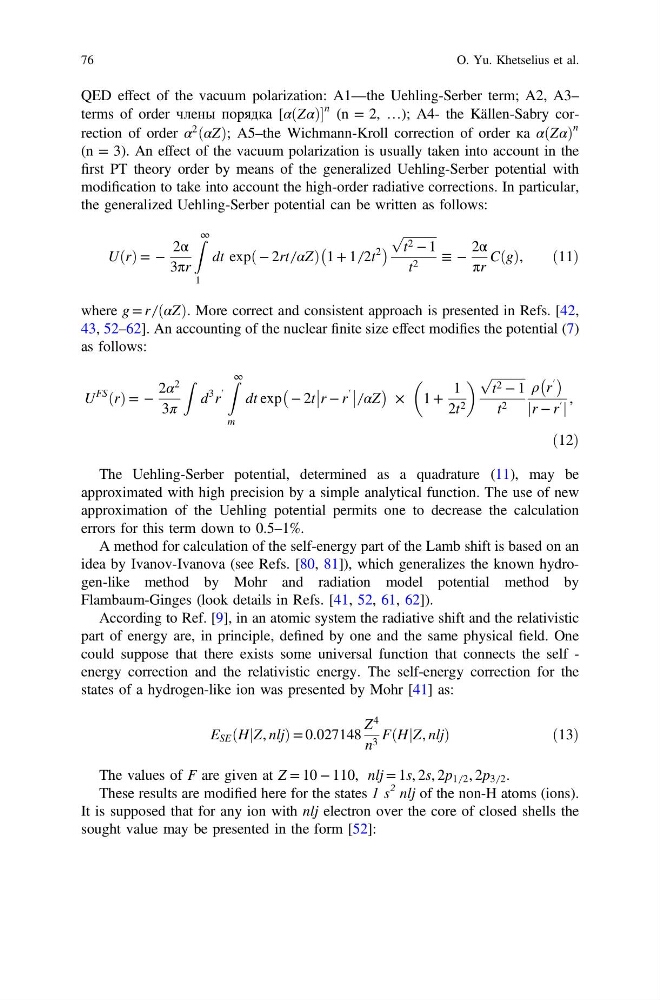
the generalized Uehling-Serber potential can be written as follows:
U r
ð Þ = −
2α
3πr
Z ∞
1
dt exp − 2rt ̸ αZ
ð
Þ1 + 1 ̸ 2t
2
À
Á
ffiffiffiffiffiffiffiffiffiffiffi
t 2 − 1
p
t 2
≡ −
2α
πr
C g
ð Þ,
ð11Þ
where g = r ̸ ðαZÞ. More correct and consistent approach is presented in Refs. [42,
43, 52–62]. An accounting of the nuclear finite size effect modifies the potential (7)
as follows:
U
FS r
ð Þ = −
2α
2
3π
Z
d
3 r
′
Z ∞
m
dt exp − 2t r − r
′
̸ αZ
À
Á
× 1+
1
2t 2
ffiffiffiffiffiffiffiffiffiffiffi
t 2 − 1
p
t 2
ρ r
′
À Á
r − r ′
j
j
,
ð12Þ
The Uehling-Serber potential, determined as a quadrature (11), may be
approximated with high precision by a simple analytical function. The use of new
approximation of the Uehling potential permits one to decrease the calculation
errors for this term down to 0.5–1%.
A method for calculation of the self-energy part of the Lamb shift is based on an
idea by Ivanov-Ivanova (see Refs. [80, 81]), which generalizes the known hydrogen-like method by Mohr and radiation model potential method by
Flambaum-Ginges (look details in Refs. [41, 52, 61, 62]).
According to Ref. [9], in an atomic system the radiative shift and the relativistic
part of energy are, in principle, defined by one and the same physical field. One
could suppose that there exists some universal function that connects the self -
energy correction and the relativistic energy. The self-energy correction for the
states of a hydrogen-like ion was presented by Mohr [41] as:
E SE HjZ, nlj
ð
Þ= 0.027148
Z
4
n 3 F HjZ, nlj
ð
Þ
ð 13Þ
The values of F are given at Z = 10 − 110, nlj = 1s, 2s, 2p 1 ̸ 2 , 2p 3 ̸ 2 .
These results are modified here for the states 1 s
2 nlj of the non-H atoms (ions).
It is supposed that for any ion with nlj electron over the core of closed shells the
sought value may be presented in the form [52]:
76
O. Yu. Khetselius et al.
terms of order члeны пopядкa [α Zα
ð Þ
n (n = 2, …); A4- the Källen-Sabry correction of order α
2
αZ
ð Þ; A5–the Wichmann-Kroll correction of order кa α Zα
ð Þ
n
(n = 3). An effect of the vacuum polarization is usually taken into account in the
first PT theory order by means of the generalized Uehling-Serber potential with
modification to take into account the high-order radiative corrections. In particular,
the generalized Uehling-Serber potential can be written as follows:
U r
ð Þ = −
2α
3πr
Z ∞
1
dt exp − 2rt ̸ αZ
ð
Þ1 + 1 ̸ 2t
2
À
Á
ffiffiffiffiffiffiffiffiffiffiffi
t 2 − 1
p
t 2
≡ −
2α
πr
C g
ð Þ,
ð11Þ
where g = r ̸ ðαZÞ. More correct and consistent approach is presented in Refs. [42,
43, 52–62]. An accounting of the nuclear finite size effect modifies the potential (7)
as follows:
U
FS r
ð Þ = −
2α
2
3π
Z
d
3 r
′
Z ∞
m
dt exp − 2t r − r
′
̸ αZ
À
Á
× 1+
1
2t 2
ffiffiffiffiffiffiffiffiffiffiffi
t 2 − 1
p
t 2
ρ r
′
À Á
r − r ′
j
j
,
ð12Þ
The Uehling-Serber potential, determined as a quadrature (11), may be
approximated with high precision by a simple analytical function. The use of new
approximation of the Uehling potential permits one to decrease the calculation
errors for this term down to 0.5–1%.
A method for calculation of the self-energy part of the Lamb shift is based on an
idea by Ivanov-Ivanova (see Refs. [80, 81]), which generalizes the known hydrogen-like method by Mohr and radiation model potential method by
Flambaum-Ginges (look details in Refs. [41, 52, 61, 62]).
According to Ref. [9], in an atomic system the radiative shift and the relativistic
part of energy are, in principle, defined by one and the same physical field. One
could suppose that there exists some universal function that connects the self -
energy correction and the relativistic energy. The self-energy correction for the
states of a hydrogen-like ion was presented by Mohr [41] as:
E SE HjZ, nlj
ð
Þ= 0.027148
Z
4
n 3 F HjZ, nlj
ð
Þ
ð 13Þ
The values of F are given at Z = 10 − 110, nlj = 1s, 2s, 2p 1 ̸ 2 , 2p 3 ̸ 2 .
These results are modified here for the states 1 s
2 nlj of the non-H atoms (ions).
It is supposed that for any ion with nlj electron over the core of closed shells the
sought value may be presented in the form [52]:
76
O. Yu. Khetselius et al.