

34
F. E. Harris
be useful in reducing computational effort and/or in providing additional checks for
the numerical work. This section of the present paper summarizes work previously
presented by the present author [37] showing how the use of concepts associated with
vector spherical harmonics [38] can be applied to derive the missing kinetic-energy
formulas for Hy-CI.
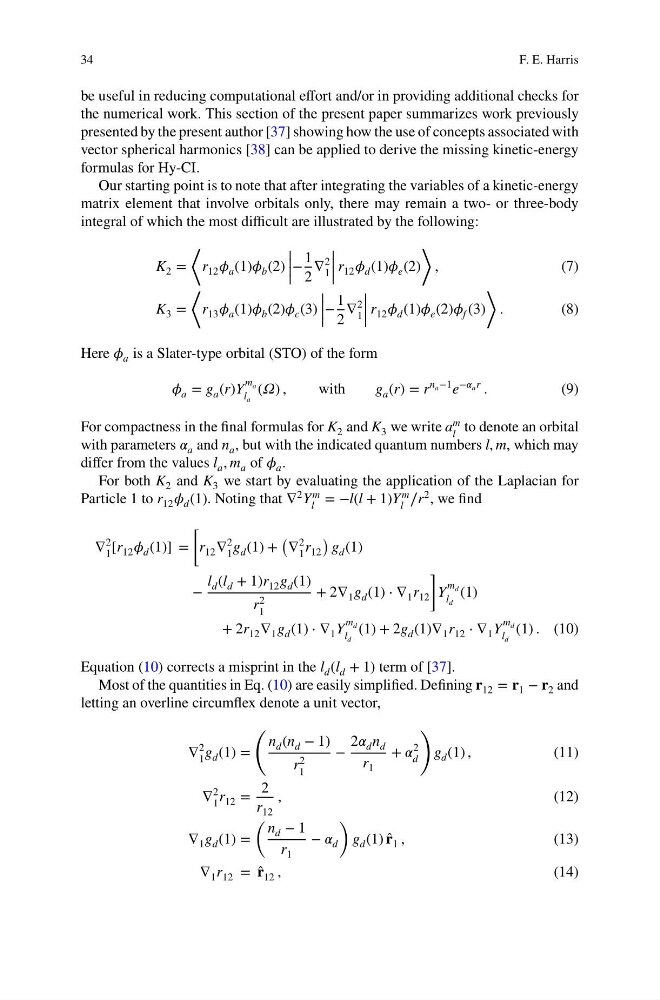
Our starting point is to note that after integrating the variables of a kinetic-energy
matrix element that involve orbitals only, there may remain a two- or three-body
integral of which the most difficult are illustrated by the following:
K 2 =
⟨
r 12 í µí¼ a (1)í µí¼ b (2)
|
|
|
|
−
1
2
∇
2
1
|
|
|
|
r 12 í µí¼ d (1)í µí¼ e (2)
⟩
,
(7)
K 3 =
⟨
r 13 í µí¼ a (1)í µí¼ b (2)í µí¼ c (3)
|
|
|
|
−
1
2
∇
2
1
|
|
|
|
r 12 í µí¼ d (1)í µí¼ e (2)í µí¼ f (3)
⟩
.
(8)
Here í µí¼ a is a Slater-type orbital (STO) of the form
í µí¼ a = g a (r)Y
m a
l a
(í µí»º) ,
with
g a (r) = r
n a −1 e
−í µí»¼ a r
.
(9)
For compactness in the final formulas for K 2 and K 3 we write a
m
l
to denote an orbital
with parameters í µí»¼ a and n a , but with the indicated quantum numbers l, m, which may
differ from the values l a , m a of í µí¼ a .
For both K 2 and K 3 we start by evaluating the application of the Laplacian for
Particle 1 to r 12 í µí¼ d (1). Noting that ∇ 2 Y
m
l
= −l(l + 1)Y
m
l
∕r 2 , we find
∇
2
1 [r 12 í µí¼ d (1)] =
[
r 12 ∇
2
1 g d (1) +
(
∇
2
1 r 12
)
g d (1)
−
l d (l d + 1)r 12 g d (1)
r
2
1
+ 2∇ 1 g d (1) ⋅ ∇ 1 r 12
]
Y
m d
l d
(1)
+ 2r 12 ∇ 1 g d (1) ⋅ ∇ 1 Y
m d
l d
(1) + 2g d (1)∇ 1 r 12 ⋅ ∇ 1 Y
m d
l d
(1) . (10)
Equation (10) corrects a misprint in the l d (l d + 1) term of [37].
Most of the quantities in Eq. (10) are easily simplified. Defining í µí°« 12 = í µí°« 1 − í µí°« 2 and
letting an overline circumflex denote a unit vector,
∇
2
1 g d (1) =
(
n d (n d − 1)
r
2
1
−
2í µí»¼ d n d
r 1
+ í µí»¼
2
d
)
g d (1) ,
(11)
∇
2
1 r 12 =
2
r 12
,
(12)
∇ 1 g d (1) =
( n d − 1
r 1
− í µí»¼ d
)
g d (1) ̂
í µí°« 1 ,
(13)
∇ 1 r 12 = ̂
í µí°« 12 ,
(14)
F. E. Harris
be useful in reducing computational effort and/or in providing additional checks for
the numerical work. This section of the present paper summarizes work previously
presented by the present author [37] showing how the use of concepts associated with
vector spherical harmonics [38] can be applied to derive the missing kinetic-energy
formulas for Hy-CI.
Our starting point is to note that after integrating the variables of a kinetic-energy
matrix element that involve orbitals only, there may remain a two- or three-body
integral of which the most difficult are illustrated by the following:
K 2 =
⟨
r 12 í µí¼ a (1)í µí¼ b (2)
|
|
|
|
−
1
2
∇
2
1
|
|
|
|
r 12 í µí¼ d (1)í µí¼ e (2)
⟩
,
(7)
K 3 =
⟨
r 13 í µí¼ a (1)í µí¼ b (2)í µí¼ c (3)
|
|
|
|
−
1
2
∇
2
1
|
|
|
|
r 12 í µí¼ d (1)í µí¼ e (2)í µí¼ f (3)
⟩
.
(8)
Here í µí¼ a is a Slater-type orbital (STO) of the form
í µí¼ a = g a (r)Y
m a
l a
(í µí»º) ,
with
g a (r) = r
n a −1 e
−í µí»¼ a r
.
(9)
For compactness in the final formulas for K 2 and K 3 we write a
m
l
to denote an orbital
with parameters í µí»¼ a and n a , but with the indicated quantum numbers l, m, which may
differ from the values l a , m a of í µí¼ a .
For both K 2 and K 3 we start by evaluating the application of the Laplacian for
Particle 1 to r 12 í µí¼ d (1). Noting that ∇ 2 Y
m
l
= −l(l + 1)Y
m
l
∕r 2 , we find
∇
2
1 [r 12 í µí¼ d (1)] =
[
r 12 ∇
2
1 g d (1) +
(
∇
2
1 r 12
)
g d (1)
−
l d (l d + 1)r 12 g d (1)
r
2
1
+ 2∇ 1 g d (1) ⋅ ∇ 1 r 12
]
Y
m d
l d
(1)
+ 2r 12 ∇ 1 g d (1) ⋅ ∇ 1 Y
m d
l d
(1) + 2g d (1)∇ 1 r 12 ⋅ ∇ 1 Y
m d
l d
(1) . (10)
Equation (10) corrects a misprint in the l d (l d + 1) term of [37].
Most of the quantities in Eq. (10) are easily simplified. Defining í µí°« 12 = í µí°« 1 − í µí°« 2 and
letting an overline circumflex denote a unit vector,
∇
2
1 g d (1) =
(
n d (n d − 1)
r
2
1
−
2í µí»¼ d n d
r 1
+ í µí»¼
2
d
)
g d (1) ,
(11)
∇
2
1 r 12 =
2
r 12
,
(12)
∇ 1 g d (1) =
( n d − 1
r 1
− í µí»¼ d
)
g d (1) ̂
í µí°« 1 ,
(13)
∇ 1 r 12 = ̂
í µí°« 12 ,
(14)