

Matrix Elements for Explicitly-Correlated Atomic Wave Functions
33
5 Kinetic Energy
Unexpectedly, a bottleneck in Hylleraas-CI computations has been the computation
of kinetic-energy matrix elements. In completely orbital formulations, the derivatives describing the kinetic energy in quantum mechanics simply change the powers
of r i in a matrix element, making it simple to identify the kinetic energy in terms of
potential-energy integrals. However, the presence of factors r ij , either as powers or
in exponents, generates new complications.
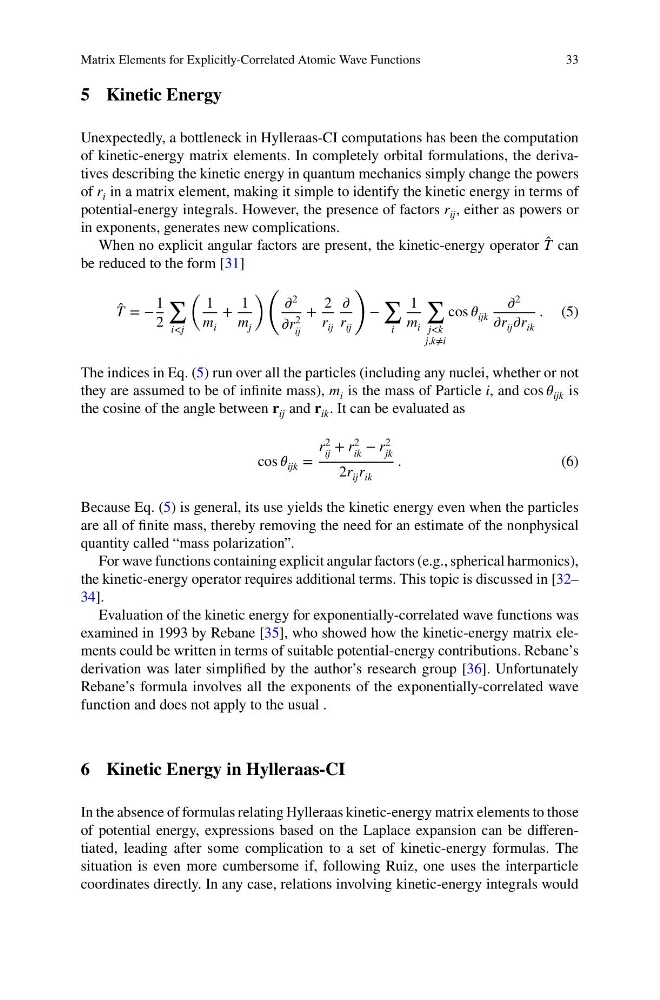
When no explicit angular factors are present, the kinetic-energy operator ̂
T can
be reduced to the form [31]
̂
T = −
1
2
∑
i
m i
+
1
m j
) (
í µí¼
2
í µí¼r
2
ij
+
2
r ij
í µí¼
r ij
)
−
∑
i
1
m i
∑
j
cos í µí¼ ijk
í µí¼
2
í µí¼r ij í µí¼r ik
. (5)
The indices in Eq. (5) run over all the particles (including any nuclei, whether or not
they are assumed to be of infinite mass), m i is the mass of Particle i, and cos í µí¼ ijk is
the cosine of the angle between í µí°« ij and í µí°« ik . It can be evaluated as
cos í µí¼ ijk =
r
2
ij
+ r
2
ik
− r
2
jk
2r ij r ik
.
(6)
Because Eq. (5) is general, its use yields the kinetic energy even when the particles
are all of finite mass, thereby removing the need for an estimate of the nonphysical
quantity called “mass polarization”.
For wave functions containing explicit angular factors (e.g., spherical harmonics),
the kinetic-energy operator requires additional terms. This topic is discussed in [32–
34].
Evaluation of the kinetic energy for exponentially-correlated wave functions was
examined in 1993 by Rebane [35], who showed how the kinetic-energy matrix elements could be written in terms of suitable potential-energy contributions. Rebane’s
derivation was later simplified by the author’s research group [36]. Unfortunately
Rebane’s formula involves all the exponents of the exponentially-correlated wave
function and does not apply to the usual .
6 Kinetic Energy in Hylleraas-CI
In the absence of formulas relating Hylleraas kinetic-energy matrix elements to those
of potential energy, expressions based on the Laplace expansion can be differentiated, leading after some complication to a set of kinetic-energy formulas. The
situation is even more cumbersome if, following Ruiz, one uses the interparticle
coordinates directly. In any case, relations involving kinetic-energy integrals would
33
5 Kinetic Energy
Unexpectedly, a bottleneck in Hylleraas-CI computations has been the computation
of kinetic-energy matrix elements. In completely orbital formulations, the derivatives describing the kinetic energy in quantum mechanics simply change the powers
of r i in a matrix element, making it simple to identify the kinetic energy in terms of
potential-energy integrals. However, the presence of factors r ij , either as powers or
in exponents, generates new complications.
When no explicit angular factors are present, the kinetic-energy operator ̂
T can
be reduced to the form [31]
̂
T = −
1
2
∑
i
m i
+
1
m j
) (
í µí¼
2
í µí¼r
2
ij
+
2
r ij
í µí¼
r ij
)
−
∑
i
1
m i
∑
j
cos í µí¼ ijk
í µí¼
2
í µí¼r ij í µí¼r ik
. (5)
The indices in Eq. (5) run over all the particles (including any nuclei, whether or not
they are assumed to be of infinite mass), m i is the mass of Particle i, and cos í µí¼ ijk is
the cosine of the angle between í µí°« ij and í µí°« ik . It can be evaluated as
cos í µí¼ ijk =
r
2
ij
+ r
2
ik
− r
2
jk
2r ij r ik
.
(6)
Because Eq. (5) is general, its use yields the kinetic energy even when the particles
are all of finite mass, thereby removing the need for an estimate of the nonphysical
quantity called “mass polarization”.
For wave functions containing explicit angular factors (e.g., spherical harmonics),
the kinetic-energy operator requires additional terms. This topic is discussed in [32–
34].
Evaluation of the kinetic energy for exponentially-correlated wave functions was
examined in 1993 by Rebane [35], who showed how the kinetic-energy matrix elements could be written in terms of suitable potential-energy contributions. Rebane’s
derivation was later simplified by the author’s research group [36]. Unfortunately
Rebane’s formula involves all the exponents of the exponentially-correlated wave
function and does not apply to the usual .
6 Kinetic Energy in Hylleraas-CI
In the absence of formulas relating Hylleraas kinetic-energy matrix elements to those
of potential energy, expressions based on the Laplace expansion can be differentiated, leading after some complication to a set of kinetic-energy formulas. The
situation is even more cumbersome if, following Ruiz, one uses the interparticle
coordinates directly. In any case, relations involving kinetic-energy integrals would