

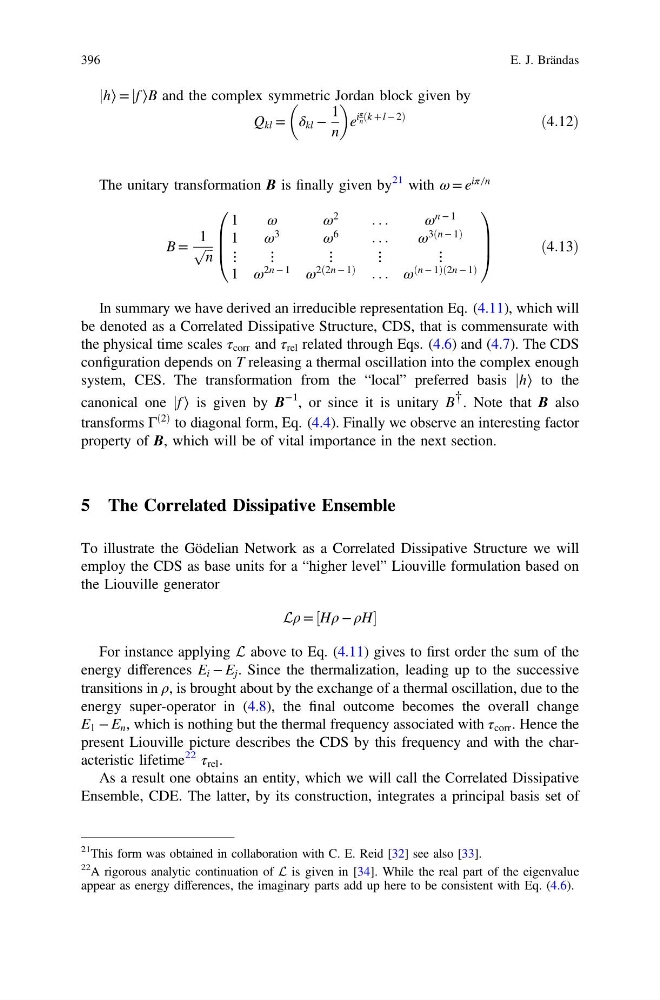
h
j ⟩ = f
j ⟩B and the complex symmetric Jordan block given by
Q kl = δ kl −
1
n
e
i
π
n k + l − 2
ð
Þ
ð4:12Þ
The unitary transformation B is finally given by
21 with ω = e
iπ ̸ n
B =
1
ffiffi ffi
n
p
1
ω
ω
2
. . .
ω
n − 1
1
ω
3
ω
6
. . .
ω
3 n − 1
ð
Þ
⋮
⋮
⋮
⋮
⋮
1 ω
2n − 1
ω
2 2n − 1
ð
Þ
. . . ω
n − 1
ð
Þ2n − 1
ð
Þ
0
B
B
@
1
C
C
A
ð4:13Þ
In summary we have derived an irreducible representation Eq. (4.11), which will
be denoted as a Correlated Dissipative Structure, CDS, that is commensurate with
the physical time scales τ corr and τ rel related through Eqs. (4.6) and (4.7). The CDS
configuration depends on T releasing a thermal oscillation into the complex enough
system, CES. The transformation from the “local” preferred basis h
j ⟩ to the
canonical one f
j ⟩ is given by B
−1 , or since it is unitary B † . Note that B also
transforms Γ
2
ð Þ to diagonal form, Eq. (4.4). Finally we observe an interesting factor
property of B, which will be of vital importance in the next section.
5 The Correlated Dissipative Ensemble
To illustrate the Gödelian Network as a Correlated Dissipative Structure we will
employ the CDS as base units for a “higher level” Liouville formulation based on
the Liouville generator
Lρ = ½Hρ − ρH
For instance applying L above to Eq. (4.11) gives to first order the sum of the
energy differences E i − E j . Since the thermalization, leading up to the successive
transitions in ρ, is brought about by the exchange of a thermal oscillation, due to the
energy super-operator in (4.8), the final outcome becomes the overall change
E 1 − E n , which is nothing but the thermal frequency associated with τ corr . Hence the
present Liouville picture describes the CDS by this frequency and with the characteristic lifetime
22
τ rel .
As a result one obtains an entity, which we will call the Correlated Dissipative
Ensemble, CDE. The latter, by its construction, integrates a principal basis set of
21
This form was obtained in collaboration with C. E. Reid [32] see also [33].
22
A rigorous analytic continuation of L is given in [34]. While the real part of the eigenvalue
appear as energy differences, the imaginary parts add up here to be consistent with Eq. (4.6).
396
E. J. Brändas
j ⟩ = f
j ⟩B and the complex symmetric Jordan block given by
Q kl = δ kl −
1
n
e
i
π
n k + l − 2
ð
Þ
ð4:12Þ
The unitary transformation B is finally given by
21 with ω = e
iπ ̸ n
B =
1
ffiffi ffi
n
p
1
ω
ω
2
. . .
ω
n − 1
1
ω
3
ω
6
. . .
ω
3 n − 1
ð
Þ
⋮
⋮
⋮
⋮
⋮
1 ω
2n − 1
ω
2 2n − 1
ð
Þ
. . . ω
n − 1
ð
Þ2n − 1
ð
Þ
0
B
B
@
1
C
C
A
ð4:13Þ
In summary we have derived an irreducible representation Eq. (4.11), which will
be denoted as a Correlated Dissipative Structure, CDS, that is commensurate with
the physical time scales τ corr and τ rel related through Eqs. (4.6) and (4.7). The CDS
configuration depends on T releasing a thermal oscillation into the complex enough
system, CES. The transformation from the “local” preferred basis h
j ⟩ to the
canonical one f
j ⟩ is given by B
−1 , or since it is unitary B † . Note that B also
transforms Γ
2
ð Þ to diagonal form, Eq. (4.4). Finally we observe an interesting factor
property of B, which will be of vital importance in the next section.
5 The Correlated Dissipative Ensemble
To illustrate the Gödelian Network as a Correlated Dissipative Structure we will
employ the CDS as base units for a “higher level” Liouville formulation based on
the Liouville generator
Lρ = ½Hρ − ρH
For instance applying L above to Eq. (4.11) gives to first order the sum of the
energy differences E i − E j . Since the thermalization, leading up to the successive
transitions in ρ, is brought about by the exchange of a thermal oscillation, due to the
energy super-operator in (4.8), the final outcome becomes the overall change
E 1 − E n , which is nothing but the thermal frequency associated with τ corr . Hence the
present Liouville picture describes the CDS by this frequency and with the characteristic lifetime
22
τ rel .
As a result one obtains an entity, which we will call the Correlated Dissipative
Ensemble, CDE. The latter, by its construction, integrates a principal basis set of
21
This form was obtained in collaboration with C. E. Reid [32] see also [33].
22
A rigorous analytic continuation of L is given in [34]. While the real part of the eigenvalue
appear as energy differences, the imaginary parts add up here to be consistent with Eq. (4.6).
396
E. J. Brändas