

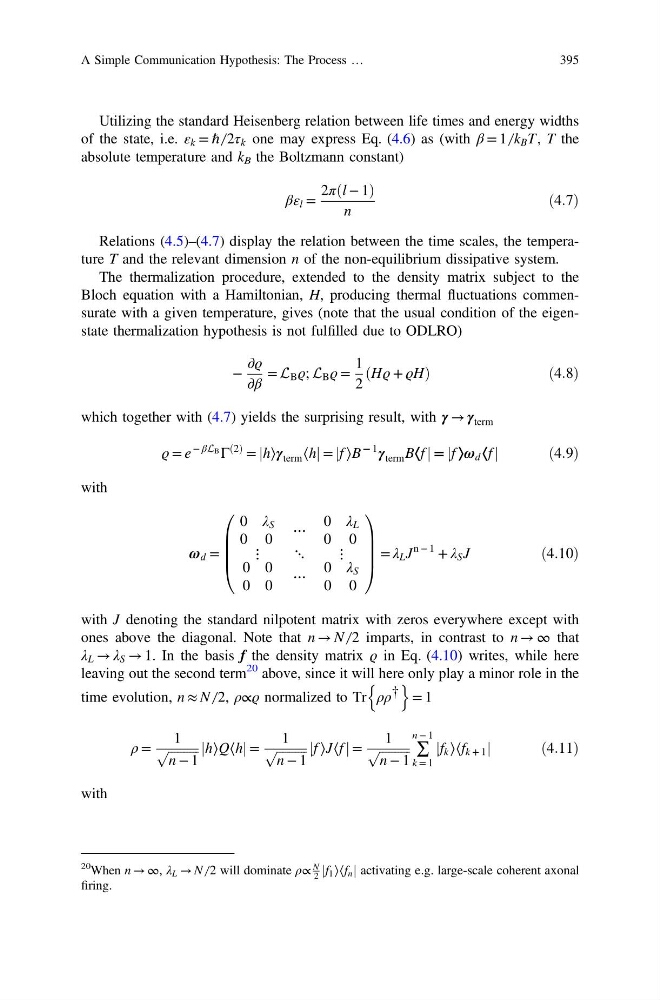
Utilizing the standard Heisenberg relation between life times and energy widths
of the state, i.e. ε k = ℏ ̸ 2τ k one may express Eq. (4.6) as (with β = 1 ̸ k B T, T the
absolute temperature and k B the Boltzmann constant)
βε l =
2πðl − 1Þ
n
ð4:7Þ
Relations (4.5)–(4.7) display the relation between the time scales, the temperature T and the relevant dimension n of the non-equilibrium dissipative system.
The thermalization procedure, extended to the density matrix subject to the
Bloch equation with a Hamiltonian, H, producing thermal fluctuations commensurate with a given temperature, gives (note that the usual condition of the eigenstate thermalization hypothesis is not fulfilled due to ODLRO)
−
∂ϱ
∂β
= L B ϱ; L B ϱ =
1
2
Hϱ + ϱH
ð
Þ
ð 4:8Þ
which together with (4.7) yields the surprising result, with γ → γ term
ϱ = e
− βL B Γ
ð2Þ = h
j ⟩γ term ⟨hj = f
j ⟩B
− 1
γ term B⟨f j = f
j ⟩ω d ⟨f j
ð4:9Þ
with
ω d =
0 λ S
0 0
⋯
0 λ L
0 0
⋮
⋱
⋮
0 0
0 0
⋯
0 λ S
0 0
0
B
B
B
@
1
C
C
C
A
= λ L J
n − 1 + λ S J
ð4:10Þ
with J denoting the standard nilpotent matrix with zeros everywhere except with
ones above the diagonal. Note that n → N ̸ 2 imparts, in contrast to n → ∞ that
λ L → λ S → 1. In the basis f the density matrix ϱ in Eq. (4.10) writes, while here
leaving out the second term
20 above, since it will here only play a minor role in the
time evolution, n ≈ N ̸ 2, ρ∝ϱ normalized to Tr ρρ †
n
o
= 1
ρ =
1
ffiffiffiffiffiffiffiffiffiffi
n − 1
p
h
j ⟩Q⟨hj =
1
ffiffiffiffiffiffiffiffiffiffi
n − 1
p
f
j ⟩J⟨f j =
1
ffiffiffiffiffiffiffiffiffiffi
n − 1
p
∑
n − 1
k = 1
f k
j ⟩⟨f k + 1 j
ð4:11Þ
with
20
When n → ∞, λ L → N ̸ 2 will dominate ρ∝
N
2 f 1
j ⟩⟨f n j activating e.g. large-scale coherent axonal
firing.
A Simple Communication Hypothesis: The Process …
395
of the state, i.e. ε k = ℏ ̸ 2τ k one may express Eq. (4.6) as (with β = 1 ̸ k B T, T the
absolute temperature and k B the Boltzmann constant)
βε l =
2πðl − 1Þ
n
ð4:7Þ
Relations (4.5)–(4.7) display the relation between the time scales, the temperature T and the relevant dimension n of the non-equilibrium dissipative system.
The thermalization procedure, extended to the density matrix subject to the
Bloch equation with a Hamiltonian, H, producing thermal fluctuations commensurate with a given temperature, gives (note that the usual condition of the eigenstate thermalization hypothesis is not fulfilled due to ODLRO)
−
∂ϱ
∂β
= L B ϱ; L B ϱ =
1
2
Hϱ + ϱH
ð
Þ
ð 4:8Þ
which together with (4.7) yields the surprising result, with γ → γ term
ϱ = e
− βL B Γ
ð2Þ = h
j ⟩γ term ⟨hj = f
j ⟩B
− 1
γ term B⟨f j = f
j ⟩ω d ⟨f j
ð4:9Þ
with
ω d =
0 λ S
0 0
⋯
0 λ L
0 0
⋮
⋱
⋮
0 0
0 0
⋯
0 λ S
0 0
0
B
B
B
@
1
C
C
C
A
= λ L J
n − 1 + λ S J
ð4:10Þ
with J denoting the standard nilpotent matrix with zeros everywhere except with
ones above the diagonal. Note that n → N ̸ 2 imparts, in contrast to n → ∞ that
λ L → λ S → 1. In the basis f the density matrix ϱ in Eq. (4.10) writes, while here
leaving out the second term
20 above, since it will here only play a minor role in the
time evolution, n ≈ N ̸ 2, ρ∝ϱ normalized to Tr ρρ †
n
o
= 1
ρ =
1
ffiffiffiffiffiffiffiffiffiffi
n − 1
p
h
j ⟩Q⟨hj =
1
ffiffiffiffiffiffiffiffiffiffi
n − 1
p
f
j ⟩J⟨f j =
1
ffiffiffiffiffiffiffiffiffiffi
n − 1
p
∑
n − 1
k = 1
f k
j ⟩⟨f k + 1 j
ð4:11Þ
with
20
When n → ∞, λ L → N ̸ 2 will dominate ρ∝
N
2 f 1
j ⟩⟨f n j activating e.g. large-scale coherent axonal
firing.
A Simple Communication Hypothesis: The Process …
395