

theorem is that the mappings between the electron- and the nuclear degrees of
freedom, and back, exhibits the same classical canonical form. This imparts the
possibility of a dual interpretation of the actual matrix representations of either the
electronic motion or the associated nuclear motion in principle bypassing the
Born-Oppenheimer approximation.
One may also view the entwined dynamics as a general scattering problem with
electronic particles scattered on a number of nuclear targets yielding consistent
scattering data, see e.g. Ref. [9]. This leads to the second problem of merging
quantum and thermal correlations at precise temperatures invoking associated time
scales and rigorous dissipative (open system) dynamics, which will be done in two
steps. First we need to match the relevant time scales of the system, via a proper
thermalization procedure obtaining the system operator for the open system at the
relevant temperature exhibiting authentic time scales for a realistic description of
non-equilibrium situations of relevance for, what we will denote, Complex Enough
Systems, CES, and their interpretation.
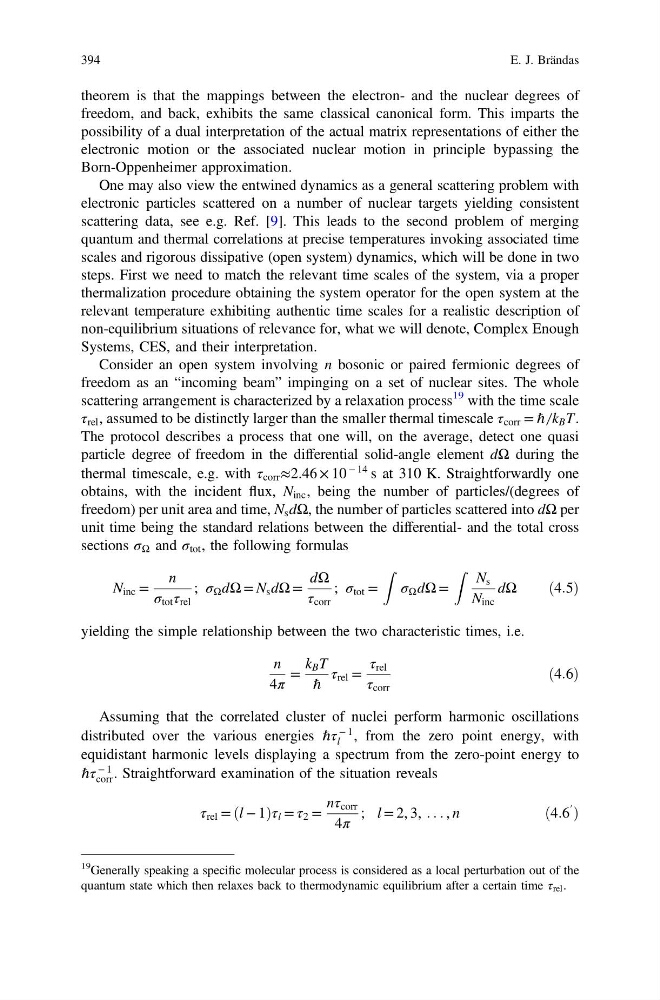
Consider an open system involving n bosonic or paired fermionic degrees of
freedom as an “incoming beam” impinging on a set of nuclear sites. The whole
scattering arrangement is characterized by a relaxation process
19 with the time scale
τ rel , assumed to be distinctly larger than the smaller thermal timescale τ corr = ℏ ̸ k B T.
The protocol describes a process that one will, on the average, detect one quasi
particle degree of freedom in the differential solid-angle element dΩ during the
thermal timescale, e.g. with τ corr ≈2.46 × 10
− 14 s at 310 K. Straightforwardly one
obtains, with the incident flux, N inc , being the number of particles/(degrees of
freedom) per unit area and time, N s dΩ, the number of particles scattered into dΩ per
unit time being the standard relations between the differential- and the total cross
sections σ Ω and σ tot , the following formulas
N inc =
n
σ tot τ rel
; σ Ω dΩ = N s dΩ =
dΩ
τ corr
; σ tot =
Z
σ Ω dΩ =
Z N s
N inc
dΩ
ð4:5Þ
yielding the simple relationship between the two characteristic times, i.e.
n
4π
=
k B T
ℏ
τ rel =
τ rel
τ corr
ð4:6Þ
Assuming that the correlated cluster of nuclei perform harmonic oscillations
distributed over the various energies ℏτ
− 1
l , from the zero point energy, with
equidistant harmonic levels displaying a spectrum from the zero-point energy to
ℏτ
− 1
corr . Straightforward examination of the situation reveals
τ rel = l − 1
ð
Þτ l = τ 2 =
nτ corr
4π
; l = 2, 3, . . . , n
ð4:6
′
Þ
19
Generally speaking a specific molecular process is considered as a local perturbation out of the
quantum state which then relaxes back to thermodynamic equilibrium after a certain time τ rel .
394
E. J. Brändas
freedom, and back, exhibits the same classical canonical form. This imparts the
possibility of a dual interpretation of the actual matrix representations of either the
electronic motion or the associated nuclear motion in principle bypassing the
Born-Oppenheimer approximation.
One may also view the entwined dynamics as a general scattering problem with
electronic particles scattered on a number of nuclear targets yielding consistent
scattering data, see e.g. Ref. [9]. This leads to the second problem of merging
quantum and thermal correlations at precise temperatures invoking associated time
scales and rigorous dissipative (open system) dynamics, which will be done in two
steps. First we need to match the relevant time scales of the system, via a proper
thermalization procedure obtaining the system operator for the open system at the
relevant temperature exhibiting authentic time scales for a realistic description of
non-equilibrium situations of relevance for, what we will denote, Complex Enough
Systems, CES, and their interpretation.
Consider an open system involving n bosonic or paired fermionic degrees of
freedom as an “incoming beam” impinging on a set of nuclear sites. The whole
scattering arrangement is characterized by a relaxation process
19 with the time scale
τ rel , assumed to be distinctly larger than the smaller thermal timescale τ corr = ℏ ̸ k B T.
The protocol describes a process that one will, on the average, detect one quasi
particle degree of freedom in the differential solid-angle element dΩ during the
thermal timescale, e.g. with τ corr ≈2.46 × 10
− 14 s at 310 K. Straightforwardly one
obtains, with the incident flux, N inc , being the number of particles/(degrees of
freedom) per unit area and time, N s dΩ, the number of particles scattered into dΩ per
unit time being the standard relations between the differential- and the total cross
sections σ Ω and σ tot , the following formulas
N inc =
n
σ tot τ rel
; σ Ω dΩ = N s dΩ =
dΩ
τ corr
; σ tot =
Z
σ Ω dΩ =
Z N s
N inc
dΩ
ð4:5Þ
yielding the simple relationship between the two characteristic times, i.e.
n
4π
=
k B T
ℏ
τ rel =
τ rel
τ corr
ð4:6Þ
Assuming that the correlated cluster of nuclei perform harmonic oscillations
distributed over the various energies ℏτ
− 1
l , from the zero point energy, with
equidistant harmonic levels displaying a spectrum from the zero-point energy to
ℏτ
− 1
corr . Straightforward examination of the situation reveals
τ rel = l − 1
ð
Þτ l = τ 2 =
nτ corr
4π
; l = 2, 3, . . . , n
ð4:6
′
Þ
19
Generally speaking a specific molecular process is considered as a local perturbation out of the
quantum state which then relaxes back to thermodynamic equilibrium after a certain time τ rel .
394
E. J. Brändas