

indicated the electronic variables. Examples of such representable density matrices
are those related to Yang’s celebrated notion of Off-Diagonal Long-Range Order,
ODLRO [26], see also an alternant derivation by Sasaki [27] and Coleman’s
concept of extreme states [28], of direct relevance for the understanding of
superconductivity and superfluidity. The extreme state corresponds to a degenerate
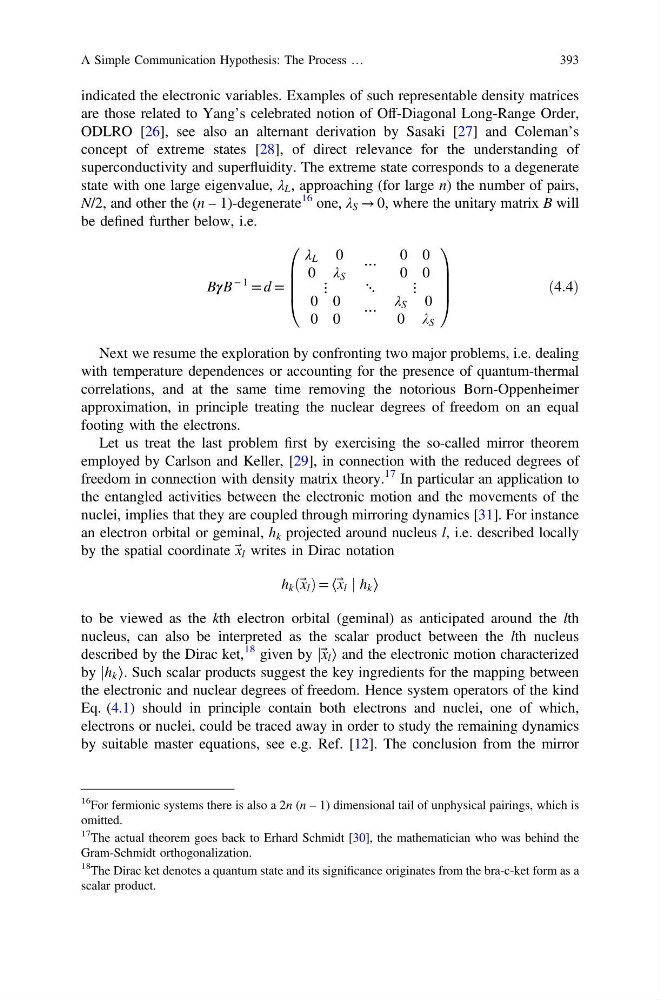
state with one large eigenvalue, λ L , approaching (for large n) the number of pairs,
N/2, and other the (n – 1)-degenerate
16 one, λ S → 0, where the unitary matrix B will
be defined further below, i.e.
BγB
− 1 = d =
λ L 0
0 λ S
⋯
0 0
0 0
⋮
⋱
⋮
0 0
0 0
⋯
λ S 0
0 λ S
0
B
B
B
@
1
C
C
C
A
ð4:4Þ
Next we resume the exploration by confronting two major problems, i.e. dealing
with temperature dependences or accounting for the presence of quantum-thermal
correlations, and at the same time removing the notorious Born-Oppenheimer
approximation, in principle treating the nuclear degrees of freedom on an equal
footing with the electrons.
Let us treat the last problem first by exercising the so-called mirror theorem
employed by Carlson and Keller, [29], in connection with the reduced degrees of
freedom in connection with density matrix theory.
17 In particular an application to
the entangled activities between the electronic motion and the movements of the
nuclei, implies that they are coupled through mirroring dynamics [31]. For instance
an electron orbital or geminal, h k projected around nucleus l, i.e. described locally
by the spatial coordinate x⃗ l writes in Dirac notation
h k x⃗ l
ð Þ= ⟨x⃗ l j h k ⟩
to be viewed as the kth electron orbital (geminal) as anticipated around the lth
nucleus, can also be interpreted as the scalar product between the lth nucleus
described by the Dirac ket,
18 given by x⃗ l
j ⟩ and the electronic motion characterized
by h k
j ⟩. Such scalar products suggest the key ingredients for the mapping between
the electronic and nuclear degrees of freedom. Hence system operators of the kind
Eq. (4.1) should in principle contain both electrons and nuclei, one of which,
electrons or nuclei, could be traced away in order to study the remaining dynamics
by suitable master equations, see e.g. Ref. [12]. The conclusion from the mirror
16
For fermionic systems there is also a 2n (n – 1) dimensional tail of unphysical pairings, which is
omitted.
17
The actual theorem goes back to Erhard Schmidt [30], the mathematician who was behind the
Gram-Schmidt orthogonalization.
18
The Dirac ket denotes a quantum state and its significance originates from the bra-c-ket form as a
scalar product.
A Simple Communication Hypothesis: The Process …
393
are those related to Yang’s celebrated notion of Off-Diagonal Long-Range Order,
ODLRO [26], see also an alternant derivation by Sasaki [27] and Coleman’s
concept of extreme states [28], of direct relevance for the understanding of
superconductivity and superfluidity. The extreme state corresponds to a degenerate
state with one large eigenvalue, λ L , approaching (for large n) the number of pairs,
N/2, and other the (n – 1)-degenerate
16 one, λ S → 0, where the unitary matrix B will
be defined further below, i.e.
BγB
− 1 = d =
λ L 0
0 λ S
⋯
0 0
0 0
⋮
⋱
⋮
0 0
0 0
⋯
λ S 0
0 λ S
0
B
B
B
@
1
C
C
C
A
ð4:4Þ
Next we resume the exploration by confronting two major problems, i.e. dealing
with temperature dependences or accounting for the presence of quantum-thermal
correlations, and at the same time removing the notorious Born-Oppenheimer
approximation, in principle treating the nuclear degrees of freedom on an equal
footing with the electrons.
Let us treat the last problem first by exercising the so-called mirror theorem
employed by Carlson and Keller, [29], in connection with the reduced degrees of
freedom in connection with density matrix theory.
17 In particular an application to
the entangled activities between the electronic motion and the movements of the
nuclei, implies that they are coupled through mirroring dynamics [31]. For instance
an electron orbital or geminal, h k projected around nucleus l, i.e. described locally
by the spatial coordinate x⃗ l writes in Dirac notation
h k x⃗ l
ð Þ= ⟨x⃗ l j h k ⟩
to be viewed as the kth electron orbital (geminal) as anticipated around the lth
nucleus, can also be interpreted as the scalar product between the lth nucleus
described by the Dirac ket,
18 given by x⃗ l
j ⟩ and the electronic motion characterized
by h k
j ⟩. Such scalar products suggest the key ingredients for the mapping between
the electronic and nuclear degrees of freedom. Hence system operators of the kind
Eq. (4.1) should in principle contain both electrons and nuclei, one of which,
electrons or nuclei, could be traced away in order to study the remaining dynamics
by suitable master equations, see e.g. Ref. [12]. The conclusion from the mirror
16
For fermionic systems there is also a 2n (n – 1) dimensional tail of unphysical pairings, which is
omitted.
17
The actual theorem goes back to Erhard Schmidt [30], the mathematician who was behind the
Gram-Schmidt orthogonalization.
18
The Dirac ket denotes a quantum state and its significance originates from the bra-c-ket form as a
scalar product.
A Simple Communication Hypothesis: The Process …
393