

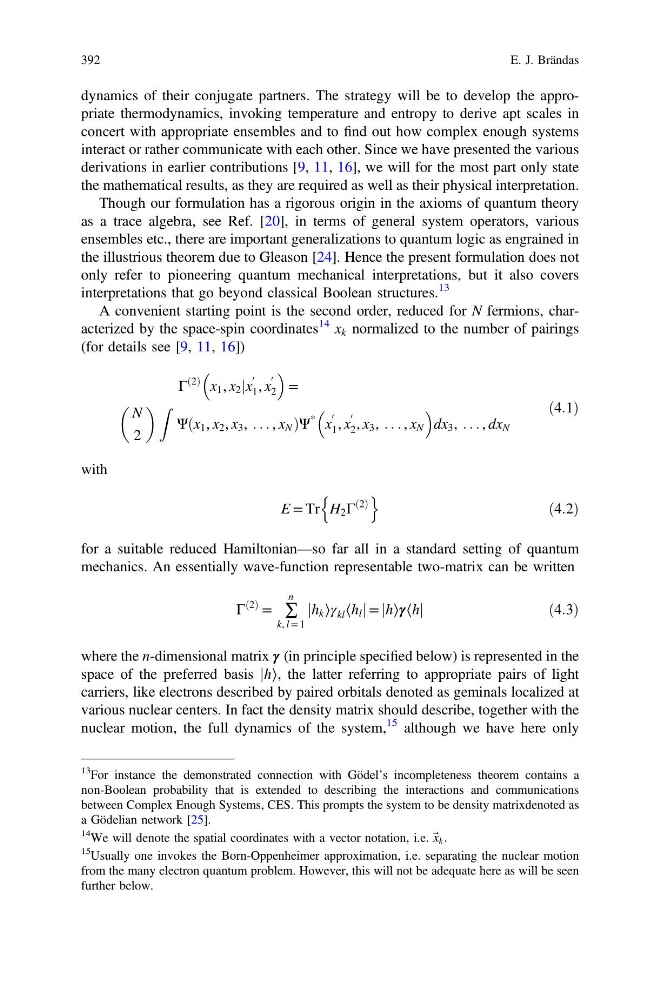
dynamics of their conjugate partners. The strategy will be to develop the appropriate thermodynamics, invoking temperature and entropy to derive apt scales in
concert with appropriate ensembles and to find out how complex enough systems
interact or rather communicate with each other. Since we have presented the various
derivations in earlier contributions [9, 11, 16], we will for the most part only state
the mathematical results, as they are required as well as their physical interpretation.
Though our formulation has a rigorous origin in the axioms of quantum theory
as a trace algebra, see Ref. [20], in terms of general system operators, various
ensembles etc., there are important generalizations to quantum logic as engrained in
the illustrious theorem due to Gleason [24]. Hence the present formulation does not
only refer to pioneering quantum mechanical interpretations, but it also covers
interpretations that go beyond classical Boolean structures.
13
A convenient starting point is the second order, reduced for N fermions, characterized by the space-spin coordinates
14 x k normalized to the number of pairings
(for details see [9, 11, 16])
Γ
2
ð Þ x 1 , x 2 jx
0
1 , x
0
2
=
N
2
Z
Ψ x 1 , x 2 , x 3 , . . . , x N
ð
Þ Ψ
* x
0
1 , x
0
2 , x 3 , . . . , x N
dx 3 , . . . , dx N
ð4:1Þ
with
E = Tr H 2 Γ
2
ð Þ
n
o
ð4:2Þ
for a suitable reduced Hamiltonian—so far all in a standard setting of quantum
mechanics. An essentially wave-function representable two-matrix can be written
Γ
2
ð Þ = ∑
n
k, l = 1
h k
j ⟩γ kl ⟨h l j = h
j ⟩γ⟨hj
ð4:3Þ
where the n-dimensional matrix γ (in principle specified below) is represented in the
space of the preferred basis h
j ⟩, the latter referring to appropriate pairs of light
carriers, like electrons described by paired orbitals denoted as geminals localized at
various nuclear centers. In fact the density matrix should describe, together with the
nuclear motion, the full dynamics of the system,
15 although we have here only
13
For instance the demonstrated connection with Gödel’s incompleteness theorem contains a
non-Boolean probability that is extended to describing the interactions and communications
between Complex Enough Systems, CES. This prompts the system to be density matrixdenoted as
a Gödelian network [25].
14
We will denote the spatial coordinates with a vector notation, i.e. x⃗ k .
15
Usually one invokes the Born-Oppenheimer approximation, i.e. separating the nuclear motion
from the many electron quantum problem. However, this will not be adequate here as will be seen
further below.
392
E. J. Brändas
concert with appropriate ensembles and to find out how complex enough systems
interact or rather communicate with each other. Since we have presented the various
derivations in earlier contributions [9, 11, 16], we will for the most part only state
the mathematical results, as they are required as well as their physical interpretation.
Though our formulation has a rigorous origin in the axioms of quantum theory
as a trace algebra, see Ref. [20], in terms of general system operators, various
ensembles etc., there are important generalizations to quantum logic as engrained in
the illustrious theorem due to Gleason [24]. Hence the present formulation does not
only refer to pioneering quantum mechanical interpretations, but it also covers
interpretations that go beyond classical Boolean structures.
13
A convenient starting point is the second order, reduced for N fermions, characterized by the space-spin coordinates
14 x k normalized to the number of pairings
(for details see [9, 11, 16])
Γ
2
ð Þ x 1 , x 2 jx
0
1 , x
0
2
=
N
2
Z
Ψ x 1 , x 2 , x 3 , . . . , x N
ð
Þ Ψ
* x
0
1 , x
0
2 , x 3 , . . . , x N
dx 3 , . . . , dx N
ð4:1Þ
with
E = Tr H 2 Γ
2
ð Þ
n
o
ð4:2Þ
for a suitable reduced Hamiltonian—so far all in a standard setting of quantum
mechanics. An essentially wave-function representable two-matrix can be written
Γ
2
ð Þ = ∑
n
k, l = 1
h k
j ⟩γ kl ⟨h l j = h
j ⟩γ⟨hj
ð4:3Þ
where the n-dimensional matrix γ (in principle specified below) is represented in the
space of the preferred basis h
j ⟩, the latter referring to appropriate pairs of light
carriers, like electrons described by paired orbitals denoted as geminals localized at
various nuclear centers. In fact the density matrix should describe, together with the
nuclear motion, the full dynamics of the system,
15 although we have here only
13
For instance the demonstrated connection with Gödel’s incompleteness theorem contains a
non-Boolean probability that is extended to describing the interactions and communications
between Complex Enough Systems, CES. This prompts the system to be density matrixdenoted as
a Gödelian network [25].
14
We will denote the spatial coordinates with a vector notation, i.e. x⃗ k .
15
Usually one invokes the Born-Oppenheimer approximation, i.e. separating the nuclear motion
from the many electron quantum problem. However, this will not be adequate here as will be seen
further below.
392
E. J. Brändas