

speed c, like the photon! As will be clear below, this implies that zero- and non-zero
rest-mass particles behave fundamentally different, which will become of crucial
importance in the case of the theory of general relativity to be reviewed below.
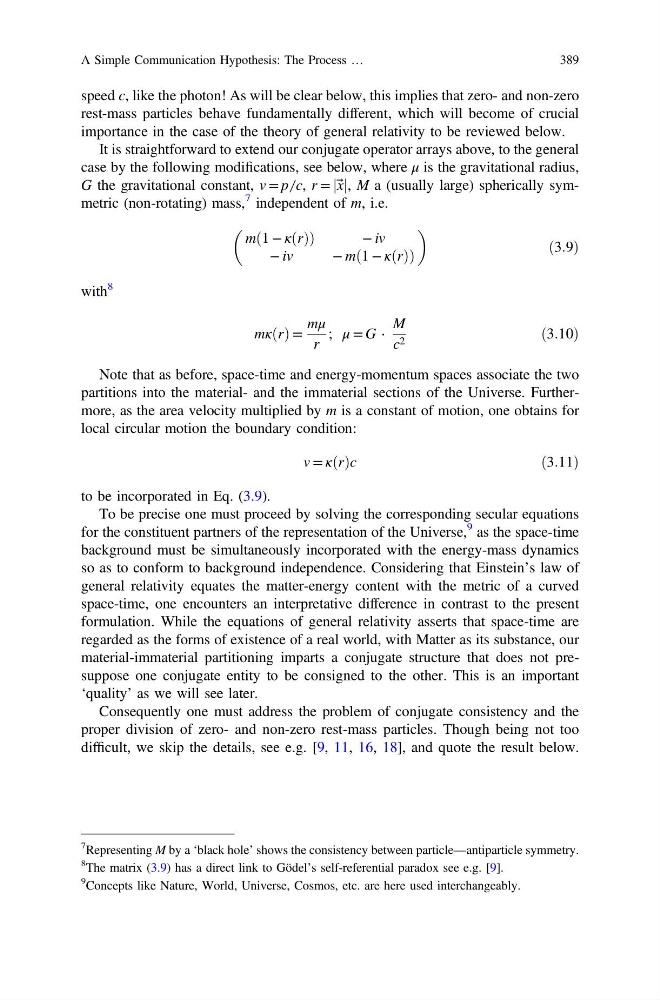
It is straightforward to extend our conjugate operator arrays above, to the general
case by the following modifications, see below, where μ is the gravitational radius,
G the gravitational constant, v = p ̸ c, r = x⃗
j j, M a (usually large) spherically symmetric (non-rotating) mass,
7 independent of m, i.e.
m 1 − κ r
ð Þ
ð
Þ
− iv
− iv
− m 1 − κ r
ð Þ
ð
Þ
ð3:9Þ
with
8
mκ r
ð Þ =
mμ
r
; μ = G ⋅
M
c 2
ð3:10Þ
Note that as before, space-time and energy-momentum spaces associate the two
partitions into the material- and the immaterial sections of the Universe. Furthermore, as the area velocity multiplied by m is a constant of motion, one obtains for
local circular motion the boundary condition:
v = κ r
ð Þc
ð3:11Þ
to be incorporated in Eq. (3.9).
To be precise one must proceed by solving the corresponding secular equations
for the constituent partners of the representation of the Universe,
9 as the space-time
background must be simultaneously incorporated with the energy-mass dynamics
so as to conform to background independence. Considering that Einstein’s law of
general relativity equates the matter-energy content with the metric of a curved
space-time, one encounters an interpretative difference in contrast to the present
formulation. While the equations of general relativity asserts that space-time are
regarded as the forms of existence of a real world, with Matter as its substance, our
material-immaterial partitioning imparts a conjugate structure that does not presuppose one conjugate entity to be consigned to the other. This is an important
‘quality’ as we will see later.
Consequently one must address the problem of conjugate consistency and the
proper division of zero- and non-zero rest-mass particles. Though being not too
difficult, we skip the details, see e.g. [9, 11, 16, 18], and quote the result below.
7
Representing M by a ‘black hole’ shows the consistency between particle—antiparticle symmetry.
8
The matrix (3.9) has a direct link to Gödel’s self-referential paradox see e.g. [9].
9
Concepts like Nature, World, Universe, Cosmos, etc. are here used interchangeably.
A Simple Communication Hypothesis: The Process …
389
rest-mass particles behave fundamentally different, which will become of crucial
importance in the case of the theory of general relativity to be reviewed below.
It is straightforward to extend our conjugate operator arrays above, to the general
case by the following modifications, see below, where μ is the gravitational radius,
G the gravitational constant, v = p ̸ c, r = x⃗
j j, M a (usually large) spherically symmetric (non-rotating) mass,
7 independent of m, i.e.
m 1 − κ r
ð Þ
ð
Þ
− iv
− iv
− m 1 − κ r
ð Þ
ð
Þ
ð3:9Þ
with
8
mκ r
ð Þ =
mμ
r
; μ = G ⋅
M
c 2
ð3:10Þ
Note that as before, space-time and energy-momentum spaces associate the two
partitions into the material- and the immaterial sections of the Universe. Furthermore, as the area velocity multiplied by m is a constant of motion, one obtains for
local circular motion the boundary condition:
v = κ r
ð Þc
ð3:11Þ
to be incorporated in Eq. (3.9).
To be precise one must proceed by solving the corresponding secular equations
for the constituent partners of the representation of the Universe,
9 as the space-time
background must be simultaneously incorporated with the energy-mass dynamics
so as to conform to background independence. Considering that Einstein’s law of
general relativity equates the matter-energy content with the metric of a curved
space-time, one encounters an interpretative difference in contrast to the present
formulation. While the equations of general relativity asserts that space-time are
regarded as the forms of existence of a real world, with Matter as its substance, our
material-immaterial partitioning imparts a conjugate structure that does not presuppose one conjugate entity to be consigned to the other. This is an important
‘quality’ as we will see later.
Consequently one must address the problem of conjugate consistency and the
proper division of zero- and non-zero rest-mass particles. Though being not too
difficult, we skip the details, see e.g. [9, 11, 16, 18], and quote the result below.
7
Representing M by a ‘black hole’ shows the consistency between particle—antiparticle symmetry.
8
The matrix (3.9) has a direct link to Gödel’s self-referential paradox see e.g. [9].
9
Concepts like Nature, World, Universe, Cosmos, etc. are here used interchangeably.
A Simple Communication Hypothesis: The Process …
389