

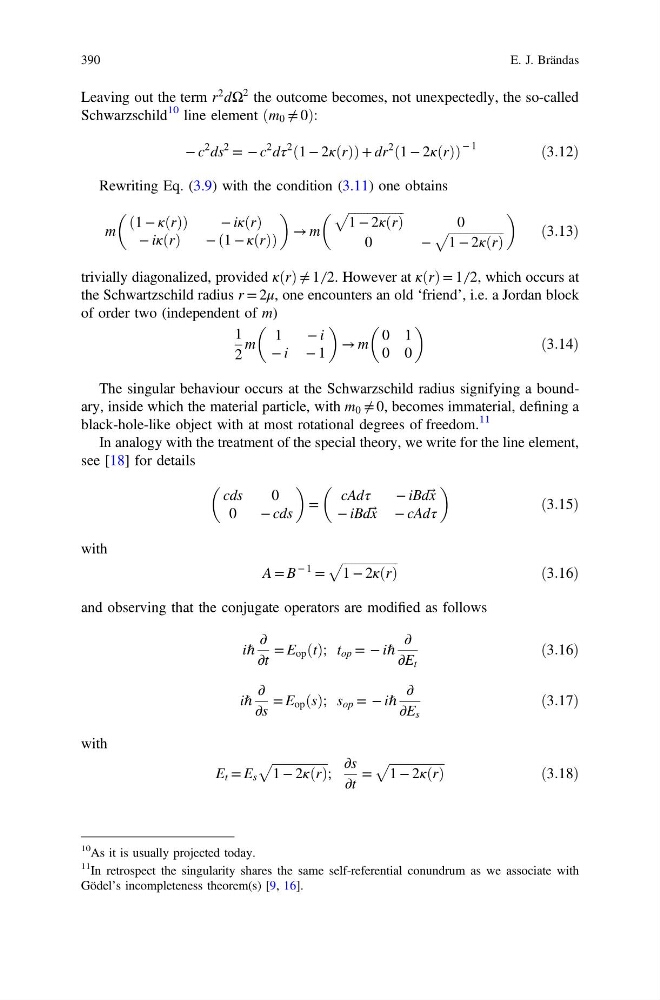
Leaving out the term r
2 dΩ
2 the outcome becomes, not unexpectedly, the so-called
Schwarzschild
10 line element ðm 0 ≠ 0Þ:
− c
2 ds
2 = − c
2 dτ
2 1 − 2κ r
ð Þ
ð
Þ+ dr
2 1 − 2κ r
ð Þ
ð
Þ
− 1
ð3:12Þ
Rewriting Eq. (3.9) with the condition (3.11) one obtains
m
1 − κ r
ð Þ
ð
Þ
− iκ r
ð Þ
− iκ r
ð Þ
− 1 − κ r
ð Þ
ð
Þ
→ m
ffiffiffiffiffiffiffiffiffiffiffiffiffiffiffiffiffiffi
1 − 2κ r
ð Þ
p
0
0
−
ffiffiffiffiffiffiffiffiffiffiffiffiffiffiffiffiffiffi
1 − 2κ r
ð Þ
p
ð3:13Þ
trivially diagonalized, provided κ r
ð Þ ≠ 1 ̸ 2. However at κ r
ð Þ = 1 ̸ 2, which occurs at
the Schwartzschild radius r = 2μ, one encounters an old ‘friend’, i.e. a Jordan block
of order two (independent of m)
1
2
m
1
− i
− i − 1
→ m
0 1
0 0
ð3:14Þ
The singular behaviour occurs at the Schwarzschild radius signifying a boundary, inside which the material particle, with m 0 ≠ 0, becomes immaterial, defining a
black-hole-like object with at most rotational degrees of freedom.
11
In analogy with the treatment of the special theory, we write for the line element,
see [18] for details
cds
0
0
− cds
=
cAdτ
− iBdx⃗
− iBdx⃗ − cAdτ
ð3:15Þ
with
A = B
− 1 =
ffiffiffiffiffiffiffiffiffiffiffiffiffiffiffiffiffiffi
1 − 2κ r
ð Þ
p
ð3:16Þ
and observing that the conjugate operators are modified as follows
iℏ
∂
∂t
= E op t
ð Þ; t op = − iℏ
∂
∂E t
ð3:16Þ
iℏ
∂
∂s
= E op s
ð Þ; s op = − iℏ
∂
∂E s
ð3:17Þ
with
E t = E s
ffiffiffiffiffiffiffiffiffiffiffiffiffiffiffiffiffiffi
1 − 2κ r
ð Þ
p
;
∂s
∂t
=
ffiffiffiffiffiffiffiffiffiffiffiffiffiffiffiffiffiffi
1 − 2κ r
ð Þ
p
ð3:18Þ
10
As it is usually projected today.
11
In retrospect the singularity shares the same self-referential conundrum as we associate with
Gödel’s incompleteness theorem(s) [9, 16].
390
E. J. Brändas
2 dΩ
2 the outcome becomes, not unexpectedly, the so-called
Schwarzschild
10 line element ðm 0 ≠ 0Þ:
− c
2 ds
2 = − c
2 dτ
2 1 − 2κ r
ð Þ
ð
Þ+ dr
2 1 − 2κ r
ð Þ
ð
Þ
− 1
ð3:12Þ
Rewriting Eq. (3.9) with the condition (3.11) one obtains
m
1 − κ r
ð Þ
ð
Þ
− iκ r
ð Þ
− iκ r
ð Þ
− 1 − κ r
ð Þ
ð
Þ
→ m
ffiffiffiffiffiffiffiffiffiffiffiffiffiffiffiffiffiffi
1 − 2κ r
ð Þ
p
0
0
−
ffiffiffiffiffiffiffiffiffiffiffiffiffiffiffiffiffiffi
1 − 2κ r
ð Þ
p
ð3:13Þ
trivially diagonalized, provided κ r
ð Þ ≠ 1 ̸ 2. However at κ r
ð Þ = 1 ̸ 2, which occurs at
the Schwartzschild radius r = 2μ, one encounters an old ‘friend’, i.e. a Jordan block
of order two (independent of m)
1
2
m
1
− i
− i − 1
→ m
0 1
0 0
ð3:14Þ
The singular behaviour occurs at the Schwarzschild radius signifying a boundary, inside which the material particle, with m 0 ≠ 0, becomes immaterial, defining a
black-hole-like object with at most rotational degrees of freedom.
11
In analogy with the treatment of the special theory, we write for the line element,
see [18] for details
cds
0
0
− cds
=
cAdτ
− iBdx⃗
− iBdx⃗ − cAdτ
ð3:15Þ
with
A = B
− 1 =
ffiffiffiffiffiffiffiffiffiffiffiffiffiffiffiffiffiffi
1 − 2κ r
ð Þ
p
ð3:16Þ
and observing that the conjugate operators are modified as follows
iℏ
∂
∂t
= E op t
ð Þ; t op = − iℏ
∂
∂E t
ð3:16Þ
iℏ
∂
∂s
= E op s
ð Þ; s op = − iℏ
∂
∂E s
ð3:17Þ
with
E t = E s
ffiffiffiffiffiffiffiffiffiffiffiffiffiffiffiffiffiffi
1 − 2κ r
ð Þ
p
;
∂s
∂t
=
ffiffiffiffiffiffiffiffiffiffiffiffiffiffiffiffiffiffi
1 − 2κ r
ð Þ
p
ð3:18Þ
10
As it is usually projected today.
11
In retrospect the singularity shares the same self-referential conundrum as we associate with
Gödel’s incompleteness theorem(s) [9, 16].
390
E. J. Brändas