

transformation, see e.g. Refs. [18, 22], since from Eqs. (3.1) and (3.2) one obtains
straightforwardly the relativistic space-time scales of special relativity
m =
m 0
ffiffiffiffiffiffiffiffiffiffiffiffi
1 − β
2
p
ð3:7Þ
with β = v ̸ c = p ̸ mc, and
τ =
τ 0
ffiffiffiffiffiffiffiffiffiffiffiffi
1 − β
2
p
; x =
x 0
ffiffiffiffiffiffiffiffiffiffiffiffi
1 − β
2
p
ð3:8Þ
In this setting Eqs. (3.7) and (3.8) are valid irrespective of whether we are
representing classical wave propagation, quantum matter waves or classical
particles.
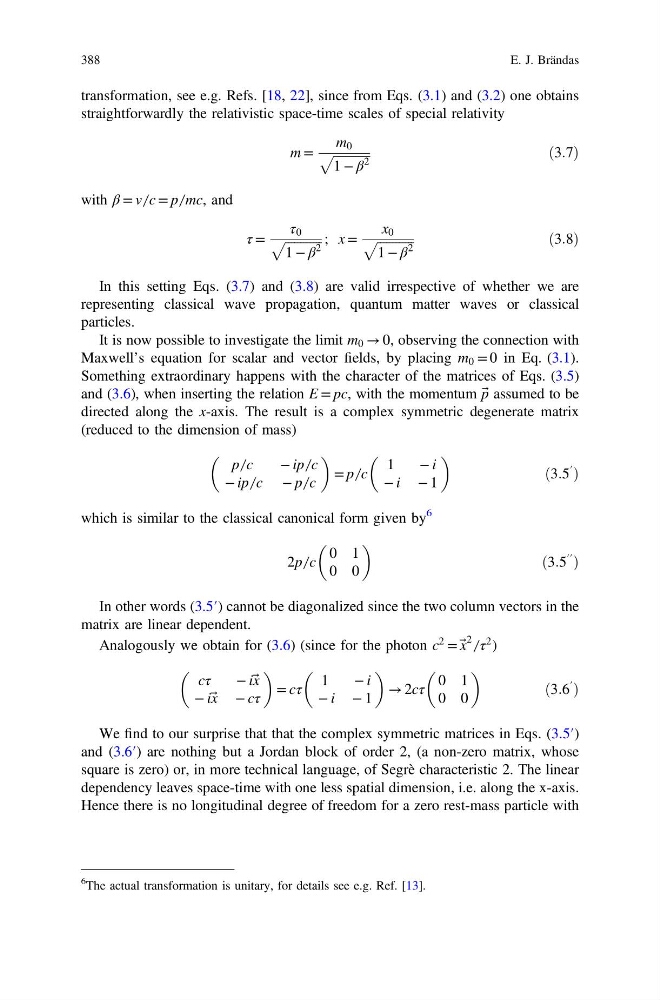
It is now possible to investigate the limit m 0 → 0, observing the connection with
Maxwell’s equation for scalar and vector fields, by placing m 0 = 0 in Eq. (3.1).
Something extraordinary happens with the character of the matrices of Eqs. (3.5)
and (3.6), when inserting the relation E = pc, with the momentum p⃗ assumed to be
directed along the x-axis. The result is a complex symmetric degenerate matrix
(reduced to the dimension of mass)
p ̸ c
− ip ̸ c
− ip ̸ c − p ̸ c
= p ̸ c
1
− i
− i − 1
ð3:5
′
Þ
which is similar to the classical canonical form given by
6
2p ̸ c
0 1
0 0
ð3:5
′′
Þ
In other words (3.5′) cannot be diagonalized since the two column vectors in the
matrix are linear dependent.
Analogously we obtain for (3.6) (since for the photon c
2 = x⃗
2 ̸ τ
2 )
cτ
− ix⃗
− ix⃗ − cτ
= cτ
1
− i
− i − 1
→ 2cτ
0 1
0 0
ð3:6
′
Þ
We find to our surprise that that the complex symmetric matrices in Eqs. (3.5′)
and (3.6′) are nothing but a Jordan block of order 2, (a non-zero matrix, whose
square is zero) or, in more technical language, of Segrè characteristic 2. The linear
dependency leaves space-time with one less spatial dimension, i.e. along the x-axis.
Hence there is no longitudinal degree of freedom for a zero rest-mass particle with
6
The actual transformation is unitary, for details see e.g. Ref. [13].
388
E. J. Brändas
straightforwardly the relativistic space-time scales of special relativity
m =
m 0
ffiffiffiffiffiffiffiffiffiffiffiffi
1 − β
2
p
ð3:7Þ
with β = v ̸ c = p ̸ mc, and
τ =
τ 0
ffiffiffiffiffiffiffiffiffiffiffiffi
1 − β
2
p
; x =
x 0
ffiffiffiffiffiffiffiffiffiffiffiffi
1 − β
2
p
ð3:8Þ
In this setting Eqs. (3.7) and (3.8) are valid irrespective of whether we are
representing classical wave propagation, quantum matter waves or classical
particles.
It is now possible to investigate the limit m 0 → 0, observing the connection with
Maxwell’s equation for scalar and vector fields, by placing m 0 = 0 in Eq. (3.1).
Something extraordinary happens with the character of the matrices of Eqs. (3.5)
and (3.6), when inserting the relation E = pc, with the momentum p⃗ assumed to be
directed along the x-axis. The result is a complex symmetric degenerate matrix
(reduced to the dimension of mass)
p ̸ c
− ip ̸ c
− ip ̸ c − p ̸ c
= p ̸ c
1
− i
− i − 1
ð3:5
′
Þ
which is similar to the classical canonical form given by
6
2p ̸ c
0 1
0 0
ð3:5
′′
Þ
In other words (3.5′) cannot be diagonalized since the two column vectors in the
matrix are linear dependent.
Analogously we obtain for (3.6) (since for the photon c
2 = x⃗
2 ̸ τ
2 )
cτ
− ix⃗
− ix⃗ − cτ
= cτ
1
− i
− i − 1
→ 2cτ
0 1
0 0
ð3:6
′
Þ
We find to our surprise that that the complex symmetric matrices in Eqs. (3.5′)
and (3.6′) are nothing but a Jordan block of order 2, (a non-zero matrix, whose
square is zero) or, in more technical language, of Segrè characteristic 2. The linear
dependency leaves space-time with one less spatial dimension, i.e. along the x-axis.
Hence there is no longitudinal degree of freedom for a zero rest-mass particle with
6
The actual transformation is unitary, for details see e.g. Ref. [13].
388
E. J. Brändas