

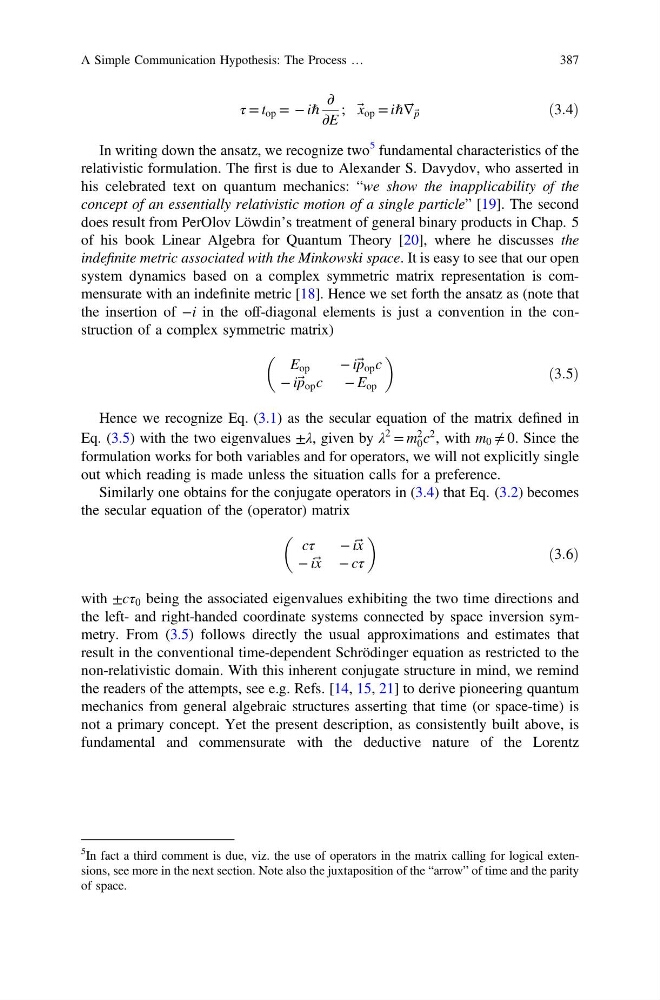
τ = t op = − iℏ
∂
∂E
; x⃗ op = iℏ∇⃗ p⃗
ð3:4Þ
In writing down the ansatz, we recognize two
5 fundamental characteristics of the
relativistic formulation. The first is due to Alexander S. Davydov, who asserted in
his celebrated text on quantum mechanics: “we show the inapplicability of the
concept of an essentially relativistic motion of a single particle” [19]. The second
does result from PerOlov Löwdin’s treatment of general binary products in Chap. 5
of his book Linear Algebra for Quantum Theory [20], where he discusses the
indefinite metric associated with the Minkowski space. It is easy to see that our open
system dynamics based on a complex symmetric matrix representation is commensurate with an indefinite metric [18]. Hence we set forth the ansatz as (note that
the insertion of −i in the off-diagonal elements is just a convention in the construction of a complex symmetric matrix)
E op
− ip⃗ op c
− ip⃗ op c − E op
ð3:5Þ
Hence we recognize Eq. (3.1) as the secular equation of the matrix defined in
Eq. (3.5) with the two eigenvalues ±λ, given by λ
2 = m
2
0 c
2 , with m 0 ≠ 0. Since the
formulation works for both variables and for operators, we will not explicitly single
out which reading is made unless the situation calls for a preference.
Similarly one obtains for the conjugate operators in (3.4) that Eq. (3.2) becomes
the secular equation of the (operator) matrix
cτ
− ix⃗
− ix⃗ − cτ
ð3:6Þ
with ±cτ 0 being the associated eigenvalues exhibiting the two time directions and
the left- and right-handed coordinate systems connected by space inversion symmetry. From (3.5) follows directly the usual approximations and estimates that
result in the conventional time-dependent Schrödinger equation as restricted to the
non-relativistic domain. With this inherent conjugate structure in mind, we remind
the readers of the attempts, see e.g. Refs. [14, 15, 21] to derive pioneering quantum
mechanics from general algebraic structures asserting that time (or space-time) is
not a primary concept. Yet the present description, as consistently built above, is
fundamental and commensurate with the deductive nature of the Lorentz
5
In fact a third comment is due, viz. the use of operators in the matrix calling for logical extensions, see more in the next section. Note also the juxtaposition of the “arrow” of time and the parity
of space.
A Simple Communication Hypothesis: The Process …
387
∂
∂E
; x⃗ op = iℏ∇⃗ p⃗
ð3:4Þ
In writing down the ansatz, we recognize two
5 fundamental characteristics of the
relativistic formulation. The first is due to Alexander S. Davydov, who asserted in
his celebrated text on quantum mechanics: “we show the inapplicability of the
concept of an essentially relativistic motion of a single particle” [19]. The second
does result from PerOlov Löwdin’s treatment of general binary products in Chap. 5
of his book Linear Algebra for Quantum Theory [20], where he discusses the
indefinite metric associated with the Minkowski space. It is easy to see that our open
system dynamics based on a complex symmetric matrix representation is commensurate with an indefinite metric [18]. Hence we set forth the ansatz as (note that
the insertion of −i in the off-diagonal elements is just a convention in the construction of a complex symmetric matrix)
E op
− ip⃗ op c
− ip⃗ op c − E op
ð3:5Þ
Hence we recognize Eq. (3.1) as the secular equation of the matrix defined in
Eq. (3.5) with the two eigenvalues ±λ, given by λ
2 = m
2
0 c
2 , with m 0 ≠ 0. Since the
formulation works for both variables and for operators, we will not explicitly single
out which reading is made unless the situation calls for a preference.
Similarly one obtains for the conjugate operators in (3.4) that Eq. (3.2) becomes
the secular equation of the (operator) matrix
cτ
− ix⃗
− ix⃗ − cτ
ð3:6Þ
with ±cτ 0 being the associated eigenvalues exhibiting the two time directions and
the left- and right-handed coordinate systems connected by space inversion symmetry. From (3.5) follows directly the usual approximations and estimates that
result in the conventional time-dependent Schrödinger equation as restricted to the
non-relativistic domain. With this inherent conjugate structure in mind, we remind
the readers of the attempts, see e.g. Refs. [14, 15, 21] to derive pioneering quantum
mechanics from general algebraic structures asserting that time (or space-time) is
not a primary concept. Yet the present description, as consistently built above, is
fundamental and commensurate with the deductive nature of the Lorentz
5
In fact a third comment is due, viz. the use of operators in the matrix calling for logical extensions, see more in the next section. Note also the juxtaposition of the “arrow” of time and the parity
of space.
A Simple Communication Hypothesis: The Process …
387