

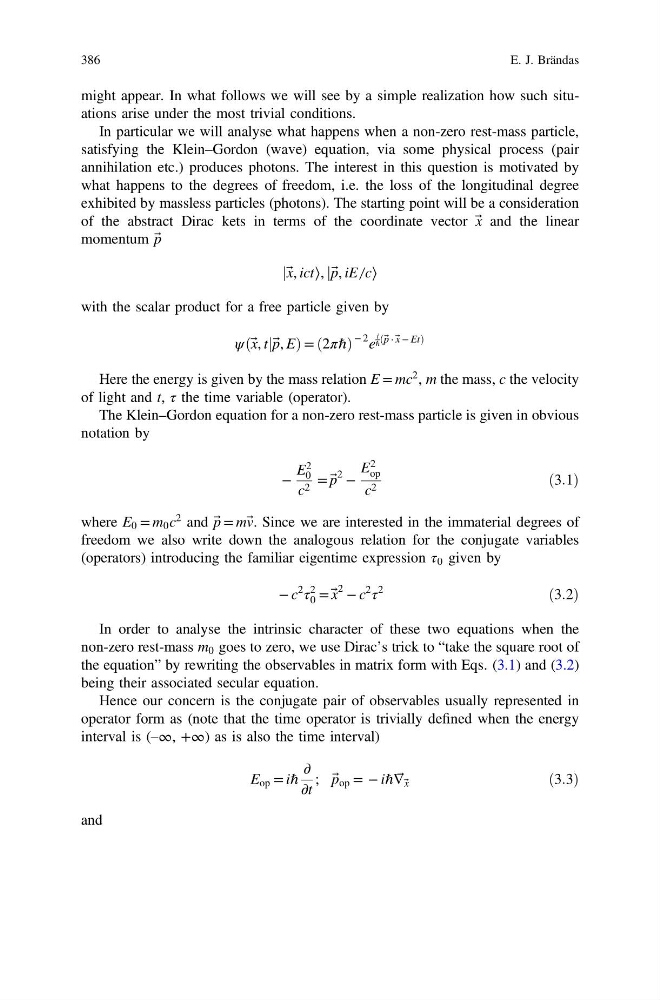
might appear. In what follows we will see by a simple realization how such situations arise under the most trivial conditions.
In particular we will analyse what happens when a non-zero rest-mass particle,
satisfying the Klein–Gordon (wave) equation, via some physical process (pair
annihilation etc.) produces photons. The interest in this question is motivated by
what happens to the degrees of freedom, i.e. the loss of the longitudinal degree
exhibited by massless particles (photons). The starting point will be a consideration
of the abstract Dirac kets in terms of the coordinate vector x⃗ and the linear
momentum p⃗
x⃗ , ict
j
⟩, p⃗ , iE ̸ c
j
⟩
with the scalar product for a free particle given by
ψðx⃗ , tjp⃗ , EÞ = 2πℏ
ð
Þ
− 2 e
i
ℏ p⃗ ⋅ x⃗ − Et
ð
Þ
Here the energy is given by the mass relation E = mc
2 , m the mass, c the velocity
of light and t, τ the time variable (operator).
The Klein–Gordon equation for a non-zero rest-mass particle is given in obvious
notation by
−
E
2
0
c 2 = p⃗
2 −
E
2
op
c 2
ð3:1Þ
where E 0 = m 0 c
2 and p⃗ = mv⃗ . Since we are interested in the immaterial degrees of
freedom we also write down the analogous relation for the conjugate variables
(operators) introducing the familiar eigentime expression τ 0 given by
− c
2
τ
2
0 = x⃗
2 − c
2
τ
2
ð3:2Þ
In order to analyse the intrinsic character of these two equations when the
non-zero rest-mass m 0 goes to zero, we use Dirac’s trick to “take the square root of
the equation” by rewriting the observables in matrix form with Eqs. (3.1) and (3.2)
being their associated secular equation.
Hence our concern is the conjugate pair of observables usually represented in
operator form as (note that the time operator is trivially defined when the energy
interval is (–∞, +∞) as is also the time interval)
E op = iℏ
∂
∂t
; p⃗ op = − iℏ∇⃗ x⃗
ð3:3Þ
and
386
E. J. Brändas
In particular we will analyse what happens when a non-zero rest-mass particle,
satisfying the Klein–Gordon (wave) equation, via some physical process (pair
annihilation etc.) produces photons. The interest in this question is motivated by
what happens to the degrees of freedom, i.e. the loss of the longitudinal degree
exhibited by massless particles (photons). The starting point will be a consideration
of the abstract Dirac kets in terms of the coordinate vector x⃗ and the linear
momentum p⃗
x⃗ , ict
j
⟩, p⃗ , iE ̸ c
j
⟩
with the scalar product for a free particle given by
ψðx⃗ , tjp⃗ , EÞ = 2πℏ
ð
Þ
− 2 e
i
ℏ p⃗ ⋅ x⃗ − Et
ð
Þ
Here the energy is given by the mass relation E = mc
2 , m the mass, c the velocity
of light and t, τ the time variable (operator).
The Klein–Gordon equation for a non-zero rest-mass particle is given in obvious
notation by
−
E
2
0
c 2 = p⃗
2 −
E
2
op
c 2
ð3:1Þ
where E 0 = m 0 c
2 and p⃗ = mv⃗ . Since we are interested in the immaterial degrees of
freedom we also write down the analogous relation for the conjugate variables
(operators) introducing the familiar eigentime expression τ 0 given by
− c
2
τ
2
0 = x⃗
2 − c
2
τ
2
ð3:2Þ
In order to analyse the intrinsic character of these two equations when the
non-zero rest-mass m 0 goes to zero, we use Dirac’s trick to “take the square root of
the equation” by rewriting the observables in matrix form with Eqs. (3.1) and (3.2)
being their associated secular equation.
Hence our concern is the conjugate pair of observables usually represented in
operator form as (note that the time operator is trivially defined when the energy
interval is (–∞, +∞) as is also the time interval)
E op = iℏ
∂
∂t
; p⃗ op = − iℏ∇⃗ x⃗
ð3:3Þ
and
386
E. J. Brändas