

where the inverses of d e , a w and a e are defined in Eqs. (34), (42) and (26),
respectively. It can be noted that the exponents in Eq. (43) are related to the
consecutive Catalan numbers 3, 7 and 127 by: 5 = (3 + 7)/2; 67 = (7 + 127)/2.
6.3 Hypothetical Infraelectric and Supragravific Forces
The question has often been raised as to whether the Newton and Coulomb forces
may not behave differently at very large or very short distances, or whether there
may not be other, undisclosed forces. Cosmological observations have led to the
conclusions that there is a dark energy and a dark matter constituting, respectively,
75% and 21% of the observable Universe. Could there also be forces still larger than
the electric and nuclear forces or smaller than the gravific force?
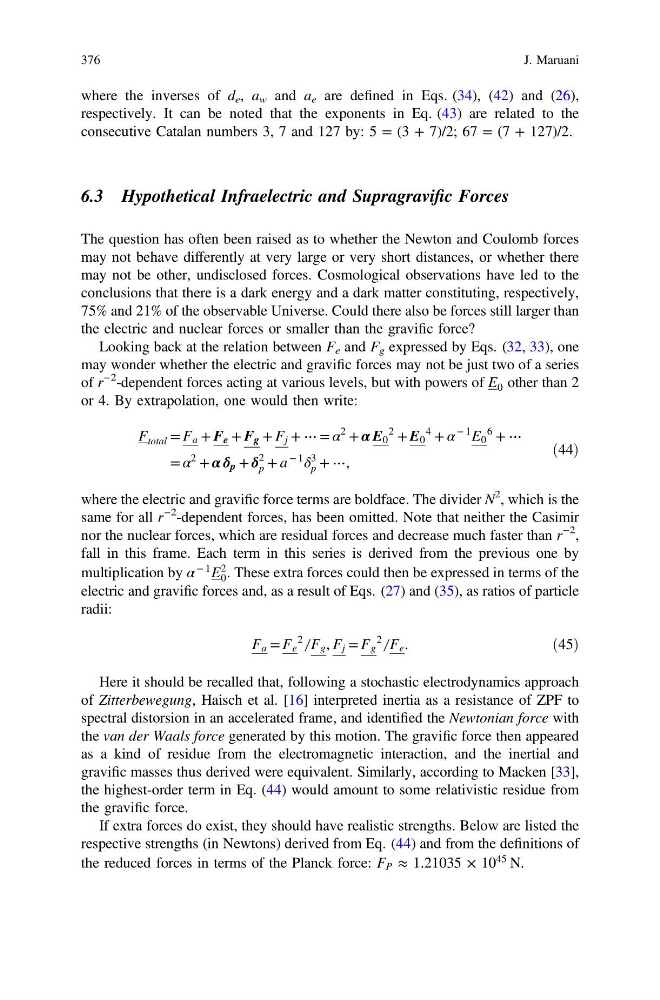
Looking back at the relation between F e and F g expressed by Eqs. (32, 33), one
may wonder whether the electric and gravific forces may not be just two of a series
of r
−2 -dependent forces acting at various levels, but with powers of E 0 other than 2
or 4. By extrapolation, one would then write:
F total = F a + F e + F g + F j + ⋯ = α
2 + α E 0
2 + E 0
4 + α
− 1 E 0
6 + ⋯
= α
2 + α δ p + δ
2
p + a
− 1
δ
3
p + ⋯,
ð44Þ
where the electric and gravific force terms are boldface. The divider N
2 , which is the
same for all r
−2 -dependent forces, has been omitted. Note that neither the Casimir
nor the nuclear forces, which are residual forces and decrease much faster than r
−2 ,
fall in this frame. Each term in this series is derived from the previous one by
multiplication by α
− 1 E
2
0 . These extra forces could then be expressed in terms of the
electric and gravific forces and, as a result of Eqs. (27) and (35), as ratios of particle
radii:
F a = F e
2
̸ F g , F j = F g
2
̸ F e .
ð45Þ
Here it should be recalled that, following a stochastic electrodynamics approach
of Zitterbewegung, Haisch et al. [16] interpreted inertia as a resistance of ZPF to
spectral distorsion in an accelerated frame, and identified the Newtonian force with
the van der Waals force generated by this motion. The gravific force then appeared
as a kind of residue from the electromagnetic interaction, and the inertial and
gravific masses thus derived were equivalent. Similarly, according to Macken [33],
the highest-order term in Eq. (44) would amount to some relativistic residue from
the gravific force.
If extra forces do exist, they should have realistic strengths. Below are listed the
respective strengths (in Newtons) derived from Eq. (44) and from the definitions of
the reduced forces in terms of the Planck force: F P ≈ 1.21035 × 10
45 N.
376
J. Maruani
respectively. It can be noted that the exponents in Eq. (43) are related to the
consecutive Catalan numbers 3, 7 and 127 by: 5 = (3 + 7)/2; 67 = (7 + 127)/2.
6.3 Hypothetical Infraelectric and Supragravific Forces
The question has often been raised as to whether the Newton and Coulomb forces
may not behave differently at very large or very short distances, or whether there
may not be other, undisclosed forces. Cosmological observations have led to the
conclusions that there is a dark energy and a dark matter constituting, respectively,
75% and 21% of the observable Universe. Could there also be forces still larger than
the electric and nuclear forces or smaller than the gravific force?
Looking back at the relation between F e and F g expressed by Eqs. (32, 33), one
may wonder whether the electric and gravific forces may not be just two of a series
of r
−2 -dependent forces acting at various levels, but with powers of E 0 other than 2
or 4. By extrapolation, one would then write:
F total = F a + F e + F g + F j + ⋯ = α
2 + α E 0
2 + E 0
4 + α
− 1 E 0
6 + ⋯
= α
2 + α δ p + δ
2
p + a
− 1
δ
3
p + ⋯,
ð44Þ
where the electric and gravific force terms are boldface. The divider N
2 , which is the
same for all r
−2 -dependent forces, has been omitted. Note that neither the Casimir
nor the nuclear forces, which are residual forces and decrease much faster than r
−2 ,
fall in this frame. Each term in this series is derived from the previous one by
multiplication by α
− 1 E
2
0 . These extra forces could then be expressed in terms of the
electric and gravific forces and, as a result of Eqs. (27) and (35), as ratios of particle
radii:
F a = F e
2
̸ F g , F j = F g
2
̸ F e .
ð45Þ
Here it should be recalled that, following a stochastic electrodynamics approach
of Zitterbewegung, Haisch et al. [16] interpreted inertia as a resistance of ZPF to
spectral distorsion in an accelerated frame, and identified the Newtonian force with
the van der Waals force generated by this motion. The gravific force then appeared
as a kind of residue from the electromagnetic interaction, and the inertial and
gravific masses thus derived were equivalent. Similarly, according to Macken [33],
the highest-order term in Eq. (44) would amount to some relativistic residue from
the gravific force.
If extra forces do exist, they should have realistic strengths. Below are listed the
respective strengths (in Newtons) derived from Eq. (44) and from the definitions of
the reduced forces in terms of the Planck force: F P ≈ 1.21035 × 10
45 N.
376
J. Maruani