

A number of model potentials have been proposed for the strong force (Yukawa
1934, Woods-Saxon 1954, Reid 1968, …), most of which are central scalar
potentials involving some exponential decrease. Nowadays, in the frame of the
standard model (where protons and neutrons are seen as made up of tight-bonded
quarks), the strong force appears as a residual, dispersion-like force. Its mean
magnitude, which depends on various factors, is known with poor accuracy [38], and
its dimensionless coupling constant: α s ≈ 0.1185 [39], is ∼ 16 times larger than the
fine-structure constant α e . Although this force does not follow a 1/r
2 decrease, its
magnitude with respect to the electric force is consistent with the first sum M’ 3 of the
combinatorial hierarchy [28]: M’ 7 /M’ 3 = 137/10 ∼ 14 [40].
The weak nuclear force was introduced in 1933 by Fermi to explain β decay
[38]. It has a number of specific features: (1) contrary to the other interactions, it
does not create bound states, but it allows transformation of a neutron to a proton or
vice versa by changing a quark flavor, this inducing β decay or electron capture;
(2) it is the only interaction that can violate parity symmetry; (3) contrary to the
other interactions, mediated by massless bosons, it is mediated by three very heavy,
short-lived bosons, two charged and one neutral. Besides, it is expected to decrease
with distance even faster than the strong nuclear force. However, in spite of these
crucial differences with the electromagnetic force, it has been unified with it in an
electroweak theory.
The weak force coupling constant is usually expressed in terms of a Fermi mass:
m F ≈ 5.730073 × 10
5 m e ≈ 5.219743 × 10
−25 kg, i.e.: G F ≡ ℏ
3
̸ c m
2
F , which is in
J.m
3 while ħ is in J.s [27]. One often uses the reduced constant: G F ̸ ðℏ cÞ
3 =
1 ̸ m
2
F c
4
≈ 0.454380 × 10
15 J
− 2 [39]. But this is not dimensionless, as were
α and δ. One could also use the more familiar form: G F ̸ ℏ c = ðℏ ̸ m F cÞ
2 ≈
0.454164 × 10
− 36 m
2 , which is a Fermi-mass Compton-like area.
In order to get a dimensionless constant, some authors [29] have used the ratio
α w of this area to that for the electron mass (or its inverse a w ). However, since the
weak force acts at the nucleon level, a more relevant choice would be to use the
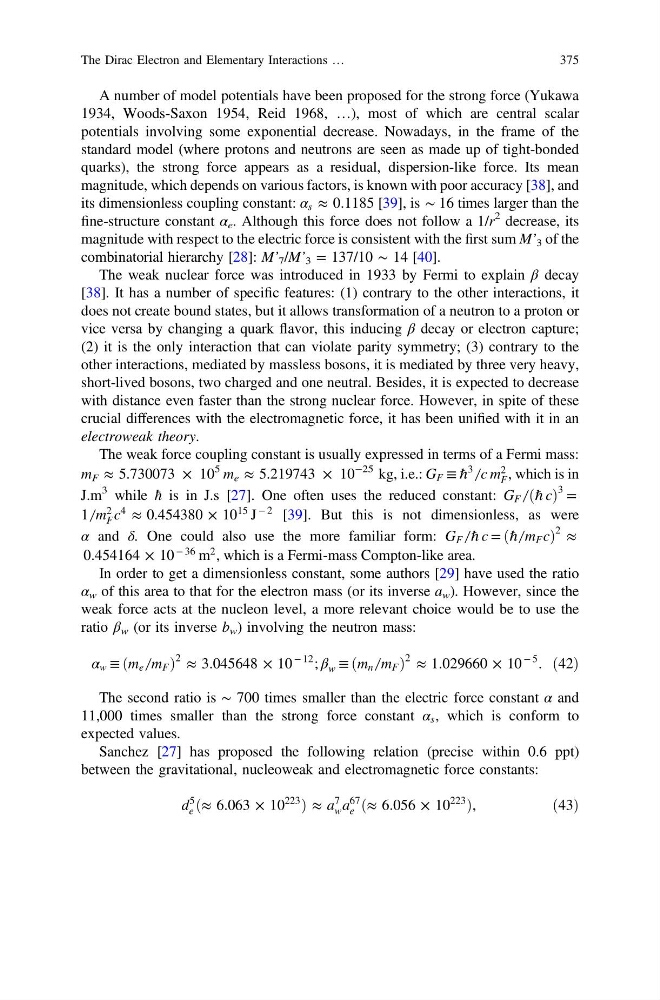
ratio β w (or its inverse b w ) involving the neutron mass:
α w ≡ ðm e ̸ m F Þ
2 ≈ 3.045648 × 10
− 12 ; β w ≡ ðm n ̸ m F Þ
2 ≈ 1.029660 × 10
− 5 . ð42Þ
The second ratio is ∼ 700 times smaller than the electric force constant α and
11,000 times smaller than the strong force constant α s , which is conform to
expected values.
Sanchez [27] has proposed the following relation (precise within 0.6 ppt)
between the gravitational, nucleoweak and electromagnetic force constants:
d
5
e ð≈ 6.063 × 10
223
Þ ≈ a
7
w a
67
e ð≈ 6.056 × 10
223
Þ,
ð43Þ
The Dirac Electron and Elementary Interactions …
375
1934, Woods-Saxon 1954, Reid 1968, …), most of which are central scalar
potentials involving some exponential decrease. Nowadays, in the frame of the
standard model (where protons and neutrons are seen as made up of tight-bonded
quarks), the strong force appears as a residual, dispersion-like force. Its mean
magnitude, which depends on various factors, is known with poor accuracy [38], and
its dimensionless coupling constant: α s ≈ 0.1185 [39], is ∼ 16 times larger than the
fine-structure constant α e . Although this force does not follow a 1/r
2 decrease, its
magnitude with respect to the electric force is consistent with the first sum M’ 3 of the
combinatorial hierarchy [28]: M’ 7 /M’ 3 = 137/10 ∼ 14 [40].
The weak nuclear force was introduced in 1933 by Fermi to explain β decay
[38]. It has a number of specific features: (1) contrary to the other interactions, it
does not create bound states, but it allows transformation of a neutron to a proton or
vice versa by changing a quark flavor, this inducing β decay or electron capture;
(2) it is the only interaction that can violate parity symmetry; (3) contrary to the
other interactions, mediated by massless bosons, it is mediated by three very heavy,
short-lived bosons, two charged and one neutral. Besides, it is expected to decrease
with distance even faster than the strong nuclear force. However, in spite of these
crucial differences with the electromagnetic force, it has been unified with it in an
electroweak theory.
The weak force coupling constant is usually expressed in terms of a Fermi mass:
m F ≈ 5.730073 × 10
5 m e ≈ 5.219743 × 10
−25 kg, i.e.: G F ≡ ℏ
3
̸ c m
2
F , which is in
J.m
3 while ħ is in J.s [27]. One often uses the reduced constant: G F ̸ ðℏ cÞ
3 =
1 ̸ m
2
F c
4
≈ 0.454380 × 10
15 J
− 2 [39]. But this is not dimensionless, as were
α and δ. One could also use the more familiar form: G F ̸ ℏ c = ðℏ ̸ m F cÞ
2 ≈
0.454164 × 10
− 36 m
2 , which is a Fermi-mass Compton-like area.
In order to get a dimensionless constant, some authors [29] have used the ratio
α w of this area to that for the electron mass (or its inverse a w ). However, since the
weak force acts at the nucleon level, a more relevant choice would be to use the
ratio β w (or its inverse b w ) involving the neutron mass:
α w ≡ ðm e ̸ m F Þ
2 ≈ 3.045648 × 10
− 12 ; β w ≡ ðm n ̸ m F Þ
2 ≈ 1.029660 × 10
− 5 . ð42Þ
The second ratio is ∼ 700 times smaller than the electric force constant α and
11,000 times smaller than the strong force constant α s , which is conform to
expected values.
Sanchez [27] has proposed the following relation (precise within 0.6 ppt)
between the gravitational, nucleoweak and electromagnetic force constants:
d
5
e ð≈ 6.063 × 10
223
Þ ≈ a
7
w a
67
e ð≈ 6.056 × 10
223
Þ,
ð43Þ
The Dirac Electron and Elementary Interactions …
375