

(2) Similarly as an effective inertia is endowed to light by confinement in an optical
resonator [33] or in a photonic crystal [37], an effective force is exerted over two
close objects by ZPF confinement between them. (3) If one uses the same scalings
as those that led to Eq. (32), the distance between the plates being expressed as an
integer number of Compton diameters: r = N− λ, one obtains:
F C ̸ A = κ E
2
0 ̸ N
4
− λ
2 , κ ≅ 0.0411234.
ð41Þ
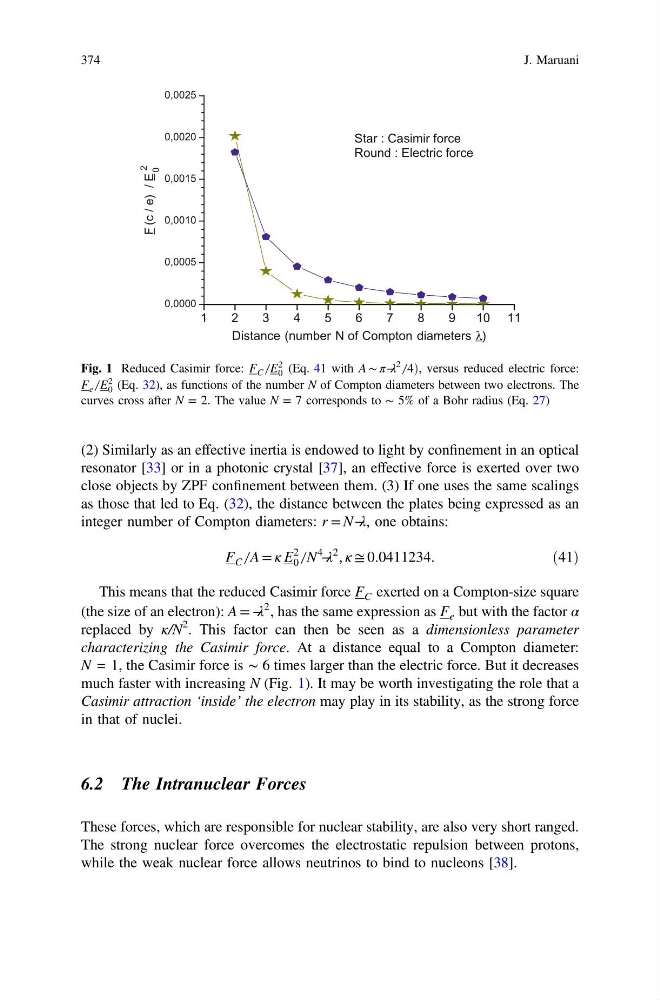
This means that the reduced Casimir force F C exerted on a Compton-size square
(the size of an electron): A = − λ
2 , has the same expression as F e but with the factor α
replaced by κ/N
2 . This factor can then be seen as a dimensionless parameter
characterizing the Casimir force. At a distance equal to a Compton diameter:
N = 1, the Casimir force is ∼ 6 times larger than the electric force. But it decreases
much faster with increasing N (Fig. 1). It may be worth investigating the role that a
Casimir attraction ‘inside’ the electron may play in its stability, as the strong force
in that of nuclei.
6.2 The Intranuclear Forces
These forces, which are responsible for nuclear stability, are also very short ranged.
The strong nuclear force overcomes the electrostatic repulsion between protons,
while the weak nuclear force allows neutrinos to bind to nucleons [38].
1
2
3
4
5
6
7
8
9
10 11
0,0000
0,0005
0,0010
0,0015
0,0020
0,0025
Star : Casimir force
Round : Electric force
Distance (number N of Compton diameters λ)
F
(c / e) / E
0
2
Fig. 1 Reduced Casimir force: F C ̸ E
2
0 (Eq. 41 with A ∼ π− λ
2 ̸ 4Þ, versus reduced electric force:
F e ̸ E
2
0 (Eq. 32), as functions of the number N of Compton diameters between two electrons. The
curves cross after N = 2. The value N = 7 corresponds to ∼ 5% of a Bohr radius (Eq. 27)
374
J. Maruani
resonator [33] or in a photonic crystal [37], an effective force is exerted over two
close objects by ZPF confinement between them. (3) If one uses the same scalings
as those that led to Eq. (32), the distance between the plates being expressed as an
integer number of Compton diameters: r = N− λ, one obtains:
F C ̸ A = κ E
2
0 ̸ N
4
− λ
2 , κ ≅ 0.0411234.
ð41Þ
This means that the reduced Casimir force F C exerted on a Compton-size square
(the size of an electron): A = − λ
2 , has the same expression as F e but with the factor α
replaced by κ/N
2 . This factor can then be seen as a dimensionless parameter
characterizing the Casimir force. At a distance equal to a Compton diameter:
N = 1, the Casimir force is ∼ 6 times larger than the electric force. But it decreases
much faster with increasing N (Fig. 1). It may be worth investigating the role that a
Casimir attraction ‘inside’ the electron may play in its stability, as the strong force
in that of nuclei.
6.2 The Intranuclear Forces
These forces, which are responsible for nuclear stability, are also very short ranged.
The strong nuclear force overcomes the electrostatic repulsion between protons,
while the weak nuclear force allows neutrinos to bind to nucleons [38].
1
2
3
4
5
6
7
8
9
10 11
0,0000
0,0005
0,0010
0,0015
0,0020
0,0025
Star : Casimir force
Round : Electric force
Distance (number N of Compton diameters λ)
F
(c / e) / E
0
2
Fig. 1 Reduced Casimir force: F C ̸ E
2
0 (Eq. 41 with A ∼ π− λ
2 ̸ 4Þ, versus reduced electric force:
F e ̸ E
2
0 (Eq. 32), as functions of the number N of Compton diameters between two electrons. The
curves cross after N = 2. The value N = 7 corresponds to ∼ 5% of a Bohr radius (Eq. 27)
374
J. Maruani