

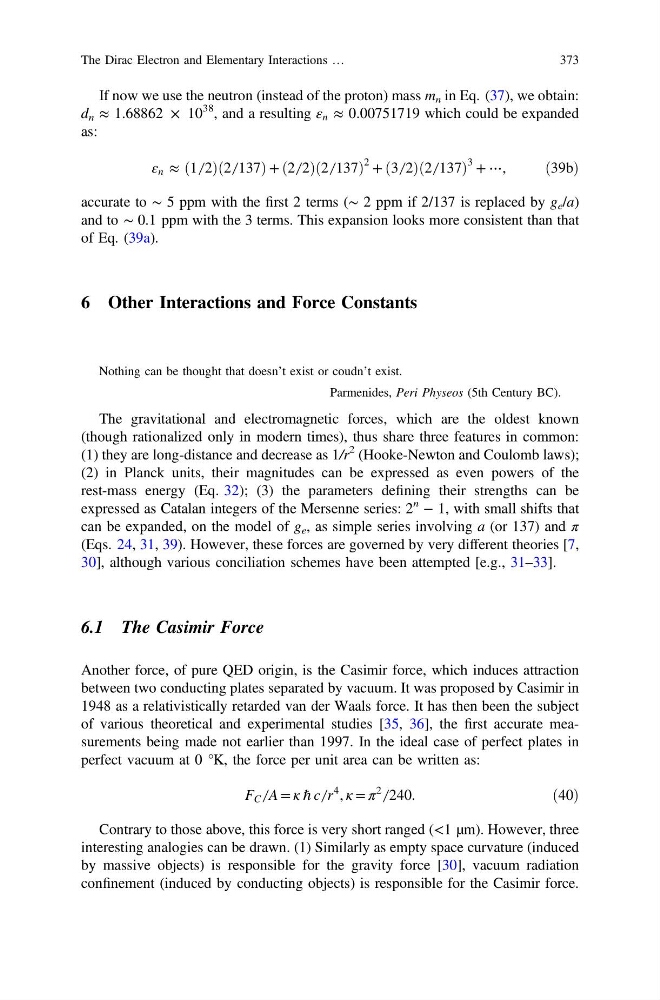
If now we use the neutron (instead of the proton) mass m n in Eq. (37), we obtain:
d n ≈ 1.68862 × 10
38 , and a resulting ε n ≈ 0.00751719 which could be expanded
as:
ε n ≈ ð1 ̸ 2Þð2 ̸ 137Þ + ð2 ̸ 2Þð2 ̸ 137Þ
2 + ð3 ̸ 2Þð2 ̸ 137Þ
3 + ⋯,
ð39bÞ
accurate to ∼ 5 ppm with the first 2 terms (∼ 2 ppm if 2/137 is replaced by g e /a)
and to ∼ 0.1 ppm with the 3 terms. This expansion looks more consistent than that
of Eq. (39a).
6 Other Interactions and Force Constants
Nothing can be thought that doesn’t exist or coudn’t exist.
Parmenides, Peri Physeos (5th Century BC).
The gravitational and electromagnetic forces, which are the oldest known
(though rationalized only in modern times), thus share three features in common:
(1) they are long-distance and decrease as 1/r
2 (Hooke-Newton and Coulomb laws);
(2) in Planck units, their magnitudes can be expressed as even powers of the
rest-mass energy (Eq. 32); (3) the parameters defining their strengths can be
expressed as Catalan integers of the Mersenne series: 2
n
− 1, with small shifts that
can be expanded, on the model of g e , as simple series involving a (or 137) and π
(Eqs. 24, 31, 39). However, these forces are governed by very different theories [7,
30], although various conciliation schemes have been attempted [e.g., 31–33].
6.1 The Casimir Force
Another force, of pure QED origin, is the Casimir force, which induces attraction
between two conducting plates separated by vacuum. It was proposed by Casimir in
1948 as a relativistically retarded van der Waals force. It has then been the subject
of various theoretical and experimental studies [35, 36], the first accurate measurements being made not earlier than 1997. In the ideal case of perfect plates in
perfect vacuum at 0 °K, the force per unit area can be written as:
F C ̸ A = κ ℏ c ̸ r
4 , κ = π
2
̸ 240.
ð40Þ
Contrary to those above, this force is very short ranged (<1 µm). However, three
interesting analogies can be drawn. (1) Similarly as empty space curvature (induced
by massive objects) is responsible for the gravity force [30], vacuum radiation
confinement (induced by conducting objects) is responsible for the Casimir force.
The Dirac Electron and Elementary Interactions …
373
d n ≈ 1.68862 × 10
38 , and a resulting ε n ≈ 0.00751719 which could be expanded
as:
ε n ≈ ð1 ̸ 2Þð2 ̸ 137Þ + ð2 ̸ 2Þð2 ̸ 137Þ
2 + ð3 ̸ 2Þð2 ̸ 137Þ
3 + ⋯,
ð39bÞ
accurate to ∼ 5 ppm with the first 2 terms (∼ 2 ppm if 2/137 is replaced by g e /a)
and to ∼ 0.1 ppm with the 3 terms. This expansion looks more consistent than that
of Eq. (39a).
6 Other Interactions and Force Constants
Nothing can be thought that doesn’t exist or coudn’t exist.
Parmenides, Peri Physeos (5th Century BC).
The gravitational and electromagnetic forces, which are the oldest known
(though rationalized only in modern times), thus share three features in common:
(1) they are long-distance and decrease as 1/r
2 (Hooke-Newton and Coulomb laws);
(2) in Planck units, their magnitudes can be expressed as even powers of the
rest-mass energy (Eq. 32); (3) the parameters defining their strengths can be
expressed as Catalan integers of the Mersenne series: 2
n
− 1, with small shifts that
can be expanded, on the model of g e , as simple series involving a (or 137) and π
(Eqs. 24, 31, 39). However, these forces are governed by very different theories [7,
30], although various conciliation schemes have been attempted [e.g., 31–33].
6.1 The Casimir Force
Another force, of pure QED origin, is the Casimir force, which induces attraction
between two conducting plates separated by vacuum. It was proposed by Casimir in
1948 as a relativistically retarded van der Waals force. It has then been the subject
of various theoretical and experimental studies [35, 36], the first accurate measurements being made not earlier than 1997. In the ideal case of perfect plates in
perfect vacuum at 0 °K, the force per unit area can be written as:
F C ̸ A = κ ℏ c ̸ r
4 , κ = π
2
̸ 240.
ð40Þ
Contrary to those above, this force is very short ranged (<1 µm). However, three
interesting analogies can be drawn. (1) Similarly as empty space curvature (induced
by massive objects) is responsible for the gravity force [30], vacuum radiation
confinement (induced by conducting objects) is responsible for the Casimir force.
The Dirac Electron and Elementary Interactions …
373