

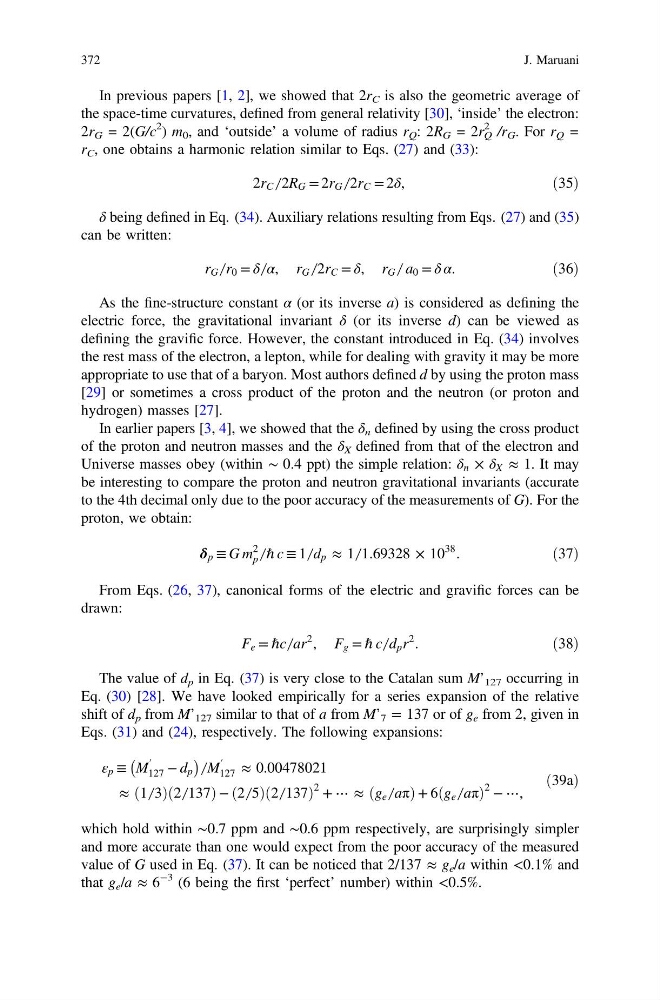
In previous papers [1, 2], we showed that 2r C is also the geometric average of
the space-time curvatures, defined from general relativity [30], ‘inside’ the electron:
2r G = 2(G/c
2 ) m 0 , and ‘outside’ a volume of radius r Q : 2R G = 2r Q
2 /r G . For r Q =
r C , one obtains a harmonic relation similar to Eqs. (27) and (33):
2r C ̸ 2R G = 2r G ̸ 2r C = 2δ,
ð35Þ
δ being defined in Eq. (34). Auxiliary relations resulting from Eqs. (27) and (35)
can be written:
r G ̸ r 0 = δ ̸ α, r G ̸ 2r C = δ, r G ̸ a 0 = δ α.
ð36Þ
As the fine-structure constant α (or its inverse a) is considered as defining the
electric force, the gravitational invariant δ (or its inverse d) can be viewed as
defining the gravific force. However, the constant introduced in Eq. (34) involves
the rest mass of the electron, a lepton, while for dealing with gravity it may be more
appropriate to use that of a baryon. Most authors defined d by using the proton mass
[29] or sometimes a cross product of the proton and the neutron (or proton and
hydrogen) masses [27].
In earlier papers [3, 4], we showed that the δ n defined by using the cross product
of the proton and neutron masses and the δ X defined from that of the electron and
Universe masses obey (within ∼ 0.4 ppt) the simple relation: δ n × δ X ≈ 1. It may
be interesting to compare the proton and neutron gravitational invariants (accurate
to the 4th decimal only due to the poor accuracy of the measurements of G). For the
proton, we obtain:
δ p ≡ G m
2
p ̸ ℏ c ≡ 1 ̸ d p ≈ 1 ̸ 1.69328 × 10
38 .
ð37Þ
From Eqs. (26, 37), canonical forms of the electric and gravific forces can be
drawn:
F e = ℏc ̸ ar
2 , F g = ℏ c ̸ d p r
2 .
ð38Þ
The value of d p in Eq. (37) is very close to the Catalan sum M’ 127 occurring in
Eq. (30) [28]. We have looked empirically for a series expansion of the relative
shift of d p from M’ 127 similar to that of a from M’ 7 = 137 or of g e from 2, given in
Eqs. (31) and (24), respectively. The following expansions:
ε p ≡ M
′
127 − d p
À
Á ̸ M
′
127 ≈ 0.00478021
≈ ð1 ̸ 3Þð2 ̸ 137Þ − ð2 ̸ 5Þð2 ̸ 137Þ
2 + ⋯ ≈ ðg e ̸ aπÞ + 6ðg e ̸ aπÞ
2 − ⋯,
ð39aÞ
which hold within ∼0.7 ppm and ∼0.6 ppm respectively, are surprisingly simpler
and more accurate than one would expect from the poor accuracy of the measured
value of G used in Eq. (37). It can be noticed that 2/137 ≈ g e /a within <0.1% and
that g e /a ≈ 6
−3 (6 being the first ‘perfect’ number) within <0.5%.
372
J. Maruani
the space-time curvatures, defined from general relativity [30], ‘inside’ the electron:
2r G = 2(G/c
2 ) m 0 , and ‘outside’ a volume of radius r Q : 2R G = 2r Q
2 /r G . For r Q =
r C , one obtains a harmonic relation similar to Eqs. (27) and (33):
2r C ̸ 2R G = 2r G ̸ 2r C = 2δ,
ð35Þ
δ being defined in Eq. (34). Auxiliary relations resulting from Eqs. (27) and (35)
can be written:
r G ̸ r 0 = δ ̸ α, r G ̸ 2r C = δ, r G ̸ a 0 = δ α.
ð36Þ
As the fine-structure constant α (or its inverse a) is considered as defining the
electric force, the gravitational invariant δ (or its inverse d) can be viewed as
defining the gravific force. However, the constant introduced in Eq. (34) involves
the rest mass of the electron, a lepton, while for dealing with gravity it may be more
appropriate to use that of a baryon. Most authors defined d by using the proton mass
[29] or sometimes a cross product of the proton and the neutron (or proton and
hydrogen) masses [27].
In earlier papers [3, 4], we showed that the δ n defined by using the cross product
of the proton and neutron masses and the δ X defined from that of the electron and
Universe masses obey (within ∼ 0.4 ppt) the simple relation: δ n × δ X ≈ 1. It may
be interesting to compare the proton and neutron gravitational invariants (accurate
to the 4th decimal only due to the poor accuracy of the measurements of G). For the
proton, we obtain:
δ p ≡ G m
2
p ̸ ℏ c ≡ 1 ̸ d p ≈ 1 ̸ 1.69328 × 10
38 .
ð37Þ
From Eqs. (26, 37), canonical forms of the electric and gravific forces can be
drawn:
F e = ℏc ̸ ar
2 , F g = ℏ c ̸ d p r
2 .
ð38Þ
The value of d p in Eq. (37) is very close to the Catalan sum M’ 127 occurring in
Eq. (30) [28]. We have looked empirically for a series expansion of the relative
shift of d p from M’ 127 similar to that of a from M’ 7 = 137 or of g e from 2, given in
Eqs. (31) and (24), respectively. The following expansions:
ε p ≡ M
′
127 − d p
À
Á ̸ M
′
127 ≈ 0.00478021
≈ ð1 ̸ 3Þð2 ̸ 137Þ − ð2 ̸ 5Þð2 ̸ 137Þ
2 + ⋯ ≈ ðg e ̸ aπÞ + 6ðg e ̸ aπÞ
2 − ⋯,
ð39aÞ
which hold within ∼0.7 ppm and ∼0.6 ppm respectively, are surprisingly simpler
and more accurate than one would expect from the poor accuracy of the measured
value of G used in Eq. (37). It can be noticed that 2/137 ≈ g e /a within <0.1% and
that g e /a ≈ 6
−3 (6 being the first ‘perfect’ number) within <0.5%.
372
J. Maruani