

properties. On the other hand, Einstein’s general relativity theory [30] expressed
space-time curvature, entailed by local equivalence of acceleration and gravity, in
the language of Riemann tensors. Among others, Chapman and Leiter [31] made
the Dirac equation conform to general relativity by expanding the principle of
covariance to spinor transformations.
For Mendel Sachs [32], the formal structure of quantum theory, including the
Pauli exclusion principle, can be derived from a low-energy, linear approximation
of a generally covariant, nonlinear field theory of inertia based on the basic ideas of
general relativity. On the other hand, John Macken [33] starts with the high-energy,
nonlinear vacuum fluctuations of quantized space-time and then derives the basic
ideas of general relativity, including the equivalence of acceleration and gravity, as
a low-energy, smooth limit.
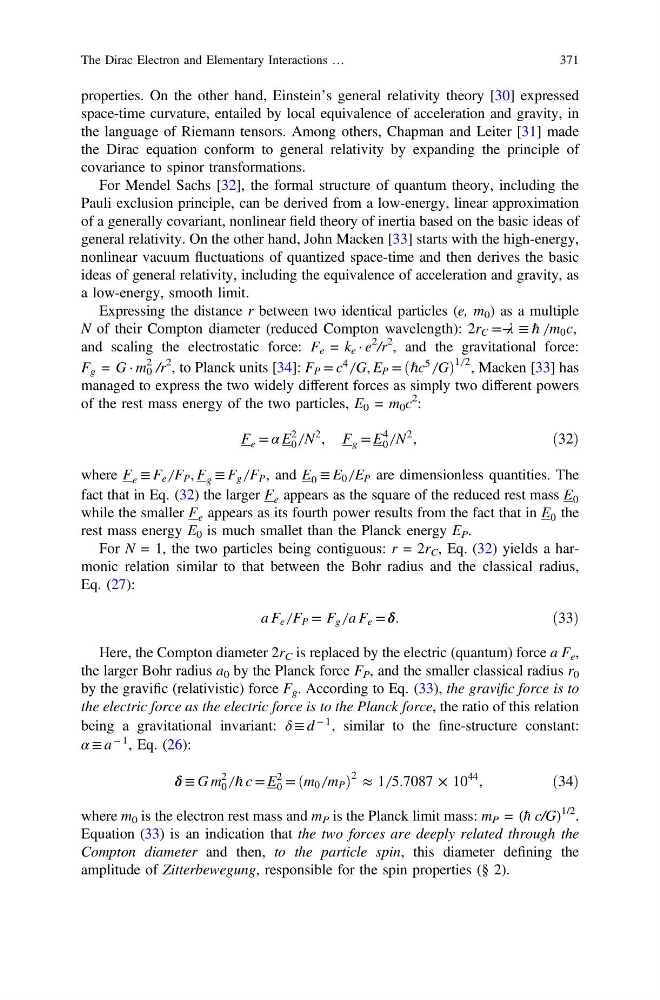
Expressing the distance r between two identical particles (e, m 0 ) as a multiple
N of their Compton diameter (reduced Compton wavelength): 2r C =− λ ≡ ℏ ̸ m 0 c,
and scaling the electrostatic force: F e = k e ⋅ e
2 /r
2 , and the gravitational force:
F g = G ⋅ m 0
2 /r
2 , to Planck units [34]: F P = c
4
̸ G, E P = ðℏc
5
̸ GÞ
1 ̸ 2 , Macken [33] has
managed to express the two widely different forces as simply two different powers
of the rest mass energy of the two particles, E 0 = m 0 c
2 :
F e = α E
2
0 ̸ N
2 , F g = E
4
0 ̸ N
2 ,
ð32Þ
where F e ≡ F e ̸ F P , F g ≡ F g ̸ F P , and E 0 ≡ E 0 ̸ E P are dimensionless quantities. The
fact that in Eq. (32) the larger F e appears as the square of the reduced rest mass E 0
while the smaller F e appears as its fourth power results from the fact that in E 0 the
rest mass energy E 0 is much smallet than the Planck energy E P .
For N = 1, the two particles being contiguous: r = 2r C , Eq. (32) yields a harmonic relation similar to that between the Bohr radius and the classical radius,
Eq. (27):
a F e ̸ F P = F g ̸ a F e = δ.
ð33Þ
Here, the Compton diameter 2r C is replaced by the electric (quantum) force a F e ,
the larger Bohr radius a 0 by the Planck force F P , and the smaller classical radius r 0
by the gravific (relativistic) force F g . According to Eq. (33), the gravific force is to
the electric force as the electric force is to the Planck force, the ratio of this relation
being a gravitational invariant: δ ≡ d
− 1 , similar to the fine-structure constant:
α ≡ a
− 1 , Eq. (26):
δ ≡ G m
2
0 ̸ ℏ c = E
2
0 = ðm 0 ̸ m P Þ
2 ≈ 1 ̸ 5.7087 × 10
44 ,
ð34Þ
where m 0 is the electron rest mass and m P is the Planck limit mass: m P = (ħ c/G)
1/2 .
Equation (33) is an indication that the two forces are deeply related through the
Compton diameter and then, to the particle spin, this diameter defining the
amplitude of Zitterbewegung, responsible for the spin properties (§ 2).
The Dirac Electron and Elementary Interactions …
371
space-time curvature, entailed by local equivalence of acceleration and gravity, in
the language of Riemann tensors. Among others, Chapman and Leiter [31] made
the Dirac equation conform to general relativity by expanding the principle of
covariance to spinor transformations.
For Mendel Sachs [32], the formal structure of quantum theory, including the
Pauli exclusion principle, can be derived from a low-energy, linear approximation
of a generally covariant, nonlinear field theory of inertia based on the basic ideas of
general relativity. On the other hand, John Macken [33] starts with the high-energy,
nonlinear vacuum fluctuations of quantized space-time and then derives the basic
ideas of general relativity, including the equivalence of acceleration and gravity, as
a low-energy, smooth limit.
Expressing the distance r between two identical particles (e, m 0 ) as a multiple
N of their Compton diameter (reduced Compton wavelength): 2r C =− λ ≡ ℏ ̸ m 0 c,
and scaling the electrostatic force: F e = k e ⋅ e
2 /r
2 , and the gravitational force:
F g = G ⋅ m 0
2 /r
2 , to Planck units [34]: F P = c
4
̸ G, E P = ðℏc
5
̸ GÞ
1 ̸ 2 , Macken [33] has
managed to express the two widely different forces as simply two different powers
of the rest mass energy of the two particles, E 0 = m 0 c
2 :
F e = α E
2
0 ̸ N
2 , F g = E
4
0 ̸ N
2 ,
ð32Þ
where F e ≡ F e ̸ F P , F g ≡ F g ̸ F P , and E 0 ≡ E 0 ̸ E P are dimensionless quantities. The
fact that in Eq. (32) the larger F e appears as the square of the reduced rest mass E 0
while the smaller F e appears as its fourth power results from the fact that in E 0 the
rest mass energy E 0 is much smallet than the Planck energy E P .
For N = 1, the two particles being contiguous: r = 2r C , Eq. (32) yields a harmonic relation similar to that between the Bohr radius and the classical radius,
Eq. (27):
a F e ̸ F P = F g ̸ a F e = δ.
ð33Þ
Here, the Compton diameter 2r C is replaced by the electric (quantum) force a F e ,
the larger Bohr radius a 0 by the Planck force F P , and the smaller classical radius r 0
by the gravific (relativistic) force F g . According to Eq. (33), the gravific force is to
the electric force as the electric force is to the Planck force, the ratio of this relation
being a gravitational invariant: δ ≡ d
− 1 , similar to the fine-structure constant:
α ≡ a
− 1 , Eq. (26):
δ ≡ G m
2
0 ̸ ℏ c = E
2
0 = ðm 0 ̸ m P Þ
2 ≈ 1 ̸ 5.7087 × 10
44 ,
ð34Þ
where m 0 is the electron rest mass and m P is the Planck limit mass: m P = (ħ c/G)
1/2 .
Equation (33) is an indication that the two forces are deeply related through the
Compton diameter and then, to the particle spin, this diameter defining the
amplitude of Zitterbewegung, responsible for the spin properties (§ 2).
The Dirac Electron and Elementary Interactions …
371