

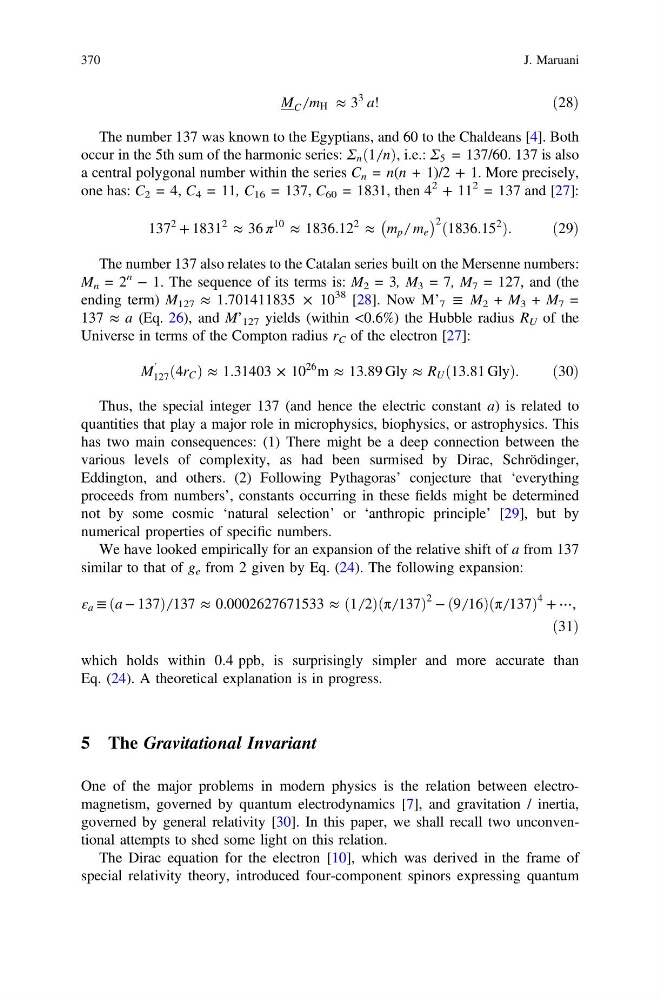
M C ̸ m H ≈ 3
3 a!
ð28Þ
The number 137 was known to the Egyptians, and 60 to the Chaldeans [4]. Both
occur in the 5th sum of the harmonic series: Σ n ð1 ̸ nÞ, i.e.: Σ 5 = 137/60. 137 is also
a central polygonal number within the series C n = n(n + 1)/2 + 1. More precisely,
one has: C 2 = 4, C 4 = 11, C 16 = 137, C 60 = 1831, then 4
2 + 11
2 = 137 and [27]:
137
2 + 1831
2
≈ 36 π
10
≈ 1836.12
2
≈ m p ̸ m e
À
Á 2 ð1836.15
2
Þ.
ð29Þ
The number 137 also relates to the Catalan series built on the Mersenne numbers:
M n = 2
n
− 1. The sequence of its terms is: M 2 = 3, M 3 = 7, M 7 = 127, and (the
ending term) M 127 ≈ 1.701411835 × 10
38 [28]. Now M’ 7 ≡ M 2 + M 3 + M 7 =
137 ≈ a (Eq. 26), and M’ 127 yields (within <0.6%) the Hubble radius R U of the
Universe in terms of the Compton radius r C of the electron [27]:
M
′
127 ð4r C Þ ≈ 1.31403 × 10
26 m ≈ 13.89 Gly ≈ R U 13.81 Gly
ð
Þ .
ð30Þ
Thus, the special integer 137 (and hence the electric constant a) is related to
quantities that play a major role in microphysics, biophysics, or astrophysics. This
has two main consequences: (1) There might be a deep connection between the
various levels of complexity, as had been surmised by Dirac, Schrödinger,
Eddington, and others. (2) Following Pythagoras’ conjecture that ‘everything
proceeds from numbers’, constants occurring in these fields might be determined
not by some cosmic ‘natural selection’ or ‘anthropic principle’ [29], but by
numerical properties of specific numbers.
We have looked empirically for an expansion of the relative shift of a from 137
similar to that of g e from 2 given by Eq. (24). The following expansion:
ε a ≡ ða − 137Þ ̸ 137 ≈ 0.0002627671533 ≈ ð1 ̸ 2Þðπ ̸ 137Þ
2 − ð9 ̸ 16Þðπ ̸ 137Þ
4 + ⋯,
ð31Þ
which holds within 0.4 ppb, is surprisingly simpler and more accurate than
Eq. (24). A theoretical explanation is in progress.
5 The Gravitational Invariant
One of the major problems in modern physics is the relation between electromagnetism, governed by quantum electrodynamics [7], and gravitation / inertia,
governed by general relativity [30]. In this paper, we shall recall two unconventional attempts to shed some light on this relation.
The Dirac equation for the electron [10], which was derived in the frame of
special relativity theory, introduced four-component spinors expressing quantum
370
J. Maruani
3 a!
ð28Þ
The number 137 was known to the Egyptians, and 60 to the Chaldeans [4]. Both
occur in the 5th sum of the harmonic series: Σ n ð1 ̸ nÞ, i.e.: Σ 5 = 137/60. 137 is also
a central polygonal number within the series C n = n(n + 1)/2 + 1. More precisely,
one has: C 2 = 4, C 4 = 11, C 16 = 137, C 60 = 1831, then 4
2 + 11
2 = 137 and [27]:
137
2 + 1831
2
≈ 36 π
10
≈ 1836.12
2
≈ m p ̸ m e
À
Á 2 ð1836.15
2
Þ.
ð29Þ
The number 137 also relates to the Catalan series built on the Mersenne numbers:
M n = 2
n
− 1. The sequence of its terms is: M 2 = 3, M 3 = 7, M 7 = 127, and (the
ending term) M 127 ≈ 1.701411835 × 10
38 [28]. Now M’ 7 ≡ M 2 + M 3 + M 7 =
137 ≈ a (Eq. 26), and M’ 127 yields (within <0.6%) the Hubble radius R U of the
Universe in terms of the Compton radius r C of the electron [27]:
M
′
127 ð4r C Þ ≈ 1.31403 × 10
26 m ≈ 13.89 Gly ≈ R U 13.81 Gly
ð
Þ .
ð30Þ
Thus, the special integer 137 (and hence the electric constant a) is related to
quantities that play a major role in microphysics, biophysics, or astrophysics. This
has two main consequences: (1) There might be a deep connection between the
various levels of complexity, as had been surmised by Dirac, Schrödinger,
Eddington, and others. (2) Following Pythagoras’ conjecture that ‘everything
proceeds from numbers’, constants occurring in these fields might be determined
not by some cosmic ‘natural selection’ or ‘anthropic principle’ [29], but by
numerical properties of specific numbers.
We have looked empirically for an expansion of the relative shift of a from 137
similar to that of g e from 2 given by Eq. (24). The following expansion:
ε a ≡ ða − 137Þ ̸ 137 ≈ 0.0002627671533 ≈ ð1 ̸ 2Þðπ ̸ 137Þ
2 − ð9 ̸ 16Þðπ ̸ 137Þ
4 + ⋯,
ð31Þ
which holds within 0.4 ppb, is surprisingly simpler and more accurate than
Eq. (24). A theoretical explanation is in progress.
5 The Gravitational Invariant
One of the major problems in modern physics is the relation between electromagnetism, governed by quantum electrodynamics [7], and gravitation / inertia,
governed by general relativity [30]. In this paper, we shall recall two unconventional attempts to shed some light on this relation.
The Dirac equation for the electron [10], which was derived in the frame of
special relativity theory, introduced four-component spinors expressing quantum
370
J. Maruani