

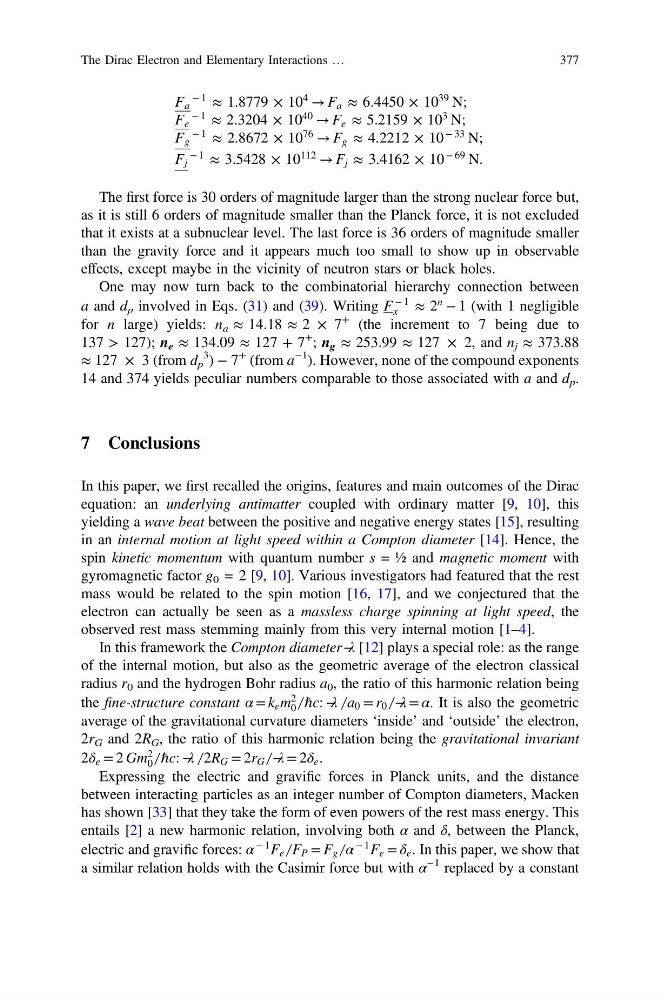
F a
− 1
≈ 1.8779 × 10
4
→ F a ≈ 6.4450 × 10
39 N;
F e
− 1
≈ 2.3204 × 10
40
→ F e ≈ 5.2159 × 10
3 N;
F g
− 1
≈ 2.8672 × 10
76
→ F g ≈ 4.2212 × 10
− 33 N;
F j
− 1
≈ 3.5428 × 10
112
→ F j ≈ 3.4162 × 10
− 69 N.
The first force is 30 orders of magnitude larger than the strong nuclear force but,
as it is still 6 orders of magnitude smaller than the Planck force, it is not excluded
that it exists at a subnuclear level. The last force is 36 orders of magnitude smaller
than the gravity force and it appears much too small to show up in observable
effects, except maybe in the vicinity of neutron stars or black holes.
One may now turn back to the combinatorial hierarchy connection between
a and d p involved in Eqs. (31) and (39). Writing F
− 1
x
≈ 2
n
− 1 (with 1 negligible
for n large) yields: n a ≈ 14.18 ≈ 2 × 7
+ (the increment to 7 being due to
137 > 127); n e ≈ 134.09 ≈ 127 + 7
+ ; n g ≈ 253.99 ≈ 127 × 2, and n j ≈ 373.88
≈ 127 × 3 (from d p
3 ) − 7
+ (from a
−1 ). However, none of the compound exponents
14 and 374 yields peculiar numbers comparable to those associated with a and d p .
7 Conclusions
In this paper, we first recalled the origins, features and main outcomes of the Dirac
equation: an underlying antimatter coupled with ordinary matter [9, 10], this
yielding a wave beat between the positive and negative energy states [15], resulting
in an internal motion at light speed within a Compton diameter [14]. Hence, the
spin kinetic momentum with quantum number s = ½ and magnetic moment with
gyromagnetic factor g 0 = 2 [9, 10]. Various investigators had featured that the rest
mass would be related to the spin motion [16, 17], and we conjectured that the
electron can actually be seen as a massless charge spinning at light speed, the
observed rest mass stemming mainly from this very internal motion [1–4].
In this framework the Compton diameter− λ [12] plays a special role: as the range
of the internal motion, but also as the geometric average of the electron classical
radius r 0 and the hydrogen Bohr radius a 0 , the ratio of this harmonic relation being
the fine-structure constant α = k e m
2
0 ̸ ℏc: − λ ̸ a 0 = r 0 ̸ − λ = α. It is also the geometric
average of the gravitational curvature diameters ‘inside’ and ‘outside’ the electron,
2r G and 2R G , the ratio of this harmonic relation being the gravitational invariant
2δ e = 2 Gm
2
0 ̸ ℏc: − λ ̸ 2R G = 2r G ̸ − λ = 2δ e .
Expressing the electric and gravific forces in Planck units, and the distance
between interacting particles as an integer number of Compton diameters, Macken
has shown [33] that they take the form of even powers of the rest mass energy. This
entails [2] a new harmonic relation, involving both α and δ, between the Planck,
electric and gravific forces: α
− 1 F e ̸ F P = F g ̸ α
− 1 F e = δ e . In this paper, we show that
a similar relation holds with the Casimir force but with α
−1 replaced by a constant
The Dirac Electron and Elementary Interactions …
377
− 1
≈ 1.8779 × 10
4
→ F a ≈ 6.4450 × 10
39 N;
F e
− 1
≈ 2.3204 × 10
40
→ F e ≈ 5.2159 × 10
3 N;
F g
− 1
≈ 2.8672 × 10
76
→ F g ≈ 4.2212 × 10
− 33 N;
F j
− 1
≈ 3.5428 × 10
112
→ F j ≈ 3.4162 × 10
− 69 N.
The first force is 30 orders of magnitude larger than the strong nuclear force but,
as it is still 6 orders of magnitude smaller than the Planck force, it is not excluded
that it exists at a subnuclear level. The last force is 36 orders of magnitude smaller
than the gravity force and it appears much too small to show up in observable
effects, except maybe in the vicinity of neutron stars or black holes.
One may now turn back to the combinatorial hierarchy connection between
a and d p involved in Eqs. (31) and (39). Writing F
− 1
x
≈ 2
n
− 1 (with 1 negligible
for n large) yields: n a ≈ 14.18 ≈ 2 × 7
+ (the increment to 7 being due to
137 > 127); n e ≈ 134.09 ≈ 127 + 7
+ ; n g ≈ 253.99 ≈ 127 × 2, and n j ≈ 373.88
≈ 127 × 3 (from d p
3 ) − 7
+ (from a
−1 ). However, none of the compound exponents
14 and 374 yields peculiar numbers comparable to those associated with a and d p .
7 Conclusions
In this paper, we first recalled the origins, features and main outcomes of the Dirac
equation: an underlying antimatter coupled with ordinary matter [9, 10], this
yielding a wave beat between the positive and negative energy states [15], resulting
in an internal motion at light speed within a Compton diameter [14]. Hence, the
spin kinetic momentum with quantum number s = ½ and magnetic moment with
gyromagnetic factor g 0 = 2 [9, 10]. Various investigators had featured that the rest
mass would be related to the spin motion [16, 17], and we conjectured that the
electron can actually be seen as a massless charge spinning at light speed, the
observed rest mass stemming mainly from this very internal motion [1–4].
In this framework the Compton diameter− λ [12] plays a special role: as the range
of the internal motion, but also as the geometric average of the electron classical
radius r 0 and the hydrogen Bohr radius a 0 , the ratio of this harmonic relation being
the fine-structure constant α = k e m
2
0 ̸ ℏc: − λ ̸ a 0 = r 0 ̸ − λ = α. It is also the geometric
average of the gravitational curvature diameters ‘inside’ and ‘outside’ the electron,
2r G and 2R G , the ratio of this harmonic relation being the gravitational invariant
2δ e = 2 Gm
2
0 ̸ ℏc: − λ ̸ 2R G = 2r G ̸ − λ = 2δ e .
Expressing the electric and gravific forces in Planck units, and the distance
between interacting particles as an integer number of Compton diameters, Macken
has shown [33] that they take the form of even powers of the rest mass energy. This
entails [2] a new harmonic relation, involving both α and δ, between the Planck,
electric and gravific forces: α
− 1 F e ̸ F P = F g ̸ α
− 1 F e = δ e . In this paper, we show that
a similar relation holds with the Casimir force but with α
−1 replaced by a constant
The Dirac Electron and Elementary Interactions …
377