

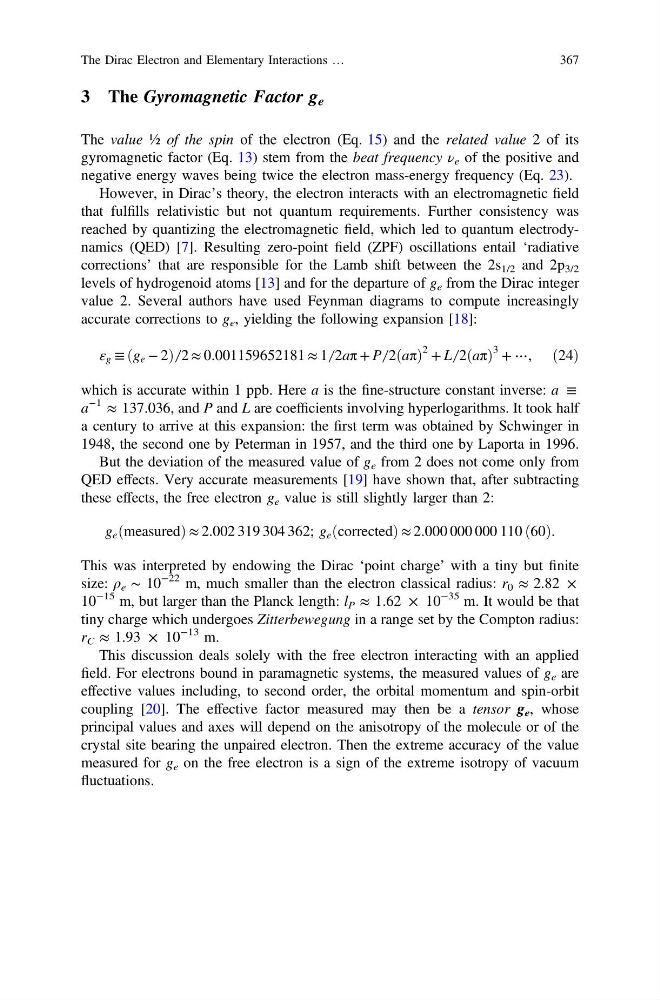
3 The Gyromagnetic Factor g e
The value ½ of the spin of the electron (Eq. 15) and the related value 2 of its
gyromagnetic factor (Eq. 13) stem from the beat frequency ν e of the positive and
negative energy waves being twice the electron mass-energy frequency (Eq. 23).
However, in Dirac’s theory, the electron interacts with an electromagnetic field
that fulfills relativistic but not quantum requirements. Further consistency was
reached by quantizing the electromagnetic field, which led to quantum electrodynamics (QED) [7]. Resulting zero-point field (ZPF) oscillations entail ‘radiative
corrections’ that are responsible for the Lamb shift between the 2s 1/2 and 2p 3/2
levels of hydrogenoid atoms [13] and for the departure of g e from the Dirac integer
value 2. Several authors have used Feynman diagrams to compute increasingly
accurate corrections to g e , yielding the following expansion [18]:
ε g ≡ g e − 2
ð
Þ ̸ 2 ≈ 0.001159652181 ≈ 1 ̸ 2aπ + P ̸ 2ðaπÞ
2 + L ̸ 2ðaπÞ
3 + ⋯, ð24Þ
which is accurate within 1 ppb. Here a is the fine-structure constant inverse: a ≡
a
−1
≈ 137.036, and P and L are coefficients involving hyperlogarithms. It took half
a century to arrive at this expansion: the first term was obtained by Schwinger in
1948, the second one by Peterman in 1957, and the third one by Laporta in 1996.
But the deviation of the measured value of g e from 2 does not come only from
QED effects. Very accurate measurements [19] have shown that, after subtracting
these effects, the free electron g e value is still slightly larger than 2:
g e ðmeasuredÞ ≈ 2.002 319 304 362; g e ðcorrectedÞ ≈ 2.000 000 000 110 ð60Þ.
This was interpreted by endowing the Dirac ‘point charge’ with a tiny but finite
size: ρ e ∼ 10
−22 m, much smaller than the electron classical radius: r 0 ≈ 2.82 ×
10
−15 m, but larger than the Planck length: l P ≈ 1.62 × 10
−35 m. It would be that
tiny charge which undergoes Zitterbewegung in a range set by the Compton radius:
r C ≈ 1.93 × 10
−13 m.
This discussion deals solely with the free electron interacting with an applied
field. For electrons bound in paramagnetic systems, the measured values of g e are
effective values including, to second order, the orbital momentum and spin-orbit
coupling [20]. The effective factor measured may then be a tensor g e , whose
principal values and axes will depend on the anisotropy of the molecule or of the
crystal site bearing the unpaired electron. Then the extreme accuracy of the value
measured for g e on the free electron is a sign of the extreme isotropy of vacuum
fluctuations.
The Dirac Electron and Elementary Interactions …
367
The value ½ of the spin of the electron (Eq. 15) and the related value 2 of its
gyromagnetic factor (Eq. 13) stem from the beat frequency ν e of the positive and
negative energy waves being twice the electron mass-energy frequency (Eq. 23).
However, in Dirac’s theory, the electron interacts with an electromagnetic field
that fulfills relativistic but not quantum requirements. Further consistency was
reached by quantizing the electromagnetic field, which led to quantum electrodynamics (QED) [7]. Resulting zero-point field (ZPF) oscillations entail ‘radiative
corrections’ that are responsible for the Lamb shift between the 2s 1/2 and 2p 3/2
levels of hydrogenoid atoms [13] and for the departure of g e from the Dirac integer
value 2. Several authors have used Feynman diagrams to compute increasingly
accurate corrections to g e , yielding the following expansion [18]:
ε g ≡ g e − 2
ð
Þ ̸ 2 ≈ 0.001159652181 ≈ 1 ̸ 2aπ + P ̸ 2ðaπÞ
2 + L ̸ 2ðaπÞ
3 + ⋯, ð24Þ
which is accurate within 1 ppb. Here a is the fine-structure constant inverse: a ≡
a
−1
≈ 137.036, and P and L are coefficients involving hyperlogarithms. It took half
a century to arrive at this expansion: the first term was obtained by Schwinger in
1948, the second one by Peterman in 1957, and the third one by Laporta in 1996.
But the deviation of the measured value of g e from 2 does not come only from
QED effects. Very accurate measurements [19] have shown that, after subtracting
these effects, the free electron g e value is still slightly larger than 2:
g e ðmeasuredÞ ≈ 2.002 319 304 362; g e ðcorrectedÞ ≈ 2.000 000 000 110 ð60Þ.
This was interpreted by endowing the Dirac ‘point charge’ with a tiny but finite
size: ρ e ∼ 10
−22 m, much smaller than the electron classical radius: r 0 ≈ 2.82 ×
10
−15 m, but larger than the Planck length: l P ≈ 1.62 × 10
−35 m. It would be that
tiny charge which undergoes Zitterbewegung in a range set by the Compton radius:
r C ≈ 1.93 × 10
−13 m.
This discussion deals solely with the free electron interacting with an applied
field. For electrons bound in paramagnetic systems, the measured values of g e are
effective values including, to second order, the orbital momentum and spin-orbit
coupling [20]. The effective factor measured may then be a tensor g e , whose
principal values and axes will depend on the anisotropy of the molecule or of the
crystal site bearing the unpaired electron. Then the extreme accuracy of the value
measured for g e on the free electron is a sign of the extreme isotropy of vacuum
fluctuations.
The Dirac Electron and Elementary Interactions …
367