

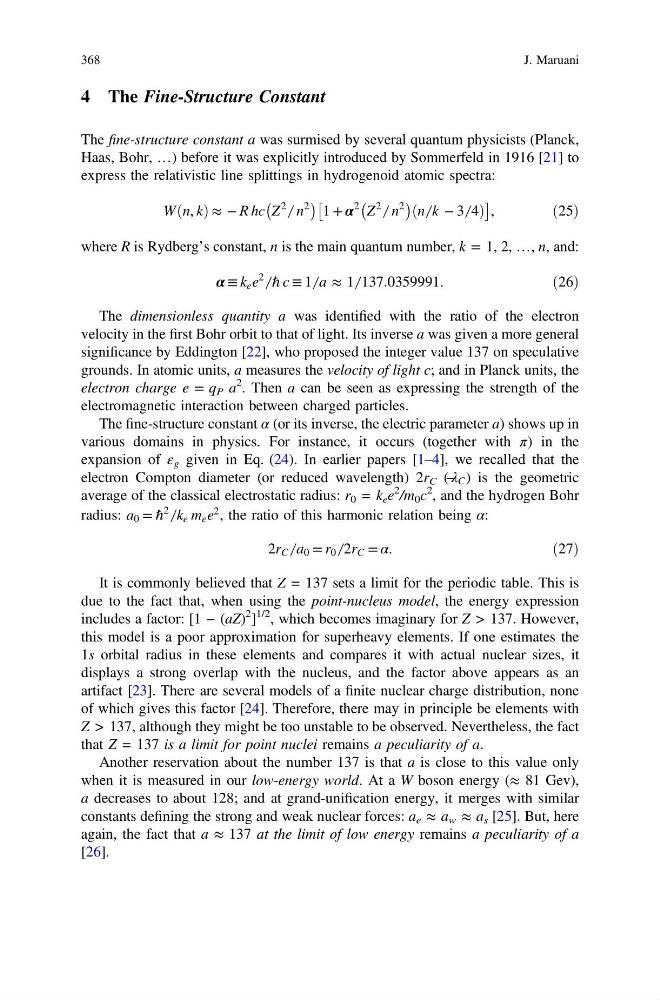
4 The Fine-Structure Constant
The fine-structure constant a was surmised by several quantum physicists (Planck,
Haas, Bohr, …) before it was explicitly introduced by Sommerfeld in 1916 [21] to
express the relativistic line splittings in hydrogenoid atomic spectra:
Wðn, kÞ ≈ − R hc Z
2
̸ n
2
À
Á
1 + α
2 Z
2
̸ n
2
À
Á
n ̸ k − 3 ̸ 4
ð
Þ
Â
Ã
,
ð25Þ
where R is Rydberg’s constant, n is the main quantum number, k = 1, 2, …, n, and:
α ≡ k e e
2
̸ ℏ c ≡ 1 ̸ a ≈ 1 ̸ 137.0359991.
ð26Þ
The dimensionless quantity a was identified with the ratio of the electron
velocity in the first Bohr orbit to that of light. Its inverse a was given a more general
significance by Eddington [22], who proposed the integer value 137 on speculative
grounds. In atomic units, a measures the velocity of light c; and in Planck units, the
electron charge e = q P a
2 . Then a can be seen as expressing the strength of the
electromagnetic interaction between charged particles.
The fine-structure constant α (or its inverse, the electric parameter a) shows up in
various domains in physics. For instance, it occurs (together with π) in the
expansion of ε g given in Eq. (24). In earlier papers [1–4], we recalled that the
electron Compton diameter (or reduced wavelength) 2r C (− λ C ) is the geometric
average of the classical electrostatic radius: r 0 = k e e
2 /m 0 c
2 , and the hydrogen Bohr
radius: a 0 = ℏ
2
̸ k e m e e
2 , the ratio of this harmonic relation being α:
2r C ̸ a 0 = r 0 ̸ 2r C = α.
ð27Þ
It is commonly believed that Z = 137 sets a limit for the periodic table. This is
due to the fact that, when using the point-nucleus model, the energy expression
includes a factor: [1 − (aZ)
2 ]
1/2
, which becomes imaginary for Z > 137. However,
this model is a poor approximation for superheavy elements. If one estimates the
1s orbital radius in these elements and compares it with actual nuclear sizes, it
displays a strong overlap with the nucleus, and the factor above appears as an
artifact [23]. There are several models of a finite nuclear charge distribution, none
of which gives this factor [24]. Therefore, there may in principle be elements with
Z > 137, although they might be too unstable to be observed. Nevertheless, the fact
that Z = 137 is a limit for point nuclei remains a peculiarity of a.
Another reservation about the number 137 is that a is close to this value only
when it is measured in our low-energy world. At a W boson energy (≈ 81 Gev),
a decreases to about 128; and at grand-unification energy, it merges with similar
constants defining the strong and weak nuclear forces: a e ≈ a w ≈ a s [25]. But, here
again, the fact that a ≈ 137 at the limit of low energy remains a peculiarity of a
[26].
368
J. Maruani
The fine-structure constant a was surmised by several quantum physicists (Planck,
Haas, Bohr, …) before it was explicitly introduced by Sommerfeld in 1916 [21] to
express the relativistic line splittings in hydrogenoid atomic spectra:
Wðn, kÞ ≈ − R hc Z
2
̸ n
2
À
Á
1 + α
2 Z
2
̸ n
2
À
Á
n ̸ k − 3 ̸ 4
ð
Þ
Â
Ã
,
ð25Þ
where R is Rydberg’s constant, n is the main quantum number, k = 1, 2, …, n, and:
α ≡ k e e
2
̸ ℏ c ≡ 1 ̸ a ≈ 1 ̸ 137.0359991.
ð26Þ
The dimensionless quantity a was identified with the ratio of the electron
velocity in the first Bohr orbit to that of light. Its inverse a was given a more general
significance by Eddington [22], who proposed the integer value 137 on speculative
grounds. In atomic units, a measures the velocity of light c; and in Planck units, the
electron charge e = q P a
2 . Then a can be seen as expressing the strength of the
electromagnetic interaction between charged particles.
The fine-structure constant α (or its inverse, the electric parameter a) shows up in
various domains in physics. For instance, it occurs (together with π) in the
expansion of ε g given in Eq. (24). In earlier papers [1–4], we recalled that the
electron Compton diameter (or reduced wavelength) 2r C (− λ C ) is the geometric
average of the classical electrostatic radius: r 0 = k e e
2 /m 0 c
2 , and the hydrogen Bohr
radius: a 0 = ℏ
2
̸ k e m e e
2 , the ratio of this harmonic relation being α:
2r C ̸ a 0 = r 0 ̸ 2r C = α.
ð27Þ
It is commonly believed that Z = 137 sets a limit for the periodic table. This is
due to the fact that, when using the point-nucleus model, the energy expression
includes a factor: [1 − (aZ)
2 ]
1/2
, which becomes imaginary for Z > 137. However,
this model is a poor approximation for superheavy elements. If one estimates the
1s orbital radius in these elements and compares it with actual nuclear sizes, it
displays a strong overlap with the nucleus, and the factor above appears as an
artifact [23]. There are several models of a finite nuclear charge distribution, none
of which gives this factor [24]. Therefore, there may in principle be elements with
Z > 137, although they might be too unstable to be observed. Nevertheless, the fact
that Z = 137 is a limit for point nuclei remains a peculiarity of a.
Another reservation about the number 137 is that a is close to this value only
when it is measured in our low-energy world. At a W boson energy (≈ 81 Gev),
a decreases to about 128; and at grand-unification energy, it merges with similar
constants defining the strong and weak nuclear forces: a e ≈ a w ≈ a s [25]. But, here
again, the fact that a ≈ 137 at the limit of low energy remains a peculiarity of a
[26].
368
J. Maruani