

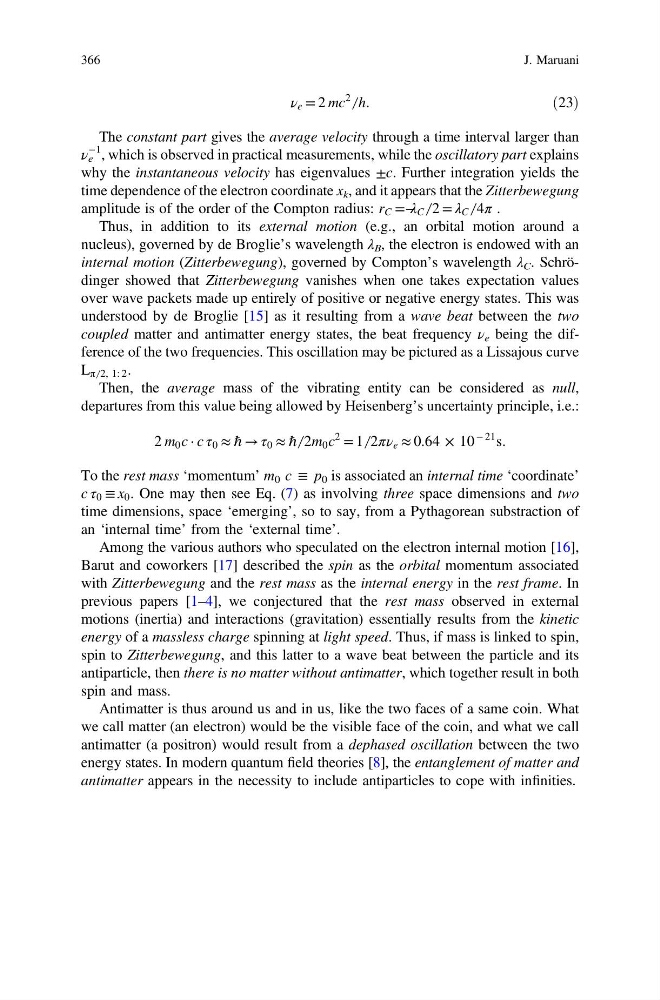
ν e = 2 mc
2
̸ h.
ð23Þ
The constant part gives the average velocity through a time interval larger than
ν e
−1 , which is observed in practical measurements, while the oscillatory part explains
why the instantaneous velocity has eigenvalues ±c. Further integration yields the
time dependence of the electron coordinate x k , and it appears that the Zitterbewegung
amplitude is of the order of the Compton radius: r C =− λ C ̸ 2 = λ C ̸ 4π .
Thus, in addition to its external motion (e.g., an orbital motion around a
nucleus), governed by de Broglie’s wavelength λ B , the electron is endowed with an
internal motion (Zitterbewegung), governed by Compton’s wavelength λ C . Schrödinger showed that Zitterbewegung vanishes when one takes expectation values
over wave packets made up entirely of positive or negative energy states. This was
understood by de Broglie [15] as it resulting from a wave beat between the two
coupled matter and antimatter energy states, the beat frequency ν e being the difference of the two frequencies. This oscillation may be pictured as a Lissajous curve
L π ̸ 2, 1: 2 .
Then, the average mass of the vibrating entity can be considered as null,
departures from this value being allowed by Heisenberg’s uncertainty principle, i.e.:
2 m 0 c ⋅ c τ 0 ≈ ℏ → τ 0 ≈ ℏ ̸ 2m 0 c
2 = 1 ̸ 2πν e ≈ 0.64 × 10
− 21 s.
To the rest mass ‘momentum’ m 0 c ≡ p 0 is associated an internal time ‘coordinate’
c τ 0 ≡ x 0 . One may then see Eq. (7) as involving three space dimensions and two
time dimensions, space ‘emerging’, so to say, from a Pythagorean substraction of
an ‘internal time’ from the ‘external time’.
Among the various authors who speculated on the electron internal motion [16],
Barut and coworkers [17] described the spin as the orbital momentum associated
with Zitterbewegung and the rest mass as the internal energy in the rest frame. In
previous papers [1–4], we conjectured that the rest mass observed in external
motions (inertia) and interactions (gravitation) essentially results from the kinetic
energy of a massless charge spinning at light speed. Thus, if mass is linked to spin,
spin to Zitterbewegung, and this latter to a wave beat between the particle and its
antiparticle, then there is no matter without antimatter, which together result in both
spin and mass.
Antimatter is thus around us and in us, like the two faces of a same coin. What
we call matter (an electron) would be the visible face of the coin, and what we call
antimatter (a positron) would result from a dephased oscillation between the two
energy states. In modern quantum field theories [8], the entanglement of matter and
antimatter appears in the necessity to include antiparticles to cope with infinities.
366
J. Maruani
2
̸ h.
ð23Þ
The constant part gives the average velocity through a time interval larger than
ν e
−1 , which is observed in practical measurements, while the oscillatory part explains
why the instantaneous velocity has eigenvalues ±c. Further integration yields the
time dependence of the electron coordinate x k , and it appears that the Zitterbewegung
amplitude is of the order of the Compton radius: r C =− λ C ̸ 2 = λ C ̸ 4π .
Thus, in addition to its external motion (e.g., an orbital motion around a
nucleus), governed by de Broglie’s wavelength λ B , the electron is endowed with an
internal motion (Zitterbewegung), governed by Compton’s wavelength λ C . Schrödinger showed that Zitterbewegung vanishes when one takes expectation values
over wave packets made up entirely of positive or negative energy states. This was
understood by de Broglie [15] as it resulting from a wave beat between the two
coupled matter and antimatter energy states, the beat frequency ν e being the difference of the two frequencies. This oscillation may be pictured as a Lissajous curve
L π ̸ 2, 1: 2 .
Then, the average mass of the vibrating entity can be considered as null,
departures from this value being allowed by Heisenberg’s uncertainty principle, i.e.:
2 m 0 c ⋅ c τ 0 ≈ ℏ → τ 0 ≈ ℏ ̸ 2m 0 c
2 = 1 ̸ 2πν e ≈ 0.64 × 10
− 21 s.
To the rest mass ‘momentum’ m 0 c ≡ p 0 is associated an internal time ‘coordinate’
c τ 0 ≡ x 0 . One may then see Eq. (7) as involving three space dimensions and two
time dimensions, space ‘emerging’, so to say, from a Pythagorean substraction of
an ‘internal time’ from the ‘external time’.
Among the various authors who speculated on the electron internal motion [16],
Barut and coworkers [17] described the spin as the orbital momentum associated
with Zitterbewegung and the rest mass as the internal energy in the rest frame. In
previous papers [1–4], we conjectured that the rest mass observed in external
motions (inertia) and interactions (gravitation) essentially results from the kinetic
energy of a massless charge spinning at light speed. Thus, if mass is linked to spin,
spin to Zitterbewegung, and this latter to a wave beat between the particle and its
antiparticle, then there is no matter without antimatter, which together result in both
spin and mass.
Antimatter is thus around us and in us, like the two faces of a same coin. What
we call matter (an electron) would be the visible face of the coin, and what we call
antimatter (a positron) would result from a dephased oscillation between the two
energy states. In modern quantum field theories [8], the entanglement of matter and
antimatter appears in the necessity to include antiparticles to cope with infinities.
366
J. Maruani