

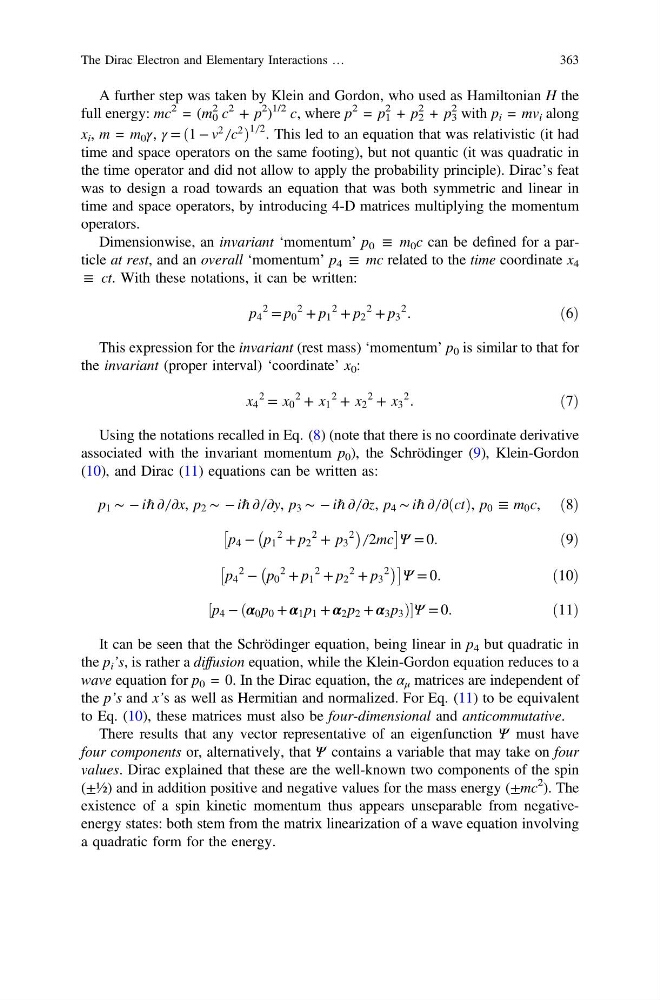
A further step was taken by Klein and Gordon, who used as Hamiltonian H the
full energy: mc
2 = (m 0
2 c
2 + p
2 )
1/2 c, where p
2 = p 1
2 + p 2
2 + p 3
2 with p i = mv i along
x i , m = m 0 γ, γ = ð1 − v
2
̸ c
2
Þ
1 ̸ 2 . This led to an equation that was relativistic (it had
time and space operators on the same footing), but not quantic (it was quadratic in
the time operator and did not allow to apply the probability principle). Dirac’s feat
was to design a road towards an equation that was both symmetric and linear in
time and space operators, by introducing 4-D matrices multiplying the momentum
operators.
Dimensionwise, an invariant ‘momentum’ p 0 ≡ m 0 c can be defined for a particle at rest, and an overall ‘momentum’ p 4 ≡ mc related to the time coordinate x 4
≡ ct. With these notations, it can be written:
p 4
2 = p 0
2 + p 1
2 + p 2
2 + p 3
2 .
ð6Þ
This expression for the invariant (rest mass) ‘momentum’ p 0 is similar to that for
the invariant (proper interval) ‘coordinate’ x 0 :
x 4
2 = x 0
2 + x 1
2 + x 2
2 + x 3
2 .
ð7Þ
Using the notations recalled in Eq. (8) (note that there is no coordinate derivative
associated with the invariant momentum p 0 ), the Schrödinger (9), Klein-Gordon
(10), and Dirac (11) equations can be written as:
p 1 ∼ − iℏ ∂ ̸ ∂x, p 2 ∼ − iℏ ∂ ̸ ∂y, p 3 ∼ − iℏ ∂ ̸ ∂z, p 4 ∼ iℏ ∂ ̸ ∂ðctÞ, p 0 ≡ m 0 c, ð8Þ
p 4 − p 1
2 + p 2
2 + p 3
2
À
Á ̸ 2mc
Â
Ã
Ψ = 0.
ð9Þ
p 4
2
− p 0
2 + p 1
2 + p 2
2 + p 3
2
À
Á
Â
Ã Ψ = 0.
ð10Þ
p 4 − ðα 0 p 0 + α 1 p 1 + α 2 p 2 + α 3 p 3 Þ
½
Ψ = 0.
ð11Þ
It can be seen that the Schrödinger equation, being linear in p 4 but quadratic in
the p i ’s, is rather a diffusion equation, while the Klein-Gordon equation reduces to a
wave equation for p 0 = 0. In the Dirac equation, the α μ matrices are independent of
the p’s and x’s as well as Hermitian and normalized. For Eq. (11) to be equivalent
to Eq. (10), these matrices must also be four-dimensional and anticommutative.
There results that any vector representative of an eigenfunction Ψ must have
four components or, alternatively, that Ψ contains a variable that may take on four
values. Dirac explained that these are the well-known two components of the spin
(±½) and in addition positive and negative values for the mass energy (±mc
2 ). The
existence of a spin kinetic momentum thus appears unseparable from negativeenergy states: both stem from the matrix linearization of a wave equation involving
a quadratic form for the energy.
The Dirac Electron and Elementary Interactions …
363
full energy: mc
2 = (m 0
2 c
2 + p
2 )
1/2 c, where p
2 = p 1
2 + p 2
2 + p 3
2 with p i = mv i along
x i , m = m 0 γ, γ = ð1 − v
2
̸ c
2
Þ
1 ̸ 2 . This led to an equation that was relativistic (it had
time and space operators on the same footing), but not quantic (it was quadratic in
the time operator and did not allow to apply the probability principle). Dirac’s feat
was to design a road towards an equation that was both symmetric and linear in
time and space operators, by introducing 4-D matrices multiplying the momentum
operators.
Dimensionwise, an invariant ‘momentum’ p 0 ≡ m 0 c can be defined for a particle at rest, and an overall ‘momentum’ p 4 ≡ mc related to the time coordinate x 4
≡ ct. With these notations, it can be written:
p 4
2 = p 0
2 + p 1
2 + p 2
2 + p 3
2 .
ð6Þ
This expression for the invariant (rest mass) ‘momentum’ p 0 is similar to that for
the invariant (proper interval) ‘coordinate’ x 0 :
x 4
2 = x 0
2 + x 1
2 + x 2
2 + x 3
2 .
ð7Þ
Using the notations recalled in Eq. (8) (note that there is no coordinate derivative
associated with the invariant momentum p 0 ), the Schrödinger (9), Klein-Gordon
(10), and Dirac (11) equations can be written as:
p 1 ∼ − iℏ ∂ ̸ ∂x, p 2 ∼ − iℏ ∂ ̸ ∂y, p 3 ∼ − iℏ ∂ ̸ ∂z, p 4 ∼ iℏ ∂ ̸ ∂ðctÞ, p 0 ≡ m 0 c, ð8Þ
p 4 − p 1
2 + p 2
2 + p 3
2
À
Á ̸ 2mc
Â
Ã
Ψ = 0.
ð9Þ
p 4
2
− p 0
2 + p 1
2 + p 2
2 + p 3
2
À
Á
Â
Ã Ψ = 0.
ð10Þ
p 4 − ðα 0 p 0 + α 1 p 1 + α 2 p 2 + α 3 p 3 Þ
½
Ψ = 0.
ð11Þ
It can be seen that the Schrödinger equation, being linear in p 4 but quadratic in
the p i ’s, is rather a diffusion equation, while the Klein-Gordon equation reduces to a
wave equation for p 0 = 0. In the Dirac equation, the α μ matrices are independent of
the p’s and x’s as well as Hermitian and normalized. For Eq. (11) to be equivalent
to Eq. (10), these matrices must also be four-dimensional and anticommutative.
There results that any vector representative of an eigenfunction Ψ must have
four components or, alternatively, that Ψ contains a variable that may take on four
values. Dirac explained that these are the well-known two components of the spin
(±½) and in addition positive and negative values for the mass energy (±mc
2 ). The
existence of a spin kinetic momentum thus appears unseparable from negativeenergy states: both stem from the matrix linearization of a wave equation involving
a quadratic form for the energy.
The Dirac Electron and Elementary Interactions …
363