

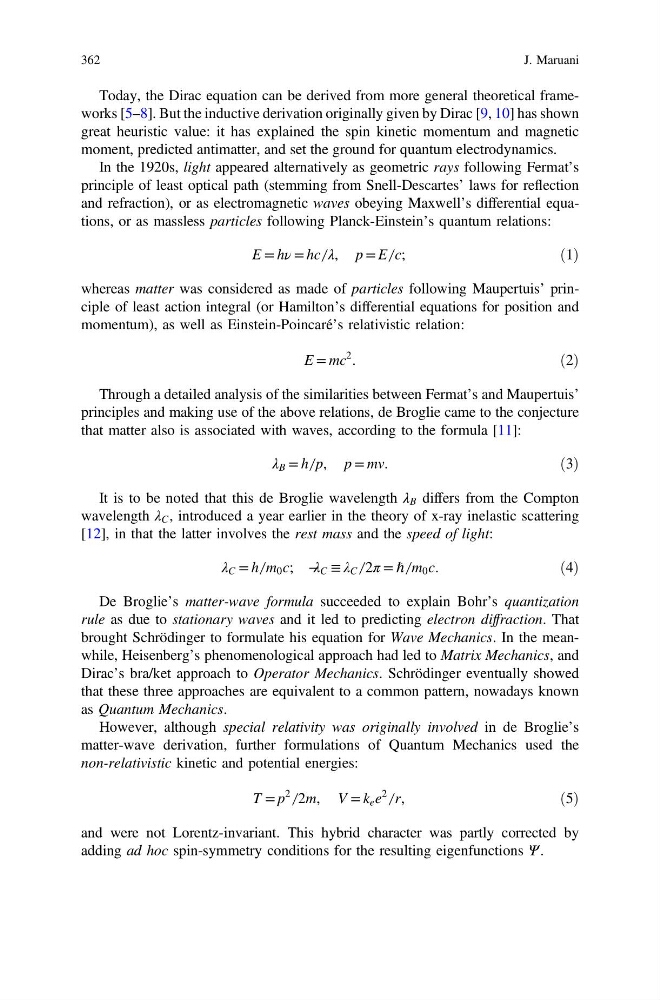
Today, the Dirac equation can be derived from more general theoretical frameworks [5–8]. But the inductive derivation originally given by Dirac [9, 10] has shown
great heuristic value: it has explained the spin kinetic momentum and magnetic
moment, predicted antimatter, and set the ground for quantum electrodynamics.
In the 1920s, light appeared alternatively as geometric rays following Fermat’s
principle of least optical path (stemming from Snell-Descartes’ laws for reflection
and refraction), or as electromagnetic waves obeying Maxwell’s differential equations, or as massless particles following Planck-Einstein’s quantum relations:
E = hν = hc ̸ λ, p = E ̸ c;
ð1Þ
whereas matter was considered as made of particles following Maupertuis’ principle of least action integral (or Hamilton’s differential equations for position and
momentum), as well as Einstein-Poincaré’s relativistic relation:
E = mc
2 .
ð2Þ
Through a detailed analysis of the similarities between Fermat’s and Maupertuis’
principles and making use of the above relations, de Broglie came to the conjecture
that matter also is associated with waves, according to the formula [11]:
λ B = h ̸ p, p = mv.
ð3Þ
It is to be noted that this de Broglie wavelength λ B differs from the Compton
wavelength λ C , introduced a year earlier in the theory of x-ray inelastic scattering
[12], in that the latter involves the rest mass and the speed of light:
λ C = h ̸ m 0 c; − λ C ≡ λ C ̸ 2π = ℏ ̸ m 0 c.
ð4Þ
De Broglie’s matter-wave formula succeeded to explain Bohr’s quantization
rule as due to stationary waves and it led to predicting electron diffraction. That
brought Schrödinger to formulate his equation for Wave Mechanics. In the meanwhile, Heisenberg’s phenomenological approach had led to Matrix Mechanics, and
Dirac’s bra/ket approach to Operator Mechanics. Schrödinger eventually showed
that these three approaches are equivalent to a common pattern, nowadays known
as Quantum Mechanics.
However, although special relativity was originally involved in de Broglie’s
matter-wave derivation, further formulations of Quantum Mechanics used the
non-relativistic kinetic and potential energies:
T = p
2
̸ 2m, V = k e e
2
̸ r,
ð5Þ
and were not Lorentz-invariant. This hybrid character was partly corrected by
adding ad hoc spin-symmetry conditions for the resulting eigenfunctions Ψ .
362
J. Maruani
great heuristic value: it has explained the spin kinetic momentum and magnetic
moment, predicted antimatter, and set the ground for quantum electrodynamics.
In the 1920s, light appeared alternatively as geometric rays following Fermat’s
principle of least optical path (stemming from Snell-Descartes’ laws for reflection
and refraction), or as electromagnetic waves obeying Maxwell’s differential equations, or as massless particles following Planck-Einstein’s quantum relations:
E = hν = hc ̸ λ, p = E ̸ c;
ð1Þ
whereas matter was considered as made of particles following Maupertuis’ principle of least action integral (or Hamilton’s differential equations for position and
momentum), as well as Einstein-Poincaré’s relativistic relation:
E = mc
2 .
ð2Þ
Through a detailed analysis of the similarities between Fermat’s and Maupertuis’
principles and making use of the above relations, de Broglie came to the conjecture
that matter also is associated with waves, according to the formula [11]:
λ B = h ̸ p, p = mv.
ð3Þ
It is to be noted that this de Broglie wavelength λ B differs from the Compton
wavelength λ C , introduced a year earlier in the theory of x-ray inelastic scattering
[12], in that the latter involves the rest mass and the speed of light:
λ C = h ̸ m 0 c; − λ C ≡ λ C ̸ 2π = ℏ ̸ m 0 c.
ð4Þ
De Broglie’s matter-wave formula succeeded to explain Bohr’s quantization
rule as due to stationary waves and it led to predicting electron diffraction. That
brought Schrödinger to formulate his equation for Wave Mechanics. In the meanwhile, Heisenberg’s phenomenological approach had led to Matrix Mechanics, and
Dirac’s bra/ket approach to Operator Mechanics. Schrödinger eventually showed
that these three approaches are equivalent to a common pattern, nowadays known
as Quantum Mechanics.
However, although special relativity was originally involved in de Broglie’s
matter-wave derivation, further formulations of Quantum Mechanics used the
non-relativistic kinetic and potential energies:
T = p
2
̸ 2m, V = k e e
2
̸ r,
ð5Þ
and were not Lorentz-invariant. This hybrid character was partly corrected by
adding ad hoc spin-symmetry conditions for the resulting eigenfunctions Ψ .
362
J. Maruani